




If she had followed a conventional path, Mary Cassatt (American, 1844–1926) never would have been an artist, much less one of the premier painters and pastelists of her generation.
Cassatt was born into an upper middle-class family, and while her father was willing to support her, his generosity excluded financing an art career. Educational options were limited; as a woman, Cassatt was prohibited from figure drawing classes at her hometown Pennsylvania Academy of Fine Arts. Moreover, the instructors didn’t take female students seriously.
When she moved to Paris, Cassatt wasn’t permitted to attend the École des Beaux-Arts, so she studied privately with prominent teachers. Given the challenges inherent in figure study, Cassatt’s later mastery is all the more impressive.
The Cleveland Museum of Art, gift of J.H. Wade, 1920.379
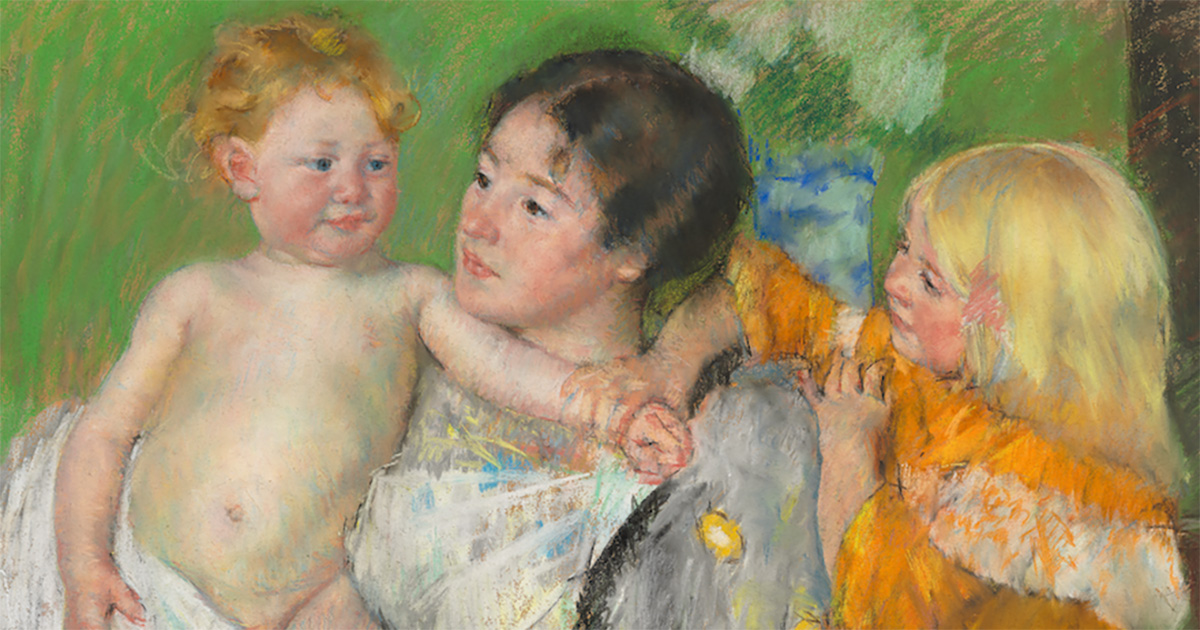
The turning point for Cassatt came when she met like-minded independent artists, particularly Edgar Degas (French, 1834–1917). Despite their technical affinity, there’s very little in Degas’ work that corresponds directly to the subject of After the Bath, with its ode to maternal love. This was Cassatt’s signature theme, the composition a secular reimagining of the traditional Madonna and Child, with the infant a focus of adoration.
When The Cleveland Museum of Art acquired After the Bath, in 1920, the museum’s bulletin stated, “There is perhaps no artist who has sensed so beautifully the feeling of the mother for the child, the spirit of intimate companionship and elemental understanding. A painter of lesser skill might have let such a subject become sentimental, but there is no sentimentality in her brushwork.”
This is true. Cassatt’s energetic approach, inventive design and deft draftsmanship assured a modern reinterpretation of a traditional theme.
Signs of Mastery
- The application of pastel is complex; the paper densely covered with dry pigment. Passages of clothing are rough-hewn; in some places, Cassatt attacks the paper violently. In others, like the hair, tones are blended to a velvety effect. Often the pastel is applied one layer over another, either to create vibrating color effects or merely to make corrections. When painting skin, Cassatt often laid down strokes of the chalk across the forms. This is most evident in the mother’s unfinished arm.
- Cassatt juxtaposes high-key skin tones with the girl’s orange dress and a chromatic green backdrop. It all holds together through a consistent, flat natural lighting. Repetition helps; the blue-greens found elsewhere in the painting recur in the figures’ hair and flesh tones.
- A mother and two children comprise a frieze running across the paper. Cassatt’s solution to connecting the figures was highly inventive, with the children’s hands meeting at the base of their mother’s neck in the center of the page. Searching for a satisfactory design, Cassatt changed the arrangement of arms and hands while the work was in progress. The mother’s unfinished arm suggests its position was altered more than once. The black edge of her garment looks similarly improvised. Cover it with your hand to observe how essential it is to the composition.
- Given the differences in finish, it’s possible that Cassatt painted the portraits from life and completed much of the composition without models. This would have been necessary since small children usually can’t hold a pose. The upside is that the frenetically painted passages imply movement and keep the design from appearing static. Incidentally, Cassatt often employed unrelated models to pose for her as mothers and children.
Jerry N. Weiss is a contributing writer to fine art magazines and teaches at The Art Students League of New York.