







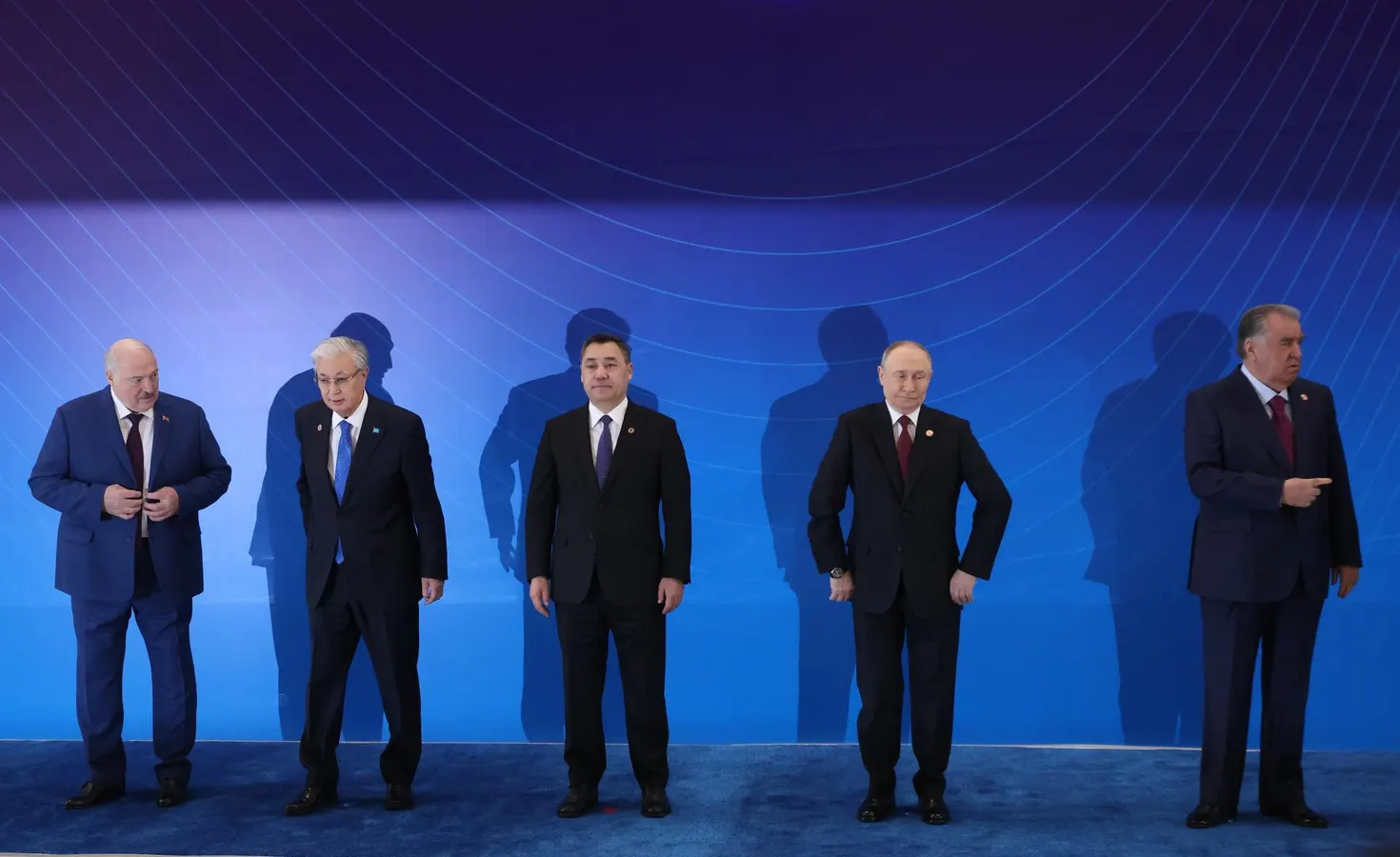

BISHKEK, KYRGYZSTAN – NOVEMBER 27: L-R: Belarusian President Alexander Lukashenko, Kazakh President Kassym-Jomart Tokayev, Kyrgyz President Sadyr Japarov, Russian President Vladimir Putin, Tajik President Emomali Rahmon, Secretary-General of the Collective Security Treaty Organization Imangali Tasmagambetov pose for a group photo during Collective Security Treaty Organization, on November 27, 2025 in Bishkek, Kyrgyzstan. Vladimir Putin makes a three-day state visit to the Kyrgyz Republic. During his stay he takes part in a regular session of the Collective Security Council of the Summit of Collective Security Treaty Organisation (CSTO). Putin will also hold talks with President of Kyrgyzstan Sadyr Japarov to discuss development of the strategic partnership and allied relationship between Russia and Kyrgyzstan. (Photo by Contributor/Getty Images)
Getty Images
On May 6, the Russian Security Council Office announced that the Collective Security Treaty Organization’s Committee of Secretaries of Security Councils will meet on May 26. Representatives from Belarus, Kazakhstan, Kyrgyzstan, Tajikistan, Russia, as well as the CSTO Secretary General Talatbek Masadykov, will discuss defense and political matters within the CSTO. They will also examine how member states can improve their collective security.
Russia, which assumed the CSTO chairmanship in January, will host the upcoming Committee of Secretaries of Security Councils meeting in Moscow. Russian President Vladimir Putin also serves as the Chairman of the Collective Security Council. The upcoming CSTO meeting comes after the organization held a series of sessions in January, where participants discussed “activities in connection with the commencement of the Russian Federation’s chairmanship of the CSTO.”
The timing of the upcoming CSTO Committee of Secretaries of Security Councils meeting is telling. Earlier this month, CSTO member Armenia hosted a summit with representatives from the European Union. During the event, Armenia signed a connectivity partnership with the EU to strengthen trade relations and security cooperation. Armenia and the EU also issued a joint statement during the meeting, which noted Armenia’s commitment to a sustainable democracy, the establishment of the EU Partnership Mission in Armenia, and the creation of the EU-Armenia High-Level Dialogue on Connectivity, where the EU and Armenia will collaborate on matters pertaining to transportation, energy, and the digital realm. The joint statement added that EU investments in Armenia are expected to reach €2.5 billion, suggesting the EU is committed to strengthening and promoting Armenia’s growth.
Tensions Grow Among Armenia, Russia, And The CSTO
During the EU summit in Yerevan this month, Armenian Prime Minister Nikol Pashinyan also hosted Ukrainian President Volodymyr Zelenskyy. In their meeting, Pashinyan and Zelenskyy discussed the “importance of deepening cooperation” between the two states.
Armenia is one of the founding members of the CSTO, but its relationships with the organization and Russia have faltered over the past few years. In 2020 and 2023, Azerbaijan launched attacks against Armenia in Karabakh. In both instances, Armenia requested assistance from Russia and the CSTO, but neither Russia nor the CSTO intervened militarily on Armenia’s behalf. In response, Pashinyan accused the CSTO of failing to “fulfill its obligations to Armenia.” As a result, Pashinyan froze Armenia’s membership in the CSTO in February 2024. Additionally, Pashinyan has opted to expand Armenia’s partnerships with Western governments, something that has been sharply criticized by Russian officials.
Following the EU-Armenia Summit in Yerevan and Pashinyan’s meeting with Zelenskyy earlier this month, Russia’s Foreign Ministry spokeswoman Maria Zakharova condemned the events. In her statement during a weekly briefing, Zakharova said it was “incomprehensible” that Pashinyan hosted Zelenskyy for a meeting. She also criticized the joint declaration issued by Armenia and the EU, noting that the partnership would “lead to Yerevan’s irreversible involvement in Brussels’ anti-Russia line.” She concluded that this would lead to political and economic consequences for Armenia.
In response to Zakharova’s statements, Pashinyan said that Armenia is “not an ally of Russia” on the issue of Ukraine. The Armenian leader also noted that he would not attend Russia’s Victory Day parade in Moscow on May 9.
Kazakhstan’s Fragile Relationship With Russia And The CSTO
Armenia is not the only CSTO founding member that has had issues with Russia. Like Armenia, Kazakhstan has also strengthened its relationship with Western countries and organizations while slowly distancing itself from the Russian Federation. This shift became more prominent after Russia launched its full-scale invasion of Ukraine in February 2022, after which Kazakh officials began regularly meeting with representatives from the United States, the United Kingdom, and the EU to discuss the strengthening of defense, economic, and energy relations. This has led to millions of dollars of foreign investments into Kazakhstan.
The Central Asian state has further enhanced its relationship with the West this year. Last month, U.S. Secretary of State Marco Rubio met with Kazakh Deputy Prime Minister and Minister of National Economy Serik Zhumangarin, Special Representative for Negotiations with the United States Erzhan Kazykhan, and Kazakh Ambassador to the United States Magzhan Ilyassov. During their meeting on April 15, they discussed the importance of strengthening diplomatic and economic relations. Then, on April 23, representatives from the EU traveled to Astana to meet with their counterparts from Kazakhstan and other Central Asian states to address water security, green energy transition, and resilience to climate change. They also “highlighted the critical role of mobilizing investments” in Central Asia. The investments made by the U.S. and the EU suggest that Kazakhstan is serious about its relationship with the West.
Aside from strengthening relations with the West while slowly distancing itself from Russia, Kazakhstan has also taken a different approach to some political matters than the CSTO. For example, the Kazakh state does not recognize the separatist republics of Donetsk and Luhansk in eastern Ukraine. Additionally, Kazakhstan has sent humanitarian aid to Ukraine during Russia’s ongoing full-scale invasion. Kazakhstan also does not want to send troops to Ukraine.
Despite these events, Kazakhstan will still be present at the CSTO’s upcoming meeting in Moscow on May 26. Kazakhstan is also set to host joint CSTO military exercises later this year.
Given these developments in Armenia and Kazakhstan, the Russian Federation will hope that the upcoming CSTO Committee of Secretaries of Security Councils meeting on May 26 will help ease tensions within the organization. Armenia will not be present, but Russia will aim to strengthen the CSTO’s position at this gathering in Moscow. Russia has adopted a motto for its 2026 presidency, saying that members of the CSTO have a “common goal and shared responsibility” as they try to navigate “collective security in a multipolar world.” The May 26 meeting also serves as a key preparatory session ahead of the CSTO Summit scheduled for Moscow on November 11. It remains to be seen, however, how both meetings will unfold and whether Russia can hold its fractured alliance together.