





SPOILER ALERT: The following piece contains plot details from the series finale of “The Comeback,” now streaming on HBO Max.
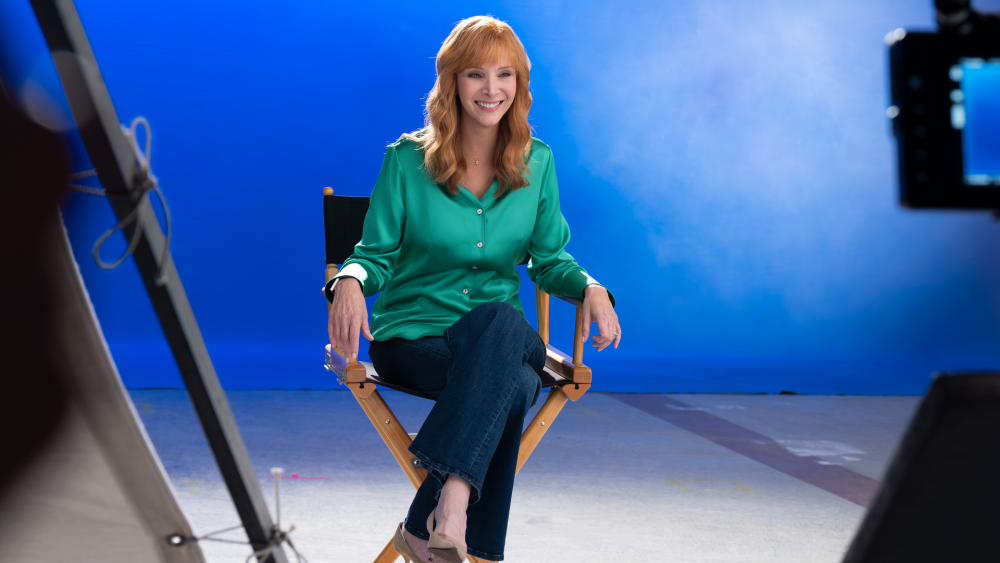
Five minutes before the credits roll, “The Comeback” is set to end on a grim note. Valerie Cherish, the sitcom actor and pioneering reality star played with insistent cheer by comedic master Lisa Kudrow, is in a trap. She’s finally the face of a hit show, the classical multi-camera “How’s That?!” on the streaming service NuNet. But she’s also the face of television written by artificial intelligence, a fact over 70% of the audience seems to have no problem with.
In signing this Faustian bargain, Valerie has been hoisted by her own petard. Once she finally decides she can’t live with robot-written scripts — only after NuNet chief Brandon (Andrew Scott) insults her home turf of sitcoms as “easy-peasy” shows that “don’t need genius” — Valerie tries to walk away, only to learn that she, too, can be replaced by AI. (She signed away the rights to her likeness via DocuSign.) Later, Valerie debates the dilemma with her husband Mark (Damian Young): to stick with her principles and let a machine get all the glory (“cut off my nose to fight my face,” in a signature Valerie malapropism) or to stick with a workplace where her demands aren’t respected and her contributions are demeaned. “I think we both know what you’re going to do,” Mark sighs. He means swallow the humiliation, and go back to set, as Valerie has so many times before.
But, miraculously, Valerie gets a way out. Powerful showrunner Jack Stevens (Bradley Whitford), who’d previously beseeched Valerie to speak out on behalf of writers at the show’s renewal announcement press conference, texts her with an offer. (Valerie did share an embarrassing story about the studio’s AI shutting down once it hit a paywall, but it was a spontaneous act motivated by personal pique, not a principled protest.) He’s writing a role just for her — a woman of a certain gravitas (not age), who’s funny and has a moral compass. Valerie can have her stardom and her integrity, too, even if the rest of her industry may not be so lucky. The end credits inform us she’ll go on to win a second Emmy for “Judge’s Table,” the tale of judge-turned-chef Eleanor Judge.
The conclusion was a fitting end to the final season “The Comeback,” in which Kudrow and her creative partner Michael Patrick King seemed torn between competing priorities. On the one hand, they wanted to sound the alarm about the intrusion of AI into creative work, a bleak satire to match the reality parody of Season 1 or the send-up of prestige, tortured-and-abusive-man driven projects of Season 2. On the other, they wanted to pay tribute to Valerie Cherish, an indelible character they’ve been stewards of for most of this century. When documentarian Jane (Laura Silverman) fondly tells Valerie that “I’ve watched you for 20 years,” she’s speaking for audience members who doubtless feel vicarious pride in her accomplishments.
The tension between these two goals ultimately proved irreconcilable. Kudrow and King went with fond farewell over scathing send-off, insulating Valerie from the consequences of the very changes they’d just done so much to dramatize. (They’d also taken some poetic license in doing so: there are protections against both AI writing and image reuse in the WGA and SAG contracts resulting from the dual strikes depicted in the season premiere.) This tendency was on display even before the finale; in the penultimate episode, Valerie runs into her former co-star Juna (Malin Akerman) on the backlot, where the now-superstar breathlessly tells her counterpart that “to me, you’re it.” The line isn’t totally convincing in the context of either Juna’s relative success or Valerie’s ongoing scandal as the mascot for AI writing, which Juna tries to make her feel better about. But it feels good to hear regardless. Doesn’t the woman who once puked in a cupcake costume on camera deserve to ride off into the sunset?
I’m as conflicted over the answer to that question as the show. “The Comeback” is Valerie Cherish and vice versa. But what if the interests of the character and her story are no longer so fully aligned? Valerie was allowed to grow in meaningful ways over the course of the series. In the Season 2 finale, she skipped the Emmys to visit her beloved hairstylist Mickey (Robert Michael Morris) in his sickbed, and in Season 3 she steps into the role of executive producer, advocating for her castmates and — yes — writers from her first real position of authority. Yet she’s still someone who accepted an AI-penned role to begin with, and more importantly, working in a declining, disrupted field that repeatedly puts her in such impossible positions. I can believe both Valerie and Hollywood have evolved, albeit in opposite directions, but by just how much?
Yet I’m still powerless before the pleasures of the final scene, in which Valerie sits down for one last talking head interview with Jane. As the image slowly shifts from black-and-white to color, and from a grainy fuzz to a sharper resolution, Valerie rebukes the embarrassment that is, to the outside observer, her defining trait. “I never felt that — humiliation,” she says. “I think you have to agree to be humiliated, and I never signed up.” It’s a forceful reclamation of agency, insisting that Valerie has had a say in everything that’s befallen her, both good and (frequently) bad. And it’s a more complex, less thuddingly obvious note to go out on than Jane’s earlier observation: “Finally, it all worked out — what an evolution you’ve had!”
In the last hours of “The Comeback,” the unconvincingly upbeat and the rewardingly nuanced jostled against each other until the final moments. The concluding joke, a callback to Jane directing Valerie’s proclamation that “Well, I got it!” with the roles reversed, was somehow both at once: a bit of flagrant fan service and a reflection of Valerie’s elevated station, connected by the meta commentary that undergirds the show. Valerie Cherish, deservedly or not, can have it all; “The Comeback,” successfully or not, tried its hardest to.