






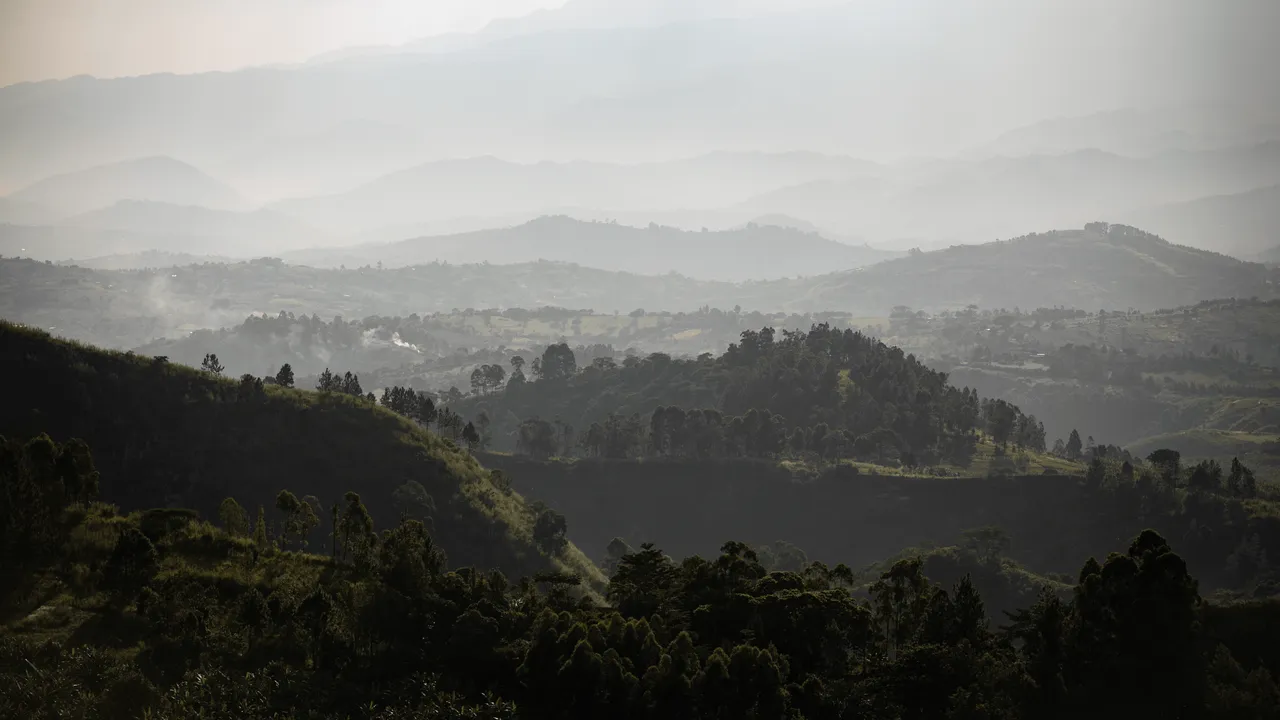
By the time we see our first gorilla, I’m ready to sit down on a patch of grass and, honestly, take a rest. After two hours of vigorous hiking, I want to ask the gorillas if they can just hang on a moment so I can catch my breath. The hike began with a bang: up a steep incline, through a non-native eucalyptus woodland, past tea plantations at 6,200 feet above sea level, then down into the dense brush. Once inside Bwindi Impenetrable Forest National Park, we traipsed along a narrow path lined with mahoganies and strangler figs while skipping over branches and lines of angry red ants.
But the gorillas do not wait. Particularly this group of 17, which is extremely active and, because there’s another gorilla family nearby, very territorial. As we follow them, clambering up hills and over plants and roots, our guide Ngabirano Onesmus hacks away at branches to make way. Suddenly it’s raining gorillas. They’re dashing past us and climbing up trees, then awkwardly sliding back down. Some sit pensively, staring into the distance—one resembles Rodin’s The Thinker, his chin gently resting on his hand. Despite my amoeba-like legs, I don’t want to miss a beat. My first inclination is to frantically take photos, but I also don’t want to witness them through a screen. I want to marvel at their human-like movements as they pick their nose and play with their feet.

This is my first time tracking mountain gorillas in Uganda. I’ve seen them before in Rwanda, not surprising since most people associate these fantastic primates with that country. But a 2018 census (results from the most recent one, in 2025, haven’t been released yet) showed that Uganda has almost half the world’s mountain gorilla population: 445 of the 1,021 that are split among three countries. “Rwanda did so well, so Uganda thought, Why not capitalize on it?” says Adielah Misbach, general manager of Silverback Lodge in Bwindi, who previously worked at One&Only Nyungwe House in Rwanda. Uganda is now making a very compelling case for tourists: New lodges have reopened in Bwindi, and, to further boost interest, the cost of a permit is almost half that of Rwanda’s, so technically you can do two days of tracking for the price of one.
I’m here on a weeklong trip with Abercrombie & Kent, a pioneering luxury travel company that’s been planning bespoke safaris in Africa since the early 1960s. The itinerary includes a must-do gorilla trek but also spotlights other pockets of the country many travelers zip past. My journey begins in the buzzing capital of Kampala. Ivan Onyunga, my guide for the next two days, collects me from my hotel. We get into a waiting car and then weave through the dense traffic, dominated by boda bodas (motorcycle taxis) loaded with cartons of eggs and sacks of potatoes bursting at the seams. We pass storefronts with hand-painted signage and people peddling watermelons and balancing bowls of mangoes and baskets of peanuts on their head.