










Walking down a makeshift runway in a top-floor studio, a model pulls on a translucent, hooded jacket embedded with LED lights. At some point, the room darkens, and the crowd watches the jacket glow — she becomes a bioluminescent creature in human form. Over a microphone, designer Callie Kinnan describes her decision to resew the entire garment in a new material: “The stretch mesh didn’t work. It kept warping when I sewed.”
“Let’s see what it looks like while running,” her mentor, Michelle Kwak, responds, testing the weight of the raincoat vinyl. Around her, students scribble notes and sketch corrections into their drawings: Watch the creases as the model walks. Observe how the fabric breathes as she jogs. Critique the exposed hems as she turns on the runway.
It’s 8 a.m. on a Thursday — much too early to be squinting at loose threads, let alone to be watching a model test-jogging down a runway — but today is the final fitting for the 42 fashion design third-year students at Otis College of Art and Design. And for these juniors, sleep is a luxury.
They’ve spent the last year studying the intricacies of sportswear, and the last three months bringing those ideas to life. For the spring semester, this cohort was divided into three mentorship groups, each one paired with an executive from either Nike, Wilson Sporting Goods or Vuori, all of whom are Otis alumni. Hailing straight from the industry, the brand mentors brought their own vision of what sportswear can be, with design briefs that covered every occasion: elevated everyday athleisure, the energy clash of vintage and contemporary and even a night run to the nightclub.
The designs seen together — lined up on mannequins at the studio’s far end, sketches of their silhouettes plastered across the walls — feel like something out of a superhero’s wardrobe from the future. Indiscernible shapes draped across mannequins, severed sleeves in electric hues, deconstructed pants and endless interactions of athletic forms in morphing neon suits.
Come May 16, their pieces will be catwalk-ready, culminating in a full-production fashion show on campus.
This program opened at the inception of Otis’ fashion department in 1980. Each year, prominent designers in the field guide upperclassmen through the process of creating a runway-ready garment, refining and improving pieces through a series of fittings. A lucky few leave the semester with job offers waiting for them after college.
From a workout to a gallery opening

Tracy wears Eva Jiang tracksuit, sports bra and bag, Fendi bag charm and Dolce and Gabbana sunglasses from Rocotito Archive, Christian Louboutin shoes from Sucia Archive and Spinelli Kilcollin jewelry.
Mentored by Vuori’s VP of men’s design Kirk Heifner, students were tasked with creating a look for an athlete who moves seamlessly from a workout to an art gallery. The challenge? Combining functionality with fashionability, while maintaining Vuori’s sleek silhouettes, simple embellishments and a quiet color palette.
“The bones and the chassis of the garment are very much performance-based, but the body that goes over top of it — what we see — should be stylish,” says Heifner.
One student, Eva Jiang, 26, moved to L.A. from Toronto in search of a more practical, industry-focused education. Attending Otis got her foot in the door. Her garment, a one-piece tracksuit made of a French terry fabric by Alexander McQueen, dresses athleisure one step up with horizontal yellow accents across the chest and ruching up the sleeves. It is paired with a matching yellow mini duffel handbag and a thin lycra and power mesh sports bra. “I didn’t want the conventional materials,” she says. “I wanted it to be elevated and luxurious.”
Jiang designed the look to be transitional — stretchy enough for the gym, but versatile enough to spend an afternoon at LACMA’s new David Geffen Galleries, pick up a breakfast burrito at Wake and Late or have a martini at the Benjamin. “I didn’t know that you could mix worlds like that,” she says.
Another student, Patrice Ilunga, 25, has observed fashion’s role across cultures and disciplines since he was a kid. Originally from the Democratic Republic of Congo, he spent his teenage years in the U.S., growing up in a community of seamstresses and store owners who always found reasons to do more rather than less. “Africans always love to dress up,” he says.

Steve wears Patrice Ilunga jacket and shorts, Oakley sunglasses, August Barron bag and vintage fur hat from Rocotito Archive, Vuori beanie, Doc Martens shoes from Steve’s Closet ‘99 and Spinelli Kilcollin jewelry.
Before beginning his mentorship with Heifner, Ilunga studied by visiting Vuori stores across L.A. The pieces he saw inspired him to bring a younger perspective and informed his more avant-garde take on the assignment .
Ilunga’s garment — a streetwear-inspired jacket and shorts set — looks minimal at first glance, but up close, it’s engineered for movement. Drawstrings along the shorts allow for adjustable length, a high turtleneck can be zipped up or pulled down for breathability, and reflective elements make the piece visible at night. “Every detail serves a function,” he says.
When the 12 Vuori students got to making garments for the first fitting, they went all out: heavy embellishments, oversize collars, extra pockets. “Kirk came in and told us to quiet everything down,” Jiang says. “He told us to make everything more sleek.”
Over the course of two more fittings, Heifner made similar small tweaks. The mentorship, Jiang says, felt like a conversation. “I always asked ‘why’ and thought through the reasoning,” she says. “Through that, we found a middle ground.” She adds that Heifner’s alumni status made the industry seem more approachable. With his guidance, she felt she could step out of her comfort zone. “You’re still in school where it’s OK to make mistakes, try new things and experiment,” she says.
For Heifner, returning as a mentor feels like giving back to the program that gave him his start — but it also pulls him out of the industry’s constraints. “The students are young and a little wild in their thoughts and designs,” he says. “They don’t have boundaries. They’re untapped in that way.”
1999 meets 2027 on the court

Tracy wears Jade Hallyday jacket, sports bra and skirt, Gucci bag from Rocotito Archive, Vivienne Westwood necklace and Maison Margiela shoes from Sucia Archive and Spinelli Kilcollin jewelry.
Wimbledon is Wilson’s Met Gala. Having outfitted players at the tournament for decades, the brand’s brief reflects its history with a contemporary twist. The assignment: Design a modern athlete kit for Wimbledon 2027, with the spirit of 1999.
Students were tasked with creating full athlete kits: training wear, on-court sets and off-court pieces. In keeping with Wimbledon tradition, the collection was entirely white. “When they told me the collection would be all white, I thought it would look extremely flat,” says student Jade Hallyday, 21. Instead, mentor and Wilson design director Deborah Sabet pushed students to think in texture. For Hallyday, that meant combining an array of fabrics. “She changed my whole perspective,” Hallyday says. “You can make a garment so interesting using only off-white fabrics.”
Born in Vietnam, Hallyday was adopted into a French family and raised in L.A. Her mother was a model and her father was a singer. They introduced her to fashion’s possibilities from a young age. Some of her earliest memories are the elaborate costumes her father used to wear on stage.
Her final garment is a three-piece set combining a lycra sports bra with a mesh cutout, a layered lace tennis skirt and a cropped sherpa jacket. But getting there was no easy feat. By the end of the fittings, Hallyday had recut and resewn all three pieces several times, adjusting shades of white, reworking the skirt’s fabrics and refining the jacket’s cut, which was her biggest challenge. “I’ve never sewn a jacket in my life,” she says. “Especially with sherpa.”
For Wanqi Wang, 21, technical thinking came first, but Sabet pushed her further. Her piece is a simple lycra zip-up unitard, adorned with tennis ball pockets on either thigh. It is layered under a sheer, billowed-sleeve floor-length windbreaker that glides on the runway.

Tracy wears Wanqi Wang romper and coat, Vaquera belt and Versace shoes from Rocotito Archive, Wilson bag and socks and Spinelli Kilcollin jewelry.
Small adjustments made big differences, like increasing pocket sizes to better fit the tennis balls and, with Sabet’s suggestion, extending her coat to the floor. The extra inches transformed the look from a casual, calf-length silhouette into a dramatic, floor-length coat with a sweeping train.
An international student from Nanjing, China, Wang hopes to bring her technical skills back to the fashion world at home, as athletic wear increasingly dominates street style in China.
The final collection for Wilson is pleated, fluffy, lacy and — with its neat A-line cuts and sophisticated collars — unmistakably tennis.
“Anything is possible to them,” Sabet says about the students. “They haven’t been jaded by rules or things that don’t sell. They have complete freedom.”
Running to the club

Steve wears Silverio-Indigo Vazquez jacket, long sleeve top and shorts, Yves Saint Laurent shoes and Dior Homme by Kim Jones sunglasses from Rocotito Archive and Nike socks.
If Vuori is understated and Wilson is elegant, Nike brings pure, raw energy. Nike women’s product line manager Alexsandra Del Real and senior technical design manager Michelle Kwak, who served as mentors, introduced an immersive brief to the students. “We wanted the pieces to tell the story of what the runner is doing post-run,” Del Real says. “Are they going to an after-party? A rave? An EDM session?”
As soon as Silverio-Indigo Vazquez, 20, heard the prompt, he thought of the word “adrenaline.” “And I stuck by it 1000%,” he says. The inner layer of his piece is a skintight runners set made of neoprene and lycra and finished with reflective orange lining. The outer layer, a removable windbreaker made of nylon and vinyl, is embedded with LED lights suitable for dark environments.
“I wanted something that you could transform in and out of,” he says. “You’re able to have functionality, transformability and still be very cool.”
A born and raised Angeleno, Vazquez developed his taste for design as a child, when he would spend weekends exploring the Garment District. “That was fun for me — touching fabrics, looking at trends, embellishments, appliques, everything,” he says. “I was so in my element.”
To find the materials for his garment, he sourced fabric from all over L.A., but tracking down transparent vinyl or even LED lights ultimately brought him back to the stores of his childhood. Vazquez made frequent trips to the Garment District with his classmates, where they traded swatches and helped each other find the best materials, often calling their instructors from inside fabric stores for guidance.
Callie Kinnan, 21, never planned to study fashion, but social work. After seeing how fashion could be a creative way to help people in their daily lives, she applied to Otis. Her look took inspiration from bioluminescent sea creatures she saw growing up in Seattle, taking the ferry to Bainbridge Island. “I wanted to capture the free-flowing movement of a jellyfish,” she says about her design.

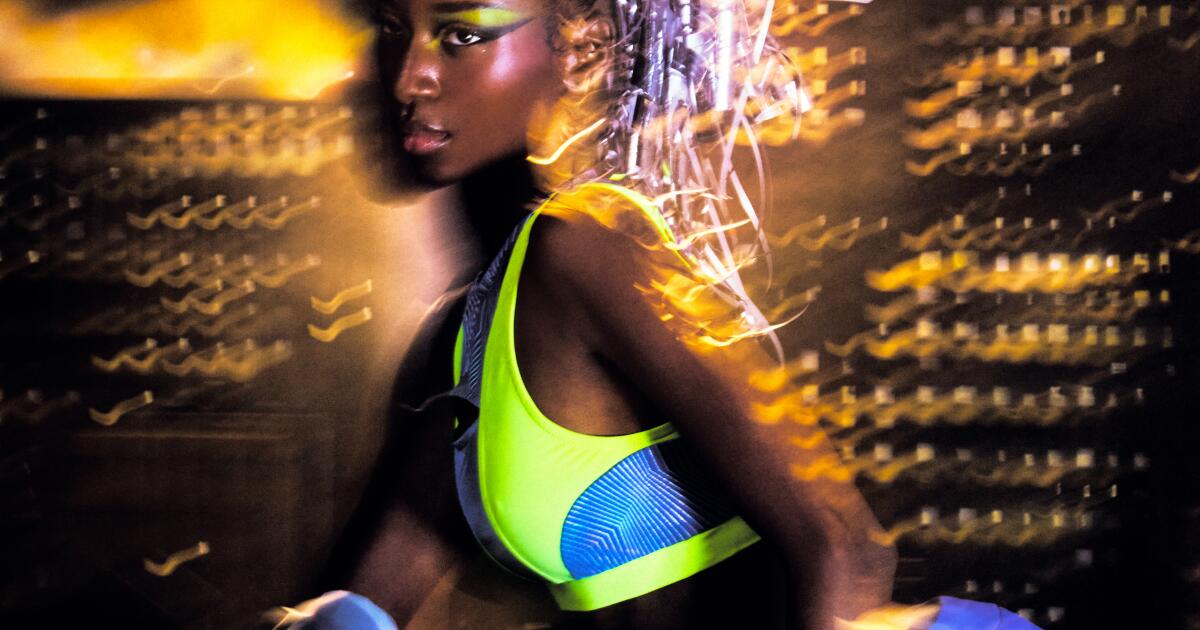
Tracy wears Callie Kinnan leggings, sports bra and jacket, Alastair McKimm X Marc Jacobs shoes from Sucia Archive and Spinelli Kilcollin jewelry.
Kinnan reflects how the program’s mentors gave students the freedom to make their designs their own: “They would say: We see Nike clothes every day; take it into a more high-fashion sphere.”
Her final piece is a neon legging and bra set made from stretch mesh. The showstopper: a long, sheer coat, with LED lights running along the back and sleeves. Working in the world of athletic wear, the mentors brought specific insight, Kinnan says. Small tips, like the cut of hoods, or the excess arm space runners need in order to move, showed students how intricate even the simplest of pieces needed to be. “For performance wear, you have to think of every single seam,” Kwak says.
The fashion industry, with its cutthroat and trend-cycling nature, is as daunting as ever to enter. Some are wary, but Otis’ junior class is keen to get out there and get started.
Still, sometimes the light at the end of the tunnel is not always visible from behind a classroom sewing machine. Impostor syndrome kicks in, fabrics start tearing, and half-fitted mannequins, under a studio light at 2 a.m., look like they might never be fully dressed. In these hazy moments, it’s passion that gives them momentum to keep sewing.
Vazquez didn’t keep track of how many all-nighters he pulled to finish his piece. Balancing 18 hours in the studio with a part-time job three days a week is not for the faint of heart. The night before his first fitting, while fixing up the zipper, Vazquez tore a large hole in the shirt. He almost had to start again from scratch. To him, the time and effort never felt like a chore. “We’re all so hungry for this,” Vazquez says. “It’s not even a job anymore.”
After a long night in the studio, Vazquez recalls a phone call with his mother. “I’m so tired,” he told her. “But I’ve never been happier.”

Photography Kaio Cesar
Styling Ronben
Talent Tracy Maiga, Steve Rivera
Hair Dominique St. Rose
Makeup Jazell Ricardo
Nails Carolyn Orellana
Set Design Braden Young
Production Cecilia Alvarez Blackwell
Styling Assistants Leonardo Breitenstein, Ariel Monroe