








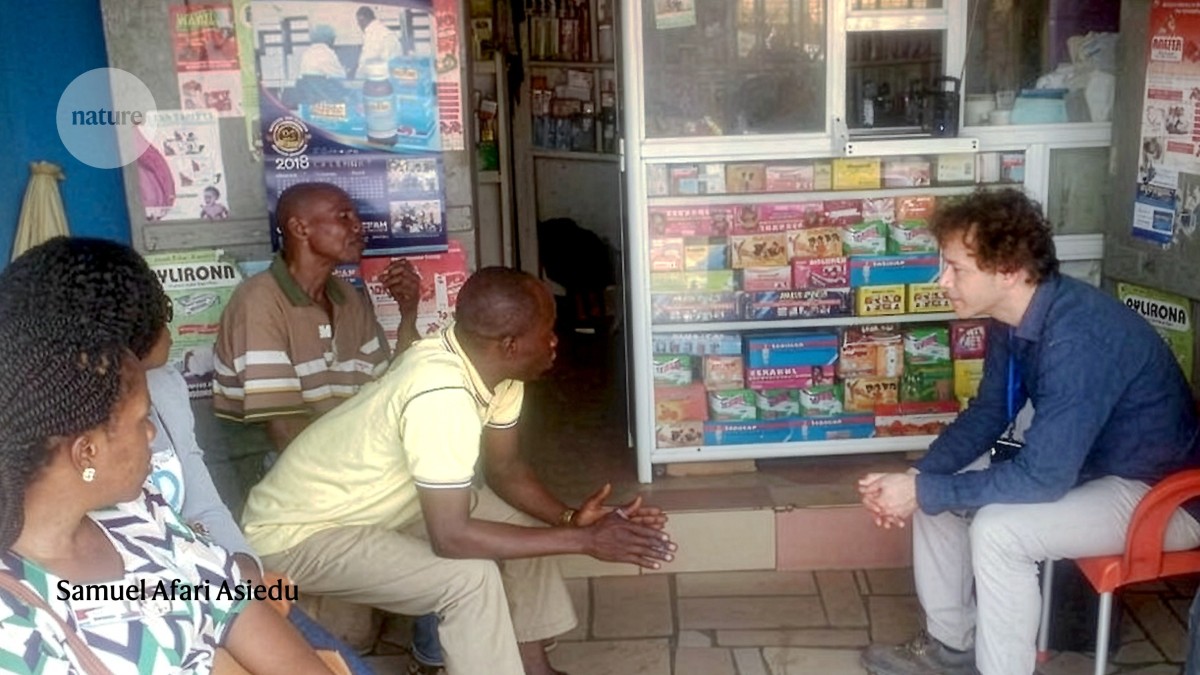
Heiman Wertheim (right) has spoken to people buying and selling antibiotics in Ghana to understand when and why antibiotics are dispensed.Credit:Samuel Afari Asiedu
If people can’t identify antibiotics, they won’t use them with the care necessary to minimize antimicrobial resistance. Heiman Wertheim, a medical microbiologist at Radboud University Medical Center in the Netherlands, is principal investigator of the Antibiotic Access and Use (ABACUS) project. He spoke to Nature about his efforts to make it easier for people to distinguish antibiotics from other medicines.
What brought your attention to this issue?
ABACUS was set up to study antibiotic consumption in low- and middle-income countries.
Nature Outlook: Antimicrobial resistance
We surveyed households in several countries in Africa and Asia about when they last used an antibiotic, and where they got it from. We also asked people coming out of pharmacies whether they had been given an antibiotic, and if so, what it was for.
It was difficult to get answers. Individuals often didn’t know what they had been given, and their medicines often lacked labelling or information leaflets. People frequently confused painkillers and antibiotics — we saw antibiotics being used for completely unrelated muscle aches.
How does this confusion come about?
Sometimes, language causes problems. In Vietnam, one word for antibiotics translates as ‘capsule’, even though other drugs are supplied as capsules and antibiotics come in other forms, too. In Mozambique and Ghana, the term ‘red-yellow’ is used, because that’s the colour of some antibiotic capsules. But they don’t all look like that.
We asked a man working at a pharmacy in Ghana to show us the last antibiotic he sold. He gave us a blister pack of tramadol capsules — a painkiller. Even the people who are selling antibiotics don’t always know.
Is the problem confined to low- and middle-income countries?
No, this is also an issue in high-income countries, particularly for generic drugs. Amoxicillin has been a generic for decades, and there are probably 30 ways it can look.
I’ve asked audiences of infectious-disease specialists, who you’d assume would know, to identify an antibiotic in a photograph of three capsules: two red and yellow, and one green and yellow. Most of them pick the green and yellow one, which is actually a painkiller.
It’s also a problem for elderly people, who might be taking several similar-looking white tablets to manage various conditions. It’s so easy for them to mix up their medication.
What’s the ideal solution?
It would be great if we could identify antibiotics from their physical appearance. Colour and shape are the most obvious tools, but we could also stamp something onto pills. We’d like there to be some visual distinctions between common medications such as diuretics and anti-hypertensives, too. We could focus on the roughly 500 essential adult medicines first, and ensure that each category of drug is easily distinguishable.
We have explored solutions with representatives from the pharmaceutical industry, regulators, policymakers and health-care professionals from around the globe. All of them thought that making antibiotics more identifiable was an obvious thing to do. Many wondered why this wasn’t already regulated.

Similar capsule design prevents people from easily distinguishing between antibiotics (left and centre) and other drugs such as painkillers (right).Credit: Samuel Afari Asiedu
What are the obstacles to standardizing appearance?
What emerged from the discussions was the fact that changing appearance would raise costs. This could make it harder to access medications in low-income settings.
The number of manufacturers of generic antibiotics around the world, which has created the current jungle of colours and shapes, also makes regulation tough. Getting everybody aligned on physical appearance is a major undertaking. In the near term, we need to look for easier wins — and labelling seems a good place to start.
How can antibiotic labelling be improved?
One idea was to use QR codes that link to reliable information. Smartphone penetration is high in low-income countries, and this approach would let us link to videos that can be understood by people who are illiterate.
To do this, we first need a consensus on what information to include. This should include basic guidance on how to use the drug and its common side effects, as well as instructions aimed at minimizing resistance, such as not saving a few pills to take another time. We hope to complete this part in the next year or two.
We’re also developing short videos for three to five antibiotics that we can use in pilot studies to get an idea of what works best in various settings. For instance, we’ll be testing whether people respond better to an animation or a real person.
We’ll then monitor antibiotic use to see whether it changes. It’s not necessarily a problem if usage goes up — people in low-income countries still die because of lack of access to these drugs. But we want antibiotics to be used for the right reason, at the right dose and for the right duration.
Are you confident QR codes on labels will be adopted?
The World Health Organization (WHO) put out a statement with regulators in January promoting clear, enforceable labelling requirements as a low-cost, high-impact tool to combat antimicrobial resistance. We were happy to see that, but what impact it has will depend on how it’s implemented.
Our proposed labelling changes will require robust governance and new legislation. Each country will need a trusted agency that issues official QR codes and ensures videos stay up to date. For now, we’re starting small in Ghana and Burkina Faso in West Africa, but we’ve submitted a proposal for funding a larger roll-out in these countries.
Hopefully, increased attention from the WHO and regulators will speed things up, and we can boost health literacy around antibiotics to ensure people know exactly what they’re taking and when best to do so.