





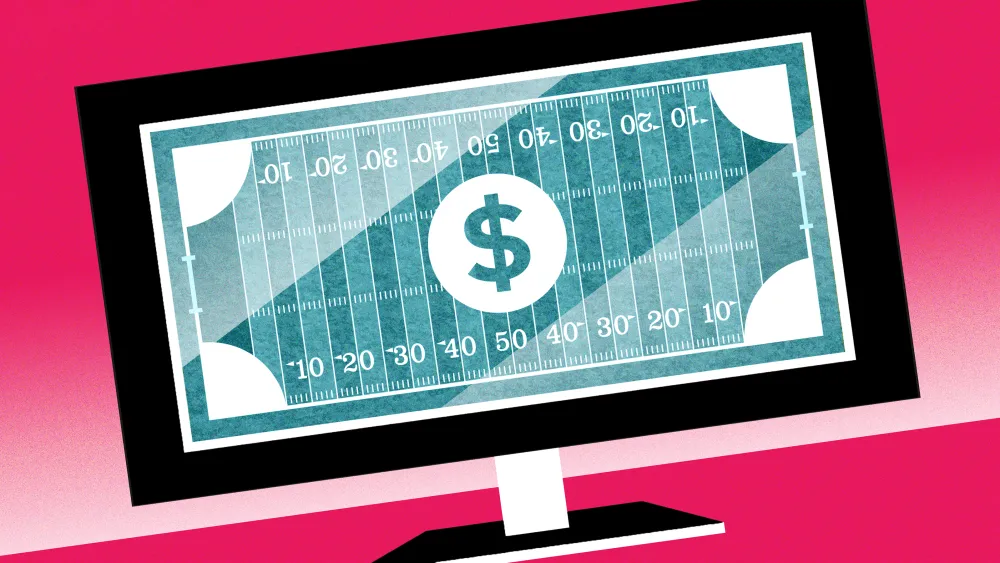
Mickey Mouse may have to execute some tricky plays in a quest for Super Bowl cheddar.
After pressing advertisers to pony up $10 million for a 30-second spot as well as a $10 million “match” for other inventory tied to its 2027 broadcast of Super Bowl LXI, Disney appears to more willing to negotiate, according to five people familiar with current discussions, and seems to be backing off some of its prior demands. Disney has sold more than 10 30-second ad slots for around $9 million each, three of these people said, and is entertaining counteroffers against the “match” that it previously sought.
“Nobody was really jumping at that $10 million ask, or the ‘match’,” says one media buying executive familiar with recent talks with Disney. “That was unrealistic.”
Disney’s progress down the field toward Super Bowl sell-out has been slower than recent norms, and its aggressive pricing has raised eyebrows across the industry. In recent years, Super Bowl broadcasters like Fox and NBC have managed to sell 40% to 60% of their Big Game ad schedule ahead of TV’s annual “upfront” market, when media conglomerates try to sell the bulk of their commercial ad time. Many of Disney’s current Super Bowl deals have been secured with “independents,” according to two people, or advertisers who aren’t represented by one of the industry’s big media-buying agencies, who don’t have a deeper relationship with Disney that might help them negotiate more favorable pricing overall.
Some of the recent Super Bowl buyers come from sectors including A.I. finance and pharmaceuticals, according to two people familiar with recent sales, and some of these buyers are “new, non-traditional entrants.” More established marketers with longer Super Bowl track records might hold out for better terms, buyers suggested.
Speaking to ad executives and marketers at Disney’s large “upfront” presentation Tuesday, Rita Ferro, Disney’s president of global advertising, noted that the company controlled a significant chunk of the hottest property on TV: football. Between ESPN‘s “Monday Night Football,” ESPN’s “College GameDay” and dozens of college games, Disney offers access to “40% of U.S. football impressions,” she said in remarks delivered to hundreds of attendees.
Some buyers believe Disney wants to increase its share of the overall TV dollars that go to football, particularly at a time when it has struck an alliance with the NFL. Under terms of that deal, ESPN has control over NFL Network and NFL RedZone under ESPN’s aegis in exchange for the league taking a minority ownership stake in the sports-media giant. “I think they were looking to leverage that,” one buying executive says.
There is certainly interest in the sport, which has in recent years been responsible for TV’s best-watched programs, including NBC’s “Sunday Night Football” and Sunday-afternoon matches telecast on Fox and CBS. Every sponsor tied to RedZone, for example, has renewed, according to a person familiar with the matter, and Disney has renewed deals with seven longtime sponsors of “Monday Night Football” or its pre-game show, “Monday Night Countdown.”
Disney’s plans for the Super Bowl are ambitious. The company’s rights deal with the NFL calls for the game to be telecast on both ABC and ESPN, with a separate “alterna-cast” led by Peyton and Eli Manning to appear on ESPN2. The telecast will take place on February 14, Valentine’s Day, and the Monday after is a federal holiday, President’s Day.
Disney may have more room to maneuver than other media companies. In a traditional Super Bowl sales process, the network airing the game will make early offers to “incumbents,” or marketers who held positions in the NFL extravaganza the last time the network aired it or in the prior year. But Disney, which has not aired a Super Bowl since 2006, has no incumbents of note.
“They are starting off from scratch, right? And that applies to the sponsorship positions, the pre-kick. It’s all jump ball, if you will,” says the buying executive. And Disney also has the Oscars and Grammys and college football playoffs in the weeks around the Super Bowl. “I think they are trying to use the Super Bowl to try to steal share of football dollars from the marketplace. If there ever was a time to do it, it’s now,” says the executive.
But Disney’s initial ask has rattled the marketplace, other buyers say. Longtime Super Bowl advertisers who typically buy several commercials found the initial ask — as much as $20 million when ad slot and match are combined — outrageous. “Over the past four or five years, or 5 years, unit costs have averaged growth around like 6 to 8 percent year to year. Going from what it was last year to an ask of $10 million? I don’t know the number on that, but it’s not 6 to 8 percent,” says the buying executive.
Were Disney executives too optimistic? Before NBC wrapped sales tied to this year’s telecast of Super Bowl LX, the company’s top sales executive, Mark Marshall, revealed the company had sold a “handful” of spots for more than $10 million. The trouble? NBC started its process by asking for around $7 million for 30 seconds of ad time, and the price was so attractive that it sparked robust demand. By the time NBC neared the end of its sales window, it had too much interest in too little supply, which squeezed prices into record territory. In reality, the bulk of the company’s Super Bowl ad inventory sold for $7 million to $8 million, according to people familiar with the matter.
Executives from other companies that carry the Super Bowl say they worry that Disney’s aggressive pitch could sour Madison Avenue on the Big Game. In an era when more people stream TV favorites at moments of their own choosing, more ad dollars are leaving traditional TV for digital and social outlets. But advertisers still need large-crowd spectacles,. because placing ads in front of smaller groups watching in their own patterns is not particularly cost efficient. And they are willing to pay for content that gathers big groups of consumers. Fox in 2025 said it generated an extra $800 million in ad revenue from its telecast of Super Bowl LIX.
“It’s not Disney’s game. It’s everyone’s game,” says one of these executives.
Ad buyers say they think there has been some success in tamping down the amount Disney wants for its “match,” but suspect the company still wants to stay close to its initial pricing. “They’re looking for offers from the marketplace — ‘Come back and bring us a number, and we’ll react to that,’ the buying executive says.