




You have full access to this article via your institution.
Hello Nature readers, would you like to get this Briefing in your inbox free every day? Sign up here.
Chinese success in cutting NO2 pollution might reflect the country’s approach to air quality, which includes the closure or relocation of polluting industries and the electrification of public transport, says environmental economist and study co-author Daniel Moran. (Deng Hua/Xinhau via Alamy)
Thousands of cities are decoupling economic growth from the burning of fossil fuels. Researchers compared levels of the greenhouse gas nitrogen dioxide (NO2) with information on gross domestic product (GDP) to track the green development trajectories of more than 5,000 of the world’s biggest cities. About 2,000 cities showed improvement in both metrics between 2019 and 2024 — most of them in China.
Nature | 6 min read
Almost 150 passengers and crew members on the hantavirus-stricken cruise ship MV Hondius have disembarked to return to their home countries, where they will quarantine. How each country deals with their isolation will differ, however, in part because transmission of the virus between people is poorly understood. Passengers from Spain, for example, will spend one week in quarantine at a military hospital, whilst those returning to the United Kingdom will be monitored for 72 hours in hospital, followed by a 45-day stint of isolation at home or at a facility.
Nature | 5 min read
Researchers and campaigners are celebrating a name change for polycystic ovary syndrome (PCOS) — now called polyendocrine metabolic ovarian syndrome (PMOS) — that reflects its primary effects on the endocrine system that regulates hormones. The condition affects around one in eight women but is commonly undiagnosed or misdiagnosed. It was given its former, misleading name in the 1930s because it can cause follicles in the ovaries that were mistaken for cysts. The new name “moves away from the incorrect focus on cysts … to recognizing this is a much broader condition”, says endocrinologist Helena Teede, who spearheaded the renaming effort.
Reference: The Lancet paper
Features & opinion
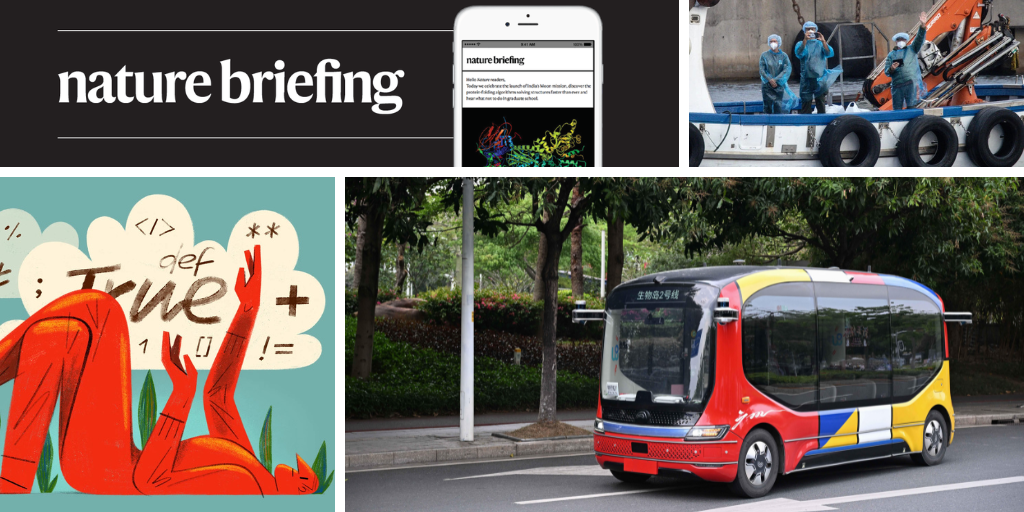
The boom in large language models (LLMs) has encouraged some researchers to try their hand at ‘vibe coding’ — in which a user asks an LLM-powered tool to build or do something with code behind it, and provides clarifying prompts until the results look right. The laid-back nature of vibe coding makes it less intimidating for people without formal coding experience, and can dramatically speed up steps in research, say early adopters. But code written by AI can be prone to errors, which can be difficult for non-experts to spot and fix, researchers say.
Nature | 11 min read
Scientists on an expedition that aimed to understand Antarctica’s remote Thwaites glacier faced a dangerous mission to drill through ice that was shifting beneath their feet. Unlike other glaciers, where a few months or years might be needed to perceive a change, Thwaites is sliding towards the sea at more than 9 metres per day. On “Thwaites, you can feel it,” says polar researcher Won Sang Lee, who led the team. Much is at stake: Thwaites already accounts for about 4% of global sea-level rise and its loss could make things worse.
The New York Times | 20 min read
Theoretical physicist Katia Moskvitch co-hosts a quantum computing podcast, The Quantum Kid, with her nine-year-old, Kai. Having such a young interviewer encourages expert guests to pitch their explanations at a level that’s accessible to non-expert listeners, and Kai’s questions are often more interesting that those adults might ask, she says. “You can’t fake a child’s curiosity or attention span. If something is boring or unclear, it shows immediately. That’s actually very valuable.”
Nature Reviews Physics | 5 min read
Today I’m back on my ‘Moon Joy’ — a catchphrase that came to capture the Artemis II crewed mission around the Moon. NASA has released many thousands of images from the journey, and science communicator Hank Green has placed them on an interactive, filterable timeline that really helps to put them in context. I could never pick a favourite, but I smiled out loud when I saw this ‘selfie’ of Canadian Space Agency astronaut Jeremy Hansen taken through a window from a camera mounted on the outside of the Orion spacecraft.
I’d love to see your favourite image from Artemis II, or of anything that brings you joy — plus your feedback on this newsletter — at briefing@nature.com.
Thanks for reading,
Flora Graham, senior editor, Nature Briefing
With contributions by Jacob Smith
• Nature Briefing: Careers — insights, advice and award-winning journalism to help you optimize your working life
• Nature Briefing: Microbiology — the most abundant living entities on our planet — microorganisms — and the role they play in health, the environment and food systems
• Nature Briefing: Anthropocene — climate change, biodiversity, sustainability and geoengineering
• Nature Briefing: AI & Robotics — 100% written by humans, of course
• Nature Briefing: Cancer — a weekly newsletter written with cancer researchers in mind
• Nature Briefing: Translational Research — covers biotechnology, drug discovery and pharma