






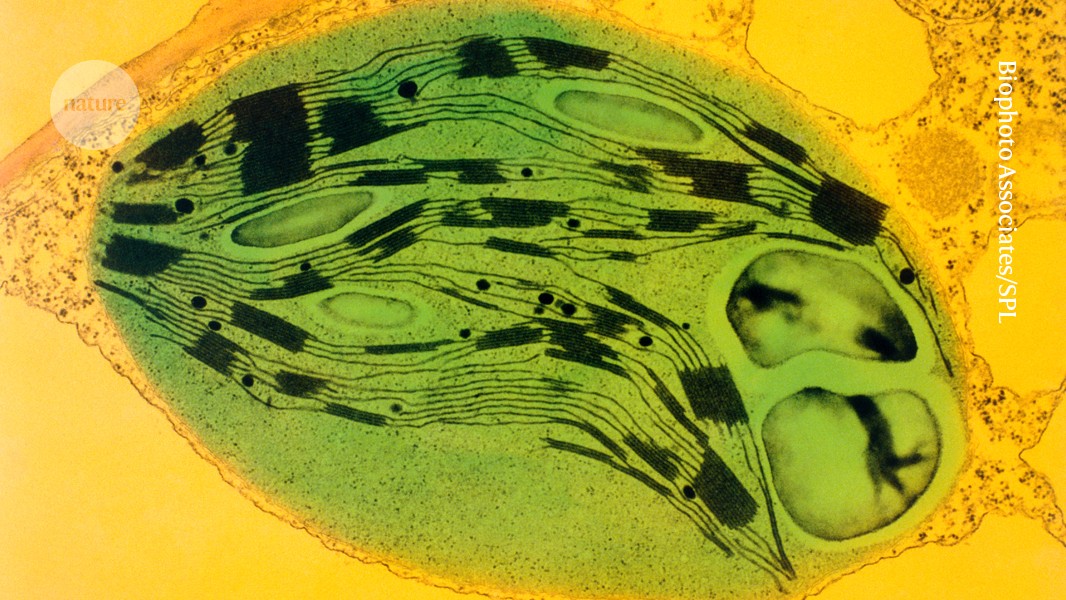
A chloroplast (green) dotted with the membranous stacks called thylakoid grana (black blocks). Scientists have harnessed grana to induce photosynthesis in mammalian cells.Credit: Biophoto Associates/Science Photo Library
Photosynthetic machinery can be harvested from spinach and transplanted into the eyes of mice, where it transforms light into molecules that carry energy and can tame inflammation1.
“We are stealing the entire technology that has evolved over millions of years in plants and are able to transplant it into the animal system,” says David Tai Leong, a biologist at the National University of Singapore and co-author of the study.
“This is really cool,” says Corey Allard, a cell biologist at Harvard University in Cambridge, Massachusetts. The findings, published today in Cell, suggest that plant-to-animal organelle swaps could lead to fresh biological insights as well as therapeutic applications.
“Any effort to do this is necessarily going to look like a party trick at first,” Allard adds. But only by trying the technique and finding out its limitations — such as how long the effects last and which cells can be targeted — can researchers work to build out the use cases, he adds.
Spinach smoothies
Kuoran Xing, a bionanotechnologist at the National University of Singapore, and his colleagues were inspired to explore the potential of cross-kingdom transplants by the ability of sea slugs to steal photosynthetic machinery from algae.
To see whether mammalian cells might be able to pull off a similar feat, Xing first headed to the local supermarket, FairPrice, to buy a range of leafy greens. By blending, filtering and centrifuging these, he isolated the leaves’ chloroplasts, the photosynthetic engines that transform light into energy. He then dunked the chloroplasts into a solution to expose their thylakoid grana, pancake-like stacks that harvest light to power the photosynthetic reactions.
Cyber-spinach turns sunlight into sugar
Spinach (Spinacia oleraceae) yielded more photosynthetic machinery than did red spinach (Amaranthus tricolor), water spinach (Ipomoea aquatica) or lettuce (Lactuca sativa). The team encapsulated the spinach grana into nanoparticles, which they dubbed LEAFs.
In the Petri dish, mammalian cells quickly internalized LEAF particles. Once inside cells, the LEAFs could transform light into chemical energy for several hours, producing the energy-carrying molecules ATP and NADPH. In plants, a second phase of photosynthesis transforms these molecules into carbohydrates — a step that LEAFs do not support.
The set of reactions performed by LEAFs is “a limited form of photosynthesis”, Leong says, “But nonetheless it is still photosynthesis.”