






WASHINGTON — Russia’s war against Ukraine is more than a military conflict: Across Russian-occupied parts of Ukraine, churches have been shuttered, clergy detained, and religious communities driven underground.
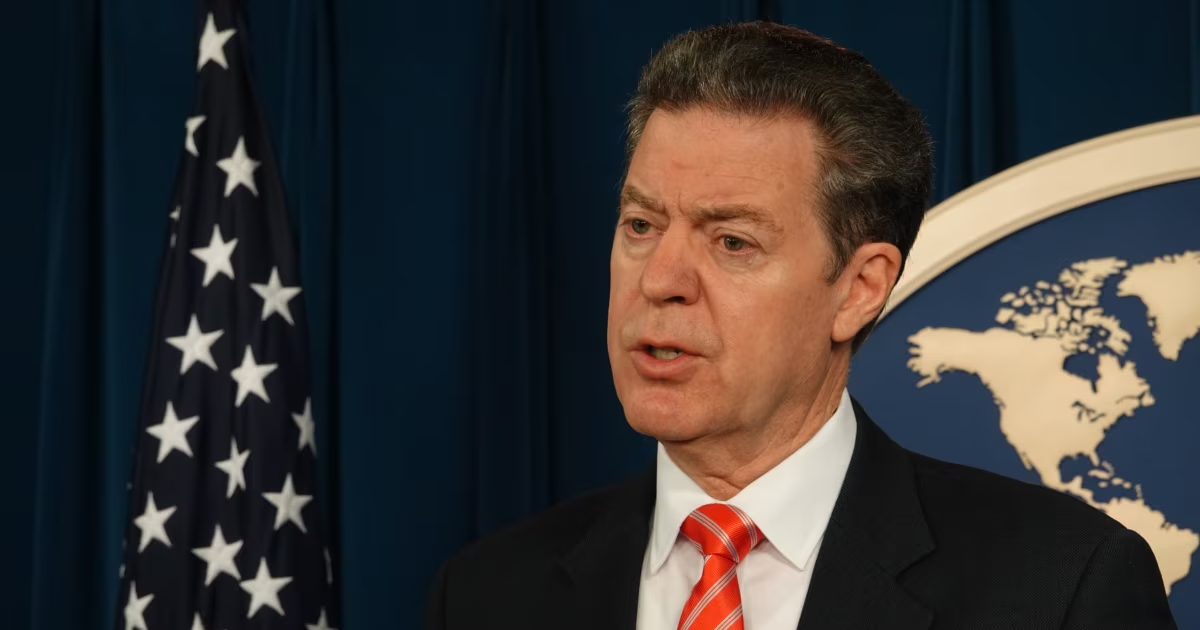
Sam Brownback, a former US senator and Kansas governor who was US ambassador-at-large for international religious freedom in 2018-21, suggests Russia’s actions are elements of a broader phenomenon of persecution and repression by governments seeking to silence dissent at home and “sow discord within democratic societies.”
In an interview with RFE/RL, Brownback argued that Russia, China, and Iran are increasingly operating as part of what he called a “dark alliance” of authoritarian states — one built on surveillance technology, censorship, ideological control, and the suppression of independent religious and civil society groups.
From Beijing’s digital monitoring systems and Tehran’s morality enforcement to Moscow’s crackdown on opposition voices, Brownback warned that democracies are facing an increasingly coordinated authoritarian model.
‘First Attacked, Last Left Standing’
RFE/RL: You’ve warned that authoritarian governments are increasingly acting like a coordinated bloc. When you look at China, Russia, and Iran, what is the single most important tactic all three regimes now share in crushing dissent?
Sam Brownback: That’s actually hard to say, because they all use every tool at their disposal. The one key tool that’s new to dictators — and that they use very strongly and effectively right now — is surveillance technology: facial-recognition systems, gait-recognition systems, and the tracking they can do through cell phones.
In addition to that, there are the Internet firewalls they put up. China has the ‘Great Firewall.’ Iran has a firewall, and during times of conflict they’ve even shut their system down completely so people cannot access outside information or communication.
Those tools are being used alongside old-fashioned repression — rounding people up and executing them, which we saw so much during the Soviet era. They’re a little more deft at it now. Often, people just get disappeared. ‘Disappeared’ has become a noun. People simply vanish.
The interesting thing happening now is that faith communities are usually among the first targets. Their leaders are often the first attacked, yet they’re also the last institutions left standing. Authoritarian regimes see them as the groups most capable of undermining their authority. I think that’s one major reason we’re seeing an increase in religious persecution around the world.
RFE/RL: In your recent book, China’s War on Faith, you argue that Beijing is waging a “war on faith.” When you compare China’s surveillance state, Iran’s morality enforcement, and Russia’s crackdown on opposition voices, are we really looking at three different systems anymore — or one evolving authoritarian model?
Brownback: I think the model of control you’re seeing is one model, and much of it is powered by Chinese surveillance technology — technology they freely share, along with lessons about implementation and adaptation.
You are seeing one clear alliance, a dark alliance, coming together to oppose the United States, the West, and, I would argue, Western civilization itself.
Western civilization was built upon the Judeo-Christian ethic that every person is unique, beautiful, possesses unfathomable worth, and has inalienable rights that come from God, not from government. That system produced a level of freedom the world had not previously seen.
These authoritarian regimes are directly attacking that idea. They are saying your rights come from the government, and they will enforce that system and force it down your throat. These are civilizations in conflict, and we’re watching that happen in real time.
RFE/RL: One striking pattern is that each regime labels dissent as foreign interference. Moscow calls critics “Western agents,” Beijing labels them separatists, Tehran brands them enemies of Islam. Has that narrative become part of the global authoritarian playbook?
Brownback: Oh, absolutely. They label groups, blacklist people, and then use those labels to ostracize and marginalize voices within society.
China calls Falun Gong an “evil cult.” They call the Dalai Lama a foreign agent or a tool of the West. They use all sorts of terminology, but the goal is always the same: isolate these voices so there’s no free competition of ideas.
My deep concern is that technology is becoming so effective at identifying dissidents that if we don’t dislodge these systems now, it will become much harder once they gain even greater control.
‘It’s Kryptonite To Them’
RFE/RL: China built the digital surveillance architecture, Russia refined disinformation warfare, and Iran mastered ideological policing. Are they effectively sharing a repression toolkit?
Brownback: I think they are, although each adapts it differently to fit local conditions. Iran builds itself around theology — but an authoritarian theology. China builds itself around nationalist Han dominance and the idea that it should dominate globally.
They use whatever domestic narrative helps rally the population. But in the end, it’s all about controlling everything and eliminating dissenting voices.
I think they look at each other and ask, ‘What works for you?’ and then adapt those tactics to their own systems. Ultimately, what they want is authoritarian control.
RFE/RL: Is the common denominator ideology — or fear? These governments seem deeply afraid of independent networks they cannot fully control: churches, journalists, dissidents, civil society. And are they now exporting repression beyond their own borders?
Brownback: Remember, these regimes are very brittle. They lack legitimacy at home.
Iran holds sham elections where every candidate must first pass through the regime’s ideological filter. China has no elections. Russia stages sham elections and either removes legitimate challengers or outright kills them.
At the end of the day, these systems are fragile. If outside voices and internal movements gained momentum, they could fall.
So yes, I think fear is the real driver. One of the points I make in the book — and something I don’t think we recognize well enough in the West — is that belief in individual rights, especially religious freedom, is a powerful weapon against these systems. It’s kryptonite to them.
They cannot tolerate independent religious institutions. And we should recognize that and push it forward. Religious freedom is deeply rooted in Western civilization, and we should be using it as a national security tool on offense against these regimes.
RFE/RL: Are democracies underestimating how quickly authoritarian technology is spreading?
Brownback: Yes, I think they are. That’s typical of democracies. Our biggest problem is often simply recognizing the threat and admitting that these regimes are actually targeting us.
We prefer to be left alone. But these governments increasingly reach into our societies. America is a nation of nations — people from every country and faith live here — and authoritarian governments often try to intimidate those communities from abroad. That’s where transnational repression comes in.
It further highlights both the importance of an open society and the fact that we need to recognize the conflict we are in.
For a long time during the Cold War, we failed to recognize the nature of the Soviet threat. Then Ronald Reagan came along and said plainly: this is a godless communist system, and it is at war with us.
These systems are in conflict, and the only solution is for us to win and for them to lose.
‘Probe, Infiltrate, And Exploit’
RFE/RL: During the Cold War, authoritarian systems often operated separately. Are Russia, China, and Iran becoming more collaborative because they see democracy movements as a shared threat?
Brownback: I think so. Again, these regimes are brittle. In a free China, I believe the Communist Party would be voted out. People just won’t say it openly because they fear prison.
But these governments also believe they can undermine Western societies through our openness. They can exploit our freedoms against us, and they’ve become increasingly emboldened.
When I was governor of Kansas, we had three Chinese espionage cases in the state. In an open society, they find ways to probe, infiltrate, and exploit openness for their own advantage.
RFE/RL: If these regimes are learning from one another, what is the most dangerous lesson they’ve absorbed in recent years?
Brownback: Probably how to infiltrate civil society and sow discord within democratic societies.
At the end of the day, they may not even care who gets elected. What they really want is to undermine confidence in democracy itself — to convince people democracy doesn’t work, that it has failed.
All the while, they heavily suppress people and deny basic human rights at home. If they can weaken faith in democracy, they see that as a victory.
RFE/RL: Final question: if Russia, China, and Iran are converging into a shared model of digital authoritarianism, what is the biggest mistake democracies are making in response?
Brownback: Not realizing we are at war with them.
We are still quibbling among ourselves while they are actively attacking us. The sooner we recognize that we are in a conflict, the greater our chances of success.
Last year, Xi Jinping gathered roughly two dozen dictators and authoritarian leaders in Beijing. That should have sent chills down our spines.
This is an alliance. It is active, organized, and opposed to the West. It is authoritarianism — fascism and communism aligned against the idea of individual liberty and individual rights.
We need to recognize we are in this fight and start fighting back.