




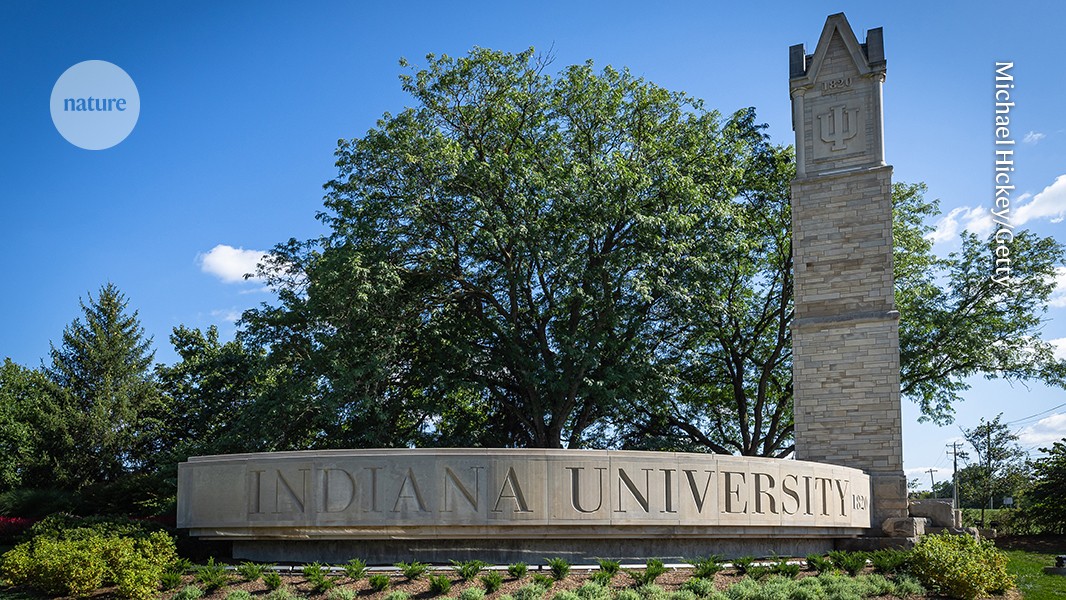
A lab at the University of Indiana Bloomington is under scrutiny from the US Department of Agriculture.Credit: Michael Hickey/Getty
Biologists at Indiana University (IU) Bloomington have been locked out of their laboratories for more than a week, after the university suddenly changed locks on its biology building on 7 May. Although university officials restored access to some labs yesterday, many scientists among the dozens originally affected still can’t reach their offices or equipment, such as freezers, where crucial reagents are stored.
Arrests of scientists over smuggled samples add to US border anxiety
University officials initially told the researchers that the lockdown was done at the request of the US Department of Agriculture (USDA), which is investigating the lab of Roger Innes, a prominent plant microbiologist at IU. The US Federal Bureau of Investigation (FBI) and the USDA have been scrutinizing Innes and his research team ever since November 2025, when the FBI arrested postdoctoral fellow Youhuang Xiang for having imported biological samples into the United States from China without declaring them.
The USDA has denied ordering the lab lockdown, and a 13 May agency notice sent to Innes that’s been seen by Nature prohibits moving samples from the site, but does not request a lab shutdown or work stoppage. Innes and the seven members of his team had to label every biological sample in their lab, including thousands of seeds, to prepare for an official USDA inspection next week, on 19 May. Other labs with shared space have also been asked to label their seed samples.
Innes has characterized the government investigations as retaliation; he has openly criticized deportations of Chinese scientists for smuggling experimental samples over the past year that the US government has characterized as dangerous. He also says that IU’s lockdown is “extreme compliance” with the USDA’s request. An IU spokesperson did not respond to Nature’s questions, but shared an e-mail stating that the lockdown was done to “ensure compliance with the USDA’s instructions that materials not be moved or destroyed”.
Smuggling accusations
The administration of US President Donald Trump has been aggressively prosecuting scientists — many of them Chinese nationals — who it accuses of illicitly bringing biological material into the country.
For example, in June 2025, FBI agents arrested Yunqing Jian, a Chinese postdoctoral scholar at the University of Michigan in Ann Arbor. Jian studies ways of combatting the fungus Fusarium graminearum, which causes blight in wheat and other grains. A year earlier, in July 2024, Zunyong Liu, who was in a relationship with Jian at the time, attempted to bring genetically modified strains of F. graminearum into the United States during a visit, without a permit. US border control officials discovered the samples and sent Liu, a microbiologist at Zhejiang University, back to China. But it wasn’t until the following June that the FBI charged Liu for smuggling and Jian for conspiring in the endeavour.

Trump’s $100K visa fee for foreign talent: how will it affect researchers?
Innes, who also studies F. graminearum, provided expert advice in Jian’s case last October because he wanted to clarify that the samples were not dangerous to US agriculture and were being used for research purposes. Legal specialists have told Nature that whether or not something is defined as harmful can determine whether a person is arrested and deported, or whether they are fined.
In his letter to Jian’s lawyer, Innes wrote that “the presence of these fungal strains in [Liu’s] luggage posed no risk to U.S. farmers, or anyone else”. Jian and four other Chinese postdoctoral scholars at the University of Michigan were later deported.
Court documents show that in November, agents prosecuting the Michigan case advised the Indianapolis FBI to investigate IU researchers. Innes alleges that the FBI focus on IU researchers was retaliation for his providing expert advice to help Jian. Other researchers who have followed the case agree. “It looks very much to me like retaliation,” says Caitilyn Allen, a plant pathologist who retired from the University of Wisconsin in Madison.
The FBI did not respond to a request for comment from Nature.
On 23 November, FBI agents arrested Xiang and charged him with smuggling. More than a year earlier, Xiang had imported plasmids derived from the common lab bacterium Escherichia coli to IU. These are circular bits of DNA that reside outside of the chromosome in cells, and that are used in genetics research. The plasmids were in a package disguised as a shipment of clothing from China.
Plasmids don’t require a permit to be imported, says Armin Moczek, the chair of IU’s biology department. But they do require that you declare them, he adds, and that’s what Xiang failed to do. They aren’t dangerous, Allen says. “Molecular biologists routinely exchange pieces of DNA that are useful for research,” she says. Xiang was stripped of his visa, jailed for more than four months and eventually deported to China.