







James Gray has always been an intensely personal filmmaker, but his last movie, “Armageddon Time” (2022), took a turn into the explicitly autobiographical — it was all about his experience growing up in dowdy middle-class Queens in the early ’80s, a setting that allowed Gray to take forays into themes of race and pop culture and the shadow of Donald Trump (whose imperious father was a character in the movie). So it’s a bit of a surprise to see Gray, in “Paper Tiger,” return to more or less that same setting and a comparable atmosphere of mouthy, close-knit Jewish domestic psychodrama. “Paper Tiger” is like a spiritual sequel to “Armageddon Time.” The difference is that the new movie has the dread-fueled engine of a neo-New Hollywood vérité thriller.
“Paper Tiger” is set in the late ’80s, which means that it’s even more ramped up with material anxiety. And whereas the father in “Armageddon Time,” brilliantly played by Jeremy Strong, was a dweeb sitting on a keg of anger, in the new movie the father, Irwin Pearl (Miles Teller), is an earnest reservoir engineer who’s as sweet and passive and trusting as he looks. The movie is about how Irwin and his brother, a high-rolling ex-cop named Gary (Adam Driver), get involved in a financial scheme that ensnares them in the tentacles of the Russian mob.
“Armageddon Time” was beautifully directed around the edges, but too anecdotal — and too message-y about its racial themes — to add up to something greater than the sum of its reminiscences. If anything, Gray’s direction has now grown even more supple and confident — he’s a master of simmering-under-the-surface family trauma — and “Paper Tiger,” for a while, feels like it’s going to be the contemporary answer to a Sidney Lumet film.
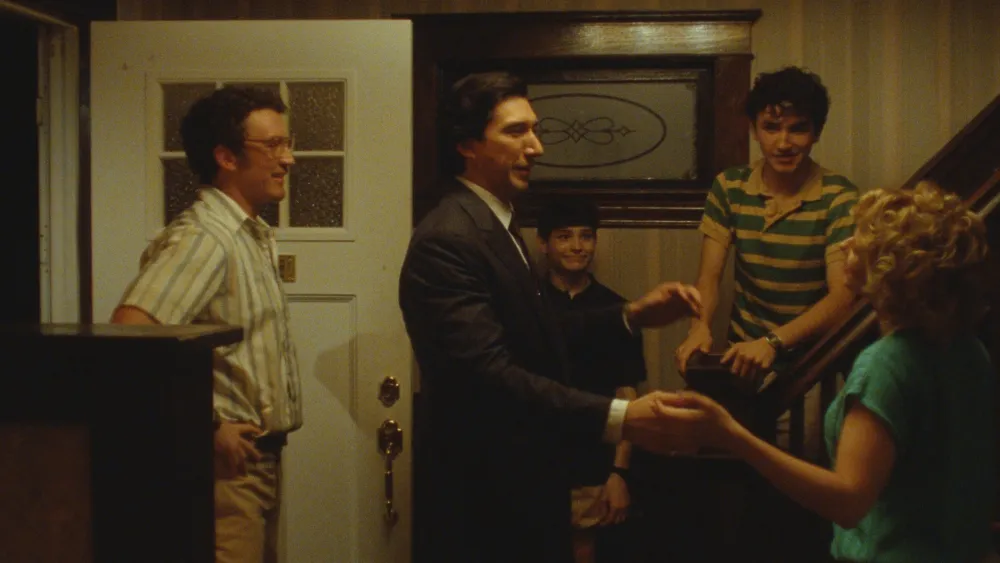
The Pearls, with two close but squabbling sons, one of whom is about to apply to college, and a mom, Hester (Scarlett Johannson, nailing the outer-borough bluntness), who keeps everyone in check, are a relatively solid unit, but they’re poorer than the family in the last film, and you can see how their ragtag financial situation eats away at them. The boys feel like their stuff is cheap and junky. And can Scott (Gavid Goudey) afford to go to an Ivy League school, which is Irwin’s dream for him? That aspiration, common as it may be, is in this case a coded form of assimilation anxiety — Irwin wants his sons to leap over the restrictions he faced as a mid-century Jewish striver.
That’s where Gary, with his flimflam charisma, comes in. One night he arrives at the Pearls’ home for dinner, bringing takeout from Peter Luger (the fabled steakhouse in Williamsburg), which is kind of outrageous. (It’s generous; it’s also an emotional bribe.) Later that night, he takes Irwin aside and lays out his plan. It seems that the powers that be in New York City have finally agreed to clean up the Gowanus Canal, the 1.8-mile stretch in Brooklyn that is one of the most famously polluted bodies of water in the U.S. Gary proposes that he and Irwin launch a company to get in on the elaborate logistics of the clean-up, all guided by Irwin’s expertise as an engineer. The potential to make a killing is there. The one stipulation, explains Gary, is that they’ll have to work with the recently arrived wave of Russian immigrants who’ve attached their livelihoods to the workings of the canal.
It all sounds feasible, or maybe too good to be true. When Irwin and Gary go down to have a meeting with Vesselinov (Alexei Yunov), who is speaking for the Russians, he has an aura of slick-haired threat, and he doesn’t seem exactly grateful to see them. Nevertheless, James Gray pulls us into rooting for this sidelong American dream. That is, until Irwin, on a whim, takes his two boys down to the canal one night to show them what their dad is planning.
He sees something he’s not supposed to: barrels of oil being dumped. One of the Russians demands that Irwin go into the office, where they sit him in a chair and punch him in the face. Meanwhile, another Russian — this one bald and sinister — goes into the car where the two boys are waiting, takes out a stiletto that looks sharp enough to slice an elephant’s hide, and holds it right up to one of the boy’s faces.
Does that sound like a scary scene? It’s actually shockingly scary. Yet I was even more shocked by the prospect of it popping up so early in the movie. “Paper Tiger” sets itself up as the kind of drama where a decent and ordinary man, in this case Irwin, gets sucked into a scheme he’s too naïve to realize is criminal, and by the time he wakes up he’s trapped. But the moment this cataclysm occurs, laying bare the vicious hooligans Irwin and Gary are “working” with, there’s only thing a man like Irwin would say: I want out. Not just because he’s not a criminal, but because he’d want to protect his family. He’d cut those ties as quickly as humanly possible.
But that’s not what happens. Despite the fact that the Russian held a knife up to his teenage son’s face, Irwin, under the thrall of his brother (or, at least, that’s the idea), goes forward with the plan, agreeing to a sit-down with Gary and the Russian Mr. Big, Semion Bogoyavich (Victor Ptak), who informs them that due to Irwin’s “transgression,” they now owe the Russians $150,000. And things just spiral down from there. Gary, oozing with ambition and bravado, explains to Irwin that the Russian are a “paper tiger” — that is, a lot less harmful than they look. This is clearly an important piece of dialogue, since it’s the title of the movie. Yet it’s also preposterous. How could anyone think these Russian mobsters are a paper tiger, when what they look like is a tiger that’s about to tear your head off?
It’s Gary’s reckless greed that powers the plot. Yet for all of Adam Driver’s moxie, the character never entirely gels. He’s a former superstar cop who worked clean…and is still wired into the police force…and has a lot of money…yet seems weirdly naïve about the Russian mob…except that he’s also a badass who isn’t scared to stand up to them…so maybe he’s just happy to get rich in the underworld…or not…because it’s never clear. You can feel James Gray wanting to will something like a Lumet version of Greek tragedy into the tale of these two brothers, and of Irwin’s blind loyalty to Gary’s huckster-psycho moves. But even the scene-to-scene skill of Gray’s direction can’t stop the movie from turning into a mixture of the grandiose and the implausible.
“Paper Tiger” certainly establishes a vivid sense of middle-class terror, sort of like an ’80s-mob version of “Cape Fear,” when the Russians spook Irwin by breaking into his home, rearranging the furniture and photographing his family members asleep. Yet the film keeps tripping itself up. At one point, the Russian boss tells Gary that he’s the one they really want to partner with, not Irwin — so why did they bother terrorizing Irwin? And Gray then layers in a plot about Hester undergoing a severe medical crisis. Johansson certainly makes you feel her pain, but it still plays as one twist too many. “Paper Tiger” adds up on paper, and I suspect that Gray, a longtime critics’ darling, will get some of his best reviews for it. The movie is engineered to be seen as “powerful.” Right now, though, I’d say that he’s an ace director who’s still being undercut by the holes in his screenplays.