





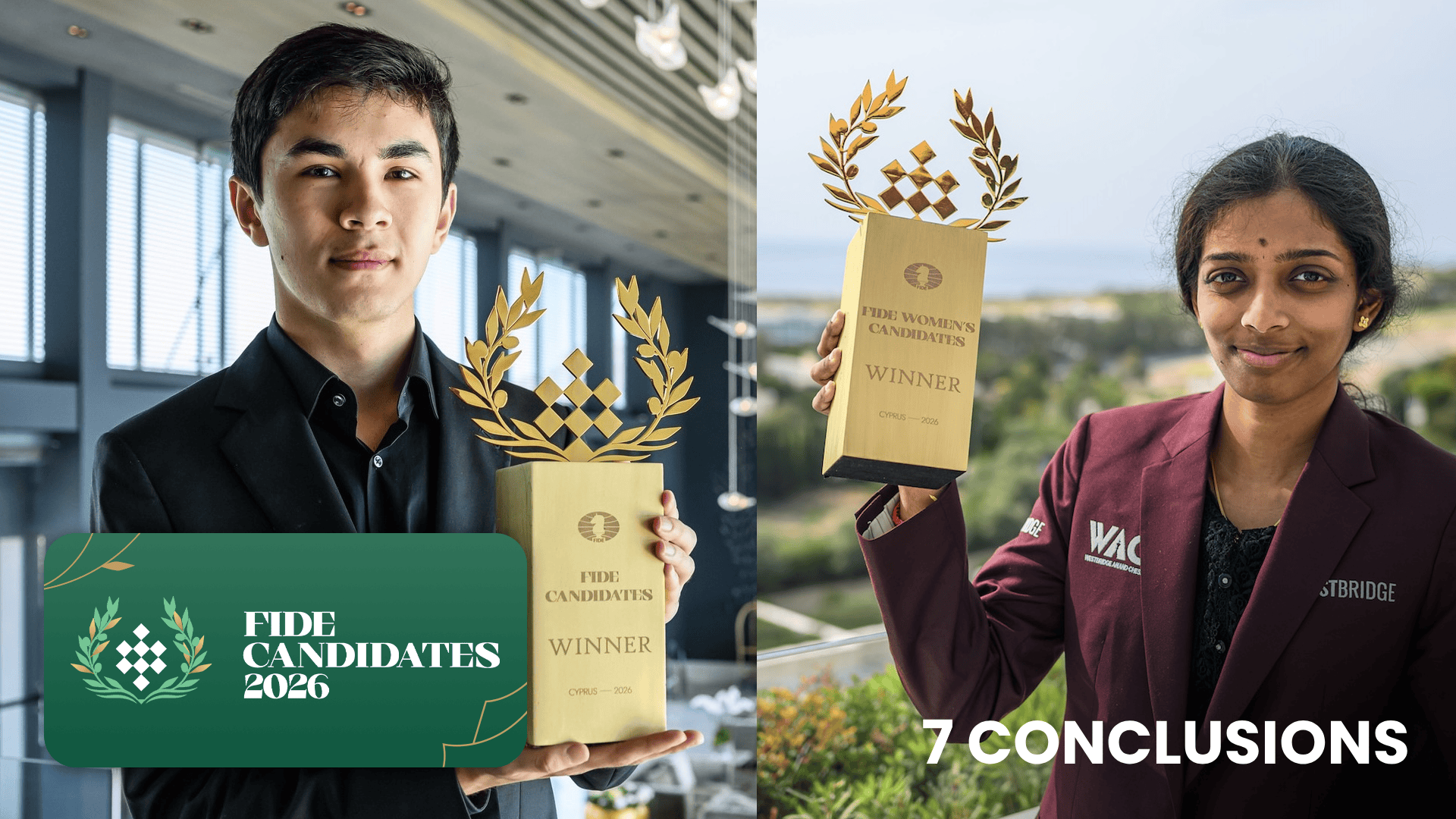
GM Javokhir Sindarov blew away the field in the 2026 FIDE Candidates Tournament in Cyprus to win €170,000 (~$200k) and, much more importantly, earn a world championship match against GM Gukesh Dommaraju. The 2026 FIDE Women’s Candidates went down to the wire, with GM Vaishali Rameshbabu winning in the final round to earn €65,400 (~$77k) and a match against GM Ju Wenjun. We take a look at seven conclusions from three weeks of high-stakes chess.
- Sindarov Pulled Off Historic Win
- Sindarov-Gukesh Will Be Youngest Ever Chess World Championship
- Giri Played “Epic” Event, But There Was Only One Winner
- Qualification For The 2028 Candidates Has Begun
- Vaishali Won Despite Starting As Bottom Seed
- Women’s Candidates Provided The Drama—All But Tan Could Have Won
- India, Uzbekistan Continue Their Rise
1. Sindarov Pulled Off Historic Win
20-year-old Uzbek-star Sindarov was among the favorites going into the FIDE Candidates, particularly after his unbeaten +4 score in the Tata Steel Masters, but no one could have predicted quite how dominant he would be. After crushing co-leader GM Fabiano Caruana in round four he took the sole lead, and he would never relinquish it before clinching victory with a round to spare.
Perhaps the greatest danger in the second half came against Caruana, who was pressing in an endgame, but otherwise Sindarov could also have scored more, since he spoiled a completely winning position against one of two players to stop him winning a mini-match: GM Matthias Bluebaum.

Effectively the tournament was decided in the first half, when Sindarov raced to 6/7, setting a new record for the Candidates held in this format, ahead of the 5.5/7 GM Ian Nepomniachtchi scored in Madrid in 2022.
In fact the best precedent was the 6.5/7 scored by GM Veselin Topalov in the same format in what was the 2005 FIDE World Championship. Topalov made seven draws to clinch the title, while Sindarov also won a game in the second half to match Topalov’s 10/14 and break the Candidates record.
| Year | Winner | Halfway Score | Total Wins | Final Score |
| 2013 | Magnus Carlsen | 5 / 7 | 5 | 8.5 / 14 |
| 2014 | Viswanathan Anand | 4.5 / 7 | 3 | 8.5 / 14 |
| 2016 | Sergey Karjakin | 4.5 / 7 | 4 | 8.5 / 14 |
| 2018 | Fabiano Caruana | 5 / 7 | 5 | 9 / 14 |
| 2021 | Ian Nepomniachtchi | 4.5 / 7 | 5 | 8.5 / 14 |
| 2022 | Ian Nepomniachtchi | 5.5 / 7 | 5 | 9.5 / 14 |
| 2024 | Gukesh Dommaraju | 4 / 7 | 5 | 9 / 14 |
| 2026 | Javokhir Sindarov | 6 / 7 | 6 | 10 / 14 |
“In my opinion here I played chess better than everyone!” Sindarov told FM Mike Klein in a final interview, adding, “When I got chances I started to play very confidently and I realized every small chance except the game against Bluebaum.”
It’s impossible to disagree with his assessment, while Sindarov also managed to combine chess with having fun: playing video games, bullet chess, padel, and some cards.
After @LevAronian teached us Marsel Belot, we become a huge fun of this game😂😂 pic.twitter.com/Kgann6ZJqQ
— Javokhir Sindarov (@GMJSindarov) April 16, 2026
He told Klein: “I’m not a guy who likes sitting, 24 hours, checking lines. I play bullet also. I just try to enjoy the moment, enjoy life, and play good chess, and everything works well!”
I just try to enjoy the moment, enjoy life, and play good chess, and everything works well!
—Javokhir Sindarov
The focus now turns to a world championship match slated to take place in November-December later this year.
2. Sindarov-Gukesh Will Be Youngest Ever Chess World Championship
The 2024 world championship match between Gukesh and GM Ding Liren already had the youngest combined age of participants in the history of the title (50, compared to 51 for GM Magnus Carlsen vs. GM Sergey Karjakin), while this match will smash that record by a decade with players who will be 20 at the time it begins: Gukesh and Sindarov. That comes only 12 years since GM Viswanathan Anand vs. GM Boris Gelfand had a combined age of 85, while the record, 96, is held by the 1892 match between first World Chess Champion Wilhelm Steinitz and Mikhail Chigorin.
“I like them both, but I somehow didn’t think that they would go so fast, so high!” said Giri, and while the players have barely played, Sindarov has the lead, with wins in the 2018 Moscow Open and 2022 Sharjah Masters. If their recent game in the Tata Steel Masters is anything to go by, we’re in for a thriller—Gukesh was winning, but Sindarov put up fantastic resistance to hold a 78-move draw.

The reason they’ve played so little is that, despite both earning the GM title at the age of 12, Sindarov has been slower to climb the chess summit, only accelerating in the last couple of years. He explained in one of his last press conferences:
I’m very happy with how I spent my life, because when these guys worked 10 hours a day, I spent my time every day with Counter-Strike… When I became a grandmaster I spent every day maybe three-four hours with Counter-Strike, and quarantine really helped me a lot because at this time I really tired of playing Counter-Strike, and I think it’s time to really work with chess. And after quarantine I really started [to work] very hard and my life really changed a lot.
I’m very happy with how I spent my life, because when these guys worked 10 hours a day, I spent my time every day with Counter-Strike.
—Javokhir Sindarov
The players share a similarity. When Gukesh won the title at the age of 18 he pointed out he still has another goal, “trying to reach the level of greatness that Magnus has achieved.”

IM Roman Vidonyak, Sindarov’s coach since January 2025, laid out a four-point plan in Cyprus: 1) Qualify for the Candidates, 2) Win the Candidates, 3) Win the world championship title, and 4) “Dominate the chess world like Karpov, Kasparov, and Carlsen.” Sindarov pointed out those are his coach’s goals, before adding, “One time in my life, I want to be the best player in the world!”
One time in my life, I want to be the best player in the world!
—Javokhir Sindarov
On current form, Sindarov would be the favorite, since he’s risen dramatically while Gukesh has slumped since winning the title, to the extent that the Indian teenager announced he was going to skip the classical events on the Grand Chess Tour.
My performance in the last few events has been quite disappointing, not just for me, but for all of you who support me.
In order to find my best form my team and I have decided that I should compete with slightly less intensity over the next few months. Consequently, we feel it… pic.twitter.com/EmtAE3hn6c
— Gukesh D (@DGukesh) March 31, 2026
Gukesh’s replacement as a full tour participant? None other than Sindarov, who will now play the Super Rapid & Blitz Poland (May 5-9) and the Super Chess Classic Romania (May 14-23).
As for the match, it’s expected to take place in November-December. Venues in India or Uzbekistan (or both) suggest themselves, though Sindarov commented: “For me, if it will be in December, probably I’ll choose some hot country, like Cyprus, because I don’t want to play a world championship match in cold weather.”
I don’t want to play a world championship match in cold weather.
—Javokhir Sindarov
Wherever the match is played, it’s going to be unmissable.
3. Giri Played “Epic” Event, But There Was Only One Winner

“Probably it’s by far my highest earning tournament, actually,” said Giri, who earned not only the €45,000 second-place prize but €5,000 for each of his 18 half points, making a total of €130,000, second only to Sindarov’s €170,000—€70,000 for 1st place plus €100,000 for his points total.
FIDE Candidates 2026 Final Standings
| Rank | Name | Fed | Rating | Score | W | D | L | Prize | Perf. | +/- |
| 1 | Javokhir Sindarov | 2745 | 10 | 6 | 8 | 0 | €170,000 | 2908 | +30.6 | |
| 2 | Anish Giri | 2753 | 8.5 | 4 | 9 | 1 | €130,000 | 2829 | +14.0 | |
| 3 | Fabiano Caruana | 2795 | 7.5 | 4 | 7 | 3 | €100,000 | 2772 | -5.2 | |
| 4 | Wei Yi | 2754 | 7 | 2 | 10 | 2 | €70,000 | 2749 | -1.0 | |
| 5 | Hikaru Nakamura | 2810 | 6.5 | 1 | 11 | 2 | €65,000 | 2712 | -18.4 | |
| 6 | Matthias Bluebaum | 2698 | 6 | 0 | 12 | 2 | €60,000 | 2707 | +1.4 | |
| 7 | Praggnanandhaa | 2741 | 6 | 1 | 10 | 3 | €60,000 | 2700 | -7.8 | |
| 8 | Andrey Esipenko | 2698 | 4.5 | 0 | 9 | 5 | €45,000 | 2624 | -13.6 |
When Nepomniachtchi appeared in Cyprus mid-tournament his only advice for winning the tournament was not to lose a game, since then you need to win two. Giri went wrong early on that score by losing the first game to GM Praggnanandhaa Rameshbabu, but that would be the Dutchman’s only loss and, coincidentally, Praggnanandhaa’s only win.
Giri, who in 2016 scored 14 draws but in 2020-1 pushed Nepomniachtchi hardest, scored four wins and gained 14 rating points to climb to world number-six, only beaten, of course, by Sindarov, whose six wins gained him 30.6 points to rise to a career-best world number-five. As Giri put it in his final press conference: “Everything is epic, small little detail, didn’t qualify for the world championship match. Otherwise, it’s epic!”
Didn’t qualify for the world championship match. Otherwise, it’s epic!
—Anish Giri on his result in Cyprus
well, at least I was in the picture 😭🤣 https://t.co/Jo0KrW3Jcj
— Anish Giri (@anishgiri) April 14, 2026
If Giri had won a won position in round 12 against GM Wei Yi he might have put some real pressure on Sindarov going into their head-to-head clash, but in the end if Giri had regrets, they were fewer than for all the other players not named Javokhir.
Caruana took third but, after a great first half, was knocked out of realistic contention to reach a second world championship match by back-to-back losses to Nakamura and Giri. Top-seed Nakamura, meanwhile, admitted his event was all but over after two losses in his first five rounds, and he went on to lose the most rating points of any participant.

Wei performed as we’ve come to expect in recent years—solidly at a very high level, but not challenging for first place.

Praggnanandhaa, as mentioned, didn’t win after his round-one success and suffered three losses, ending level with Bluebaum, who could still count his tournament as a success despite a last-round defeat taking off some of the sheen. Bluebaum is the one player who didn’t lose to Sindarov, and if the #GreatBluebaumSweep didn’t live up to the dreams of many chess fans, his solidity at the highest level was impressive—perhaps the issue was that the top players gave him enough respect that he was unable to use their over-pressing to his advantage the way he had in preceding tournaments.

For Esipenko, meanwhile, there was nothing to celebrate. After qualifying by finishing third in the 2025 FIDE World Cup he lost five games and didn’t pick up a win.
4. Qualification For The 2028 Candidates Has Begun
Players such as Esipenko and Bluebaum failing, as expected, to challenge for first place, has led to some inevitable calls to rethink how the Candidates are chosen to give rating a bigger influence. If we could handpick players we would all likely choose Abdusattorov on his form going into the event, while others missing include GMs Vincent Keymer, Alireza Firouzja, and Arjun Erigaisi.
The counterarguments are strong, however. There’s a qualification process open to all—the World Cup gave us Sindarov, Giri won the FIDE Grand Swiss, and Nakamura showed that rating isn’t always a predictor of success. What we can say for certain, however, is that the race to qualify for the 2028 FIDE Candidates has already begun!
I am stuck in this loop, please help https://t.co/UaDnpzNOW3
— Anish Giri (@anishgiri) April 15, 2026
Sindarov himself will have to qualify if he loses to Gukesh, and may be helped in the FIDE Circuit 2026-7 by the 27.42 points he picked up for first place. Giri took 19.94, Caruana 17.45, Wei 14.96, and Nakamura 12.46, with points only available to the top-five.
For now, it’s Abdusattorov who leads after first place in Wijk aan Zee and Prague, while Sindarov is second.

That’s just one qualification route, however, with the FIDE Grand Swiss (slated for May 10-25, 2027 on the Isle of Man), the 2027 FIDE World Cup, and the new Total Chess World Championship Tour also set to select players.
5. Vaishali Won Despite Starting As Bottom Seed

If Sindarov cruised to victory it was very different for Vaishali, who began with four draws and then lost to GM Zhu Jiner. A bounce-back win over GM Kateryna Lagno looked likely to be cancelled out by GM Tan Zhongyi, but a one-move blunder gave Vaishali victory and allowed her to put together a streak of four wins in six games.

Vaishali found herself a point clear of the field with three rounds to go, but admitted that put her under pressure, and her second loss to Zhu was perhaps not as much of a blow as it seemed. “When I lost to Zhu Jiner I felt, OK, we’re back to normal now!” she explained.
When I lost to Zhu Jiner I felt, OK, we’re back to normal now!
—Vaishali Rameshbabu
Vaishali went into the final round as co-leader and played a near perfect game, from her side, to defeat Lagno and win the tournament without the need for tiebreaks. Her family awaited her after the game…
Vaishali’s mother and brother congratulate her on qualifying for a World Championship match! #FIDECandidates pic.twitter.com/4FD1noerk3
— chess24 (@chess24com) April 15, 2026
…and one of her main mentors made it to the closing ceremony, even if he didn’t quite manage to surprise her!
Vaishali’s coach @Rameshchess took 3 flights from Chennai to try and surprise his protégé at the Closing Ceremony in Cyprus!#FIDECandidates pic.twitter.com/6xO5h3tvt5
— chess24 (@chess24com) April 17, 2026
The support is important, since, as Vaishali admitted, “The last two years haven’t been so easy for me.” She ended the 2024 Candidates with five wins in a row, then crossed 2500 for the first time, but in 2025, after losing the last seven games in the Chennai Challengers, she slipped as low as 2452.
Going into the Candidates, Vaishali was the lowest-rated player and, remarkably, she was still the lowest-rated of the eight players despite winning the event and gaining 26 rating points.

No wonder Vaishali pointed to her resilience in the post-tournament interviews, noting that half points she’d saved in the first half of the tournament proved vital in the end.
She’ll need all that resilience when she now faces five-time Women’s World Champion Ju in a match.

As you can see, this is another match with very little history to go on—Ju scored the one classical win in Norway Chess 2024. Vaishali is certain to go into the match armed to the teeth, with the chance to make history as the first Indian women’s world chess champion.
6. Women’s Candidates Provided The Drama—All But Tan Could Have Won
If the Open and Women’s events had been held separately, Sindarov’s victory might have been a serious anticlimax, with little real drama in the second half of the event. Instead, however, we had the Women’s event, which was absolutely impossible to predict. The early running was set by GM Anna Muzychuk, who, as a late replacement for GM Koneru Humpy (who withdrew over safety concerns), did what GM Maxime Vachier-Lagrave had done in 2020 and led after the first half. As with Vachier-Lagrave, however, Muzychuk slipped back, never recovering from losing an “unlosable” position against GM Divya Deshmukh in round eight.
Only former Women’s World Champion Tan, the runaway Women’s Candidates winner in 2024, was completely out of form, making multiple blunders and never challenging for the lead. Six of the remaining players led at some point, and the seventh, GM Aleksandra Goryachkina, was one of six players to go into the final round with a realistic chance of still winning the tournament.

Top seed Zhu beat the winner twice and had the fewest draws of any player in Cyprus, but was let down by five losses, while the biggest threat to Vaishali came from GM Bibisara Assaubayeva, who co-led with her before the final round. She faced an out-of-form opponent, but Divya managed to draw a wild game and clear the path to victory for her Indian colleague.
FIDE Women’s Candidates 2026 Final Standings
| Rank | Name | Fed | Rating | Score | W | D | L | Prize | Perf. | +/- |
| 1 | Vaishali Rameshbabu | 2470 | 8.5 | 5 | 7 | 2 | €65,400 | 2607 | +26.0 | |
| 2 | Bibisara Assaubayeva | 2516 | 8.0 | 4 | 8 | 2 | €52,200 | 2571 | +11.2 | |
| 3 | Zhu Jiner | 2578 | 7.5 | 5 | 4 | 5 | €37,300 | 2541 | -8.0 | |
| 4 | Aleksandra Goryachkina | 2534 | 7.5 | 3 | 9 | 2 | €37,300 | 2547 | +1.6 | |
| 5 | Anna Muzychuk | 2522 | 7.0 | 2 | 10 | 2 | €30,800 | 2520 | -0.2 | |
| 6 | Kateryna Lagno | 2508 | 6.5 | 4 | 5 | 5 | €28,600 | 2493 | -2.2 | |
| 7 | Divya Deshmukh | 2497 | 5.5 | 2 | 7 | 5 | €24,200 | 2497 | -10.0 | |
| 8 | Tan Zhongyi | 2535 | 5.5 | 1 | 9 | 4 | €24,200 | 2438 | -18.4 |

As with Giri in the Open tournament, Assaubayeva is the only player apart from the winner who can boast of gaining significant rating as well as also picking up a healthy prize for second place.
7. India, Uzbekistan Continue Their Rise
The FIDE Candidates 2026 cemented the rise of India and Uzbekistan as global chess powerhouses. With Vaishali’s victory, India has the chance to hold both the overall and Women’s titles, while Uzbekistan have two players in the world top-five and, of course, the challenger for the title. The country’s president phoned to congratulate Sindarov.
After Javokhir Sindarov won the FIDE Candidates Tournament 2026 with a round to spare, he received a very important call – from the President of Uzbekistan! Watch their conversation in this video – a huge thanks to Miro from @Uzchesss for providing us the video and adding English… pic.twitter.com/p3x824s5Gk
— ChessBase India (@ChessbaseIndia) April 15, 2026
Uzbekistan shares with India that success is richly rewarded, with chess victories already having earned Sindarov a car and apartment. As well as the individual world championship, there’s the Olympiad, which was won by Uzbekistan, in India, in 2022, before India hit back to win in Budapest in 2024. This year’s Olympiad will take place in Samarkand, Uzbekistan, and we can expect a great rivalry to resume again—we might even see Gukesh vs. Sindarov on top board, though Abdusattorov may have something to say about that!
In any case, as Anand said at the Closing Ceremony, we’re witnessing “a real generational shift,” with a “new wave of players” establishing themselves at the very top of the game.
We hope you enjoyed the show!
The FIDE Candidates Tournament is the most important FIDE tournament of the year. In the Open and Women’s events, eight players faced each other twice for the right to challenge the FIDE World Champions Gukesh Dommaraju and Ju Wenjun to a match for the title.
Previous coverage: