








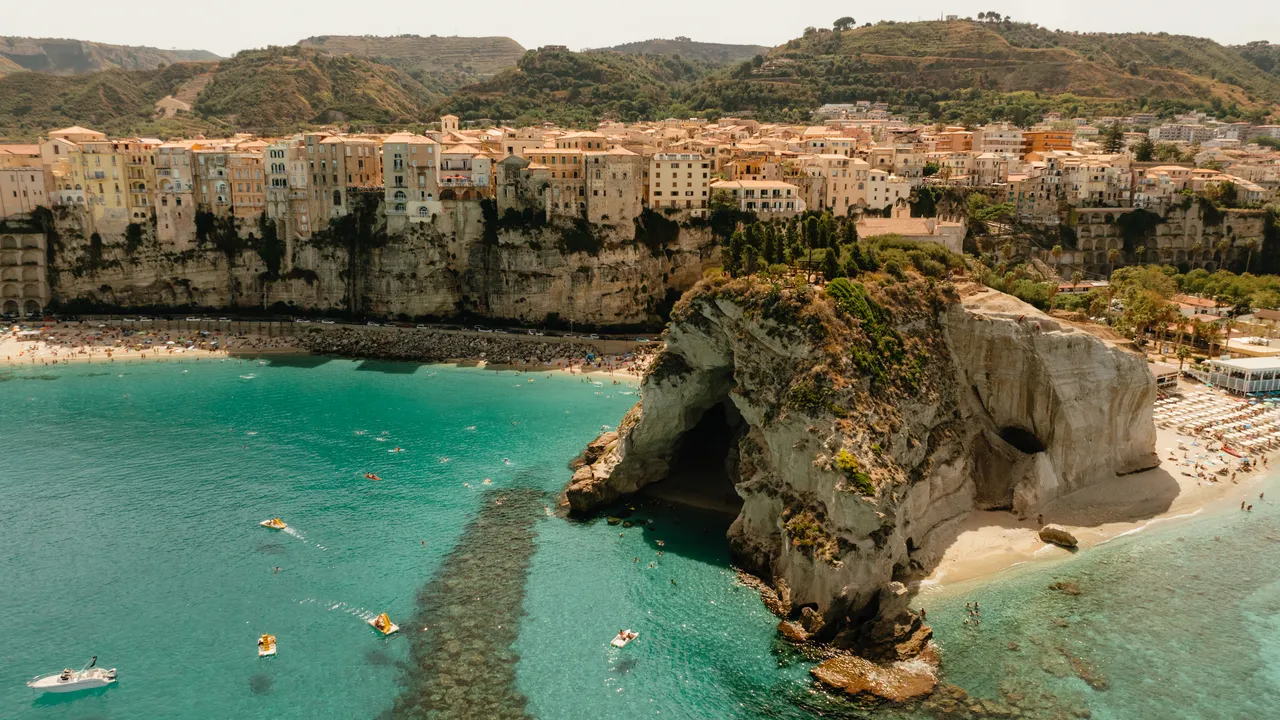
I had been in Calabria for less than 24 hours when I found myself standing in an artist’s bottega in the town of Pizzo and listening to Antonio Montesanti talk about the Greek hero Achilles. Just outside the door, cars and Vespas vroomed past, but as this cheery straw-hatted painter and ceramist talked about his Southern Italian region’s deep connection with the distant Mediterranean past, the cars became chariots and the scooters morphed into mules.
In this part of Calabria, Antonio explained, fishermen still scratch a crosshatched pattern with their nails on the cheeks of the swordfish they catch. They do this—he informed me in a matter-of-fact way, as if recounting what he’d had for lunch—to free the souls of Achilles’s loyal warriors, the Myrmidons, who transformed into these sleek, powerful silver-blue fish after the death of their commander.


Later the same day I was driving through an amiably ramshackle town called Nicotera with my German Calabrian guide, Liane Scherf. Nicotera is famous as the town that “taught the world to eat,” after being chosen in 1957 as one of the earliest data-collection centers for research into what would become known as the Mediterranean diet. After lunch on a hot July day, it felt more like the town that taught the world to have a siesta. The only sign of life came when we stopped at a pedestrian crossing for three young boys, 10 or 11 years old at a guess. The two in front were almost nine feet tall. Their hands were empty dishwashing gloves, and their heads were cardboard boxes. They bowed to our car, arms flailing, then whirled away up a steep lane. The regular-size kid that followed in their wake kept up a constant rat-a-tat on his drum.
Rather than being hunched over their game consoles, these guys were reenacting a legend that—according to Liane—dates back to the early Middle Ages, featuring a Catholic maiden called Mata and a Muslim prince called Grifone. In processions held on local feast days, Mata and Grifone become giant papier-mâché figures that are paraded through the streets. But this was not a feast day in Nicotera. Also: The boys’ “Giganti”—swaying precariously on wooden chairs that the two out front held propped on their shoulders—were clearly homemade. It looked very much like they were playing at Mata and Grifone for no good reason other than the sheer joy of the thing.
“Calabria is Sicily 20 years ago,” says Gary Portuesi of Authentic Explorations, the luxury travel outfitter with whom I am exploring this wonderful and often overlooked southern region. I have met him and his partner, Calabrian native Marco Palermo, later that night in Villa Paola, just outside Tropea. Gary is excited about Calabria and was eager to share his enthusiasm with someone like me, who knows Italy well (it’s where I live) but has never visited the region, aside from a memorably slow drive from Sicily to Naples all of four decades ago. Sicily is where Gary’s family is from, and he helped launch the island’s new, high-end tourist wave when he founded what was then called Authentic Sicily in 2002. Calabria, Gary tells me, “is the perfect destination for anyone looking for that ‘other’ Italian experience that nobody knows.”