






Inspiration takes many forms. For Jianhua Guo, it was his friend’s daughter’s diarrhoea.
Guo — an environmental microbiologist at the University of Queensland in Brisbane, Australia — was studying the emergence of antibiotic-resistant bacteria in hospital waste water. His research indicated that the resistance arises in response to not just antibiotics, but also other compounds that happen to have antibacterial properties.
His friend’s daughter had epilepsy and had been prescribed the anticonvulsant drug carbamazepine. Guo thought that the girl’s gastric issues might be due to the drug not only affecting her neurons, as intended, but also killing her intestinal bacteria. If so, he surmised, bacteria might evolve resistance to carbamazepine — and, more worryingly, perhaps also to antibiotics.
Nature Outlook: Antimicrobial resistance
In 2019, Guo’s group showed that carbamazepine could induce resistance to several commonly used antibiotics in cultured bacteria1. But it’s not just carbamazepine. In 2018, microbiologist Lisa Maier, now at the University of Tübingen in Germany, and her colleagues assessed the effects of nearly 1,200 drugs on 40 types of intestinal bacterium2. They found that 24% of the drugs had antibacterial activity.
The team also found that the bacteria that resisted non-antibiotic drugs most strongly were also the most resistant to antibiotics. “That basically implies that if you develop a resistance to a non-antibiotic drug, that will result in a cross-resistance to an antibiotic,” Maier says.
Antibiotic resistance is a growing issue, and efforts are being made to control the threat by addressing the drugs’ overuse. However, the possibility that non-antibiotic medications might be helping to drive the process is a concern. “Bacteria don’t care if we call a drug an antibiotic or not; they only care whether it has an antibacterial activity,” says Ronen Ben-Ami, an infectious-disease physician at Tel Aviv Sourasky Medical Centre in Israel. And although this antibacterial activity might be much less potent than that of recognized antibiotics, people take many of the implicated drugs for years — much longer than a ten-day course of antibiotics.
Evidence from animal and human studies is now needed to determine whether these drugs are involved. “We have lots of in vitro findings,” says Amir Mitchell, a systems biologist at the University of Massachusetts Chan Medical School in Worcester. “Whether they hold in vivo is a key question.”
Selection pressure
Antibiotic resistance starts small. When bacteria are exposed to an antibiotic, they might survive if they have a protective genetic variant. With time and repeated exposure, these bacteria can grow into a stable population that is resistant to the treatment.
To test whether a non-antibiotic drug can drive such evolution, a researcher can first apply the compound to bacteria in a dish. If it has an antibacterial effect, they then apply a known antibiotic to any surviving bacteria. If the microorganisms survive this antibiotic better than do bacteria that had not been exposed to the non-antibiotic drug, it indicates that the initial compound promoted some form of resistance.
Since 2018, medicines as varied as the β-blocker propranolol, the anti-inflammatory drug ibuprofen and various cancer chemotherapy agents, antipsychotics and antidepressants, have all been implicated in antibiotic resistance.
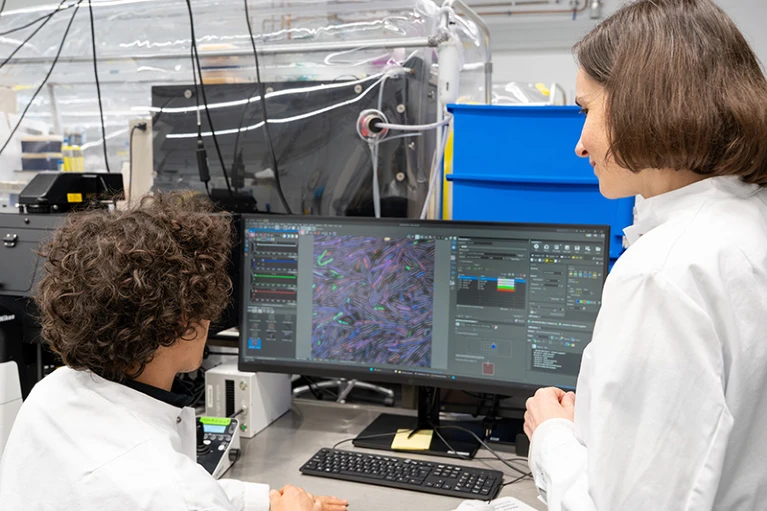
Lisa Maier (right) at the University of Tübingen, Germany, studies the effects of antibiotic exposure on human gut bacteria using fluorescence imaging.Credit: Jonas Ritz/CMFI, University of Tübingen
There are also signs that combinations of antibiotic and non-antibiotic drugs might turbocharge resistance. The diabetes drug metformin, the anti-inflammatory therapy diclofenac and 17-β-oestradiol, a component of hormone therapies, have only mild antibacterial effects. But environmental microbiologist Aimee Murray at the University of Exeter, UK, has reported that applying these drugs to bacteria alongside the antibiotic ciprofloxacin markedly reduces the concentration of antibiotic required to induce resistance3. “If you were doing a risk assessment for ciprofloxacin, and you said, ‘Anything below this concentration is safe’,” Murray says, “actually, it wouldn’t be if you had these other compounds present.”
Scientists have long known that there are many mechanisms of resistance. Some negate the effects of a single antibacterial agent, but others make microbes resistant to several. It is through these broader pathways that non-antibiotic drugs might induce resistance to antibiotics.
For example, Maier and her colleagues suggest that non-antibiotic drugs might interfere with bacterial efflux pumps2 — proteins that move a variety of toxic molecules out of the bacterium. And Guo’s group has shown that antidepressants promote resistance by helping bacteria to take up resistance genes4.
Mitchell, however, thinks that it is unlikely that lots of non-antibiotic drugs are promoting antibiotic resistance. In 2024, his group tested whether 104 non-antibiotic drugs kill Escherichia coli bacteria in the same way as antibiotics do5. Surprisingly, there was little overlap in the mechanisms, Mitchell says. Bacteria chronically exposed to the antidepressant sertraline had increased expression of efflux pumps that also export antibiotics. But microbes exposed to two other drugs evolved resistance that didn’t affect antibiotics.
Beyond the lab
The question now is whether drugs that induce antibiotic resistance in carefully controlled experiments also do so in the real world.
Waste water from hospitals is known to teem with antibiotic-resistance genes, although the role of non-antibiotic drugs in this is unclear. But given that many of the implicated drugs are ingested daily by tens of millions of people, attention is increasingly focusing on the potential development of resistance in the bacteria that live on and in our bodies.
In 2020, computational biologist Arnau Vich Vila, now at the Catholic University of Leuven (KU Leuven) in Belgium, tried to unpick how 41 medications affected the gut microbiomes of the people taking them6 — including the presence of drug-resistant microbes.
They found that people who were taking metformin or proton-pump inhibitors had more resistance genes in their gut microbiome than did those not using these drugs. And among people with inflammatory bowel disease, those who used opiates or tricyclic antidepressants had more resistance genes than did those who did not take these drugs.
“The antibiotic-resistance mechanisms that we were finding were all linked to efflux pumps,” says Vich Vila. This shared survival mechanism supports the idea that the drugs are promoting resistance, he says, rather than just changing the proportions of resistant and susceptible bacterial species already present.
If people taking certain medications accumulate antibiotic-resistant bacteria in and on their bodies, the concern is that they will be more likely to develop an infection that is difficult to treat. Ben-Ami has assessed this using data on 1,807 urinary-tract infections at his hospital7. With around half of cases caused by bacteria resistant to at least one antibiotic, he wondered whether the drugs that people took affected their risk.
Infections resistant to multiple antibiotics were more common in people taking proton-pump inhibitors, β-blockers and some cancer chemotherapies than in people not taking them. Several blood-thinning medications and some antidepressants were associated with infections resistant to a single antibiotic.
Ben-Ami says that the study supports the idea that non-antibiotic drugs drive antibiotic resistance in people, but he remains cautious.
Alan McNally, a microbiologist at the University of Birmingham, UK, thinks that caution is appropriate. So far, human data have come from observational studies in which people taking the drugs of interest will have had medical conditions not seen in healthy control groups. What’s needed, McNally says, is controlled studies in which healthy volunteers have their microbiomes examined before, during and after taking a drug. “You would expect to see some sort of increase in resistance,” he says. Guo and Mitchell are currently doing comparable studies in mice.
A high bar
The stakes are high. If researchers were to firmly establish that increased risk of antibiotic-resistant infections is a side effect of some medications, it could affect the reputability of drugs that are currently standard treatments. As a result, “it will take an awful lot of clinical evidence” for physicians to contemplate changing their approach, McNally says.
If such evidence is found, existing efforts to prevent the overuse of antibiotics might have to be expanded to other drugs, says Ben-Ami. But this won’t be easy. In theory, a physician presented with two similarly effective drugs for a given disease could opt for the one that has fewer antibacterial side effects to minimizes the risk of resistance. But drugs are often not equally effective, or might have differing side effects, so the decision is unlikely to be clear cut.
Even if resistance-promoting non-antibiotic medicines remain common, knowing their risks could still be useful. For instance, if a drug is known to induce resistance to a specific antibiotic, physicians treating infections in people who take that drug could choose another agent to fight off the infection.
Drug development could also change. Antibiotic makers rigorously test whether candidate drugs are toxic to humans. “But it was never, ever the case that someone from all the other departments sent something to test for toxicity on bacteria,” Maier says.
All this will require definitive clinical evidence. For now, there’s no suggestion that anyone should stop taking a therapy that is managing an ongoing medical condition out of fear of off-target antibacterial effects.
But researchers agree that the issue needs resolving. People consume many more non-antibiotic pharmaceuticals than they do antibiotics, and this vast group is not currently part of plans to control antimicrobial resistance. “Maybe,” says Ben-Ami, “there’s a whole big dark field around us where resistance is happening, and we’re not influencing it at all.”