







ESSENTIALS
Firm Name: Brillhart Architecture
Principals: Jacob Brillhart, Melissa Brillhart
Headquarters: Miami, Florida
Accolades: Forbes Architecture’s “America’s Top 200 Residential Architects,” 2025; Forbes Architecture’s “America’s Best-in-State Residential Architects,” 2025
House Name: Elevated Tropical Home
Location: Miami, Florida
Area & Layout: 4,500 square feet; 4 BR, 6 BA
Architectural Photographers: Michael Stavaridis (michaelstavaridis.com), Stephan Goettlicher (stephangoettlicher.com)
F
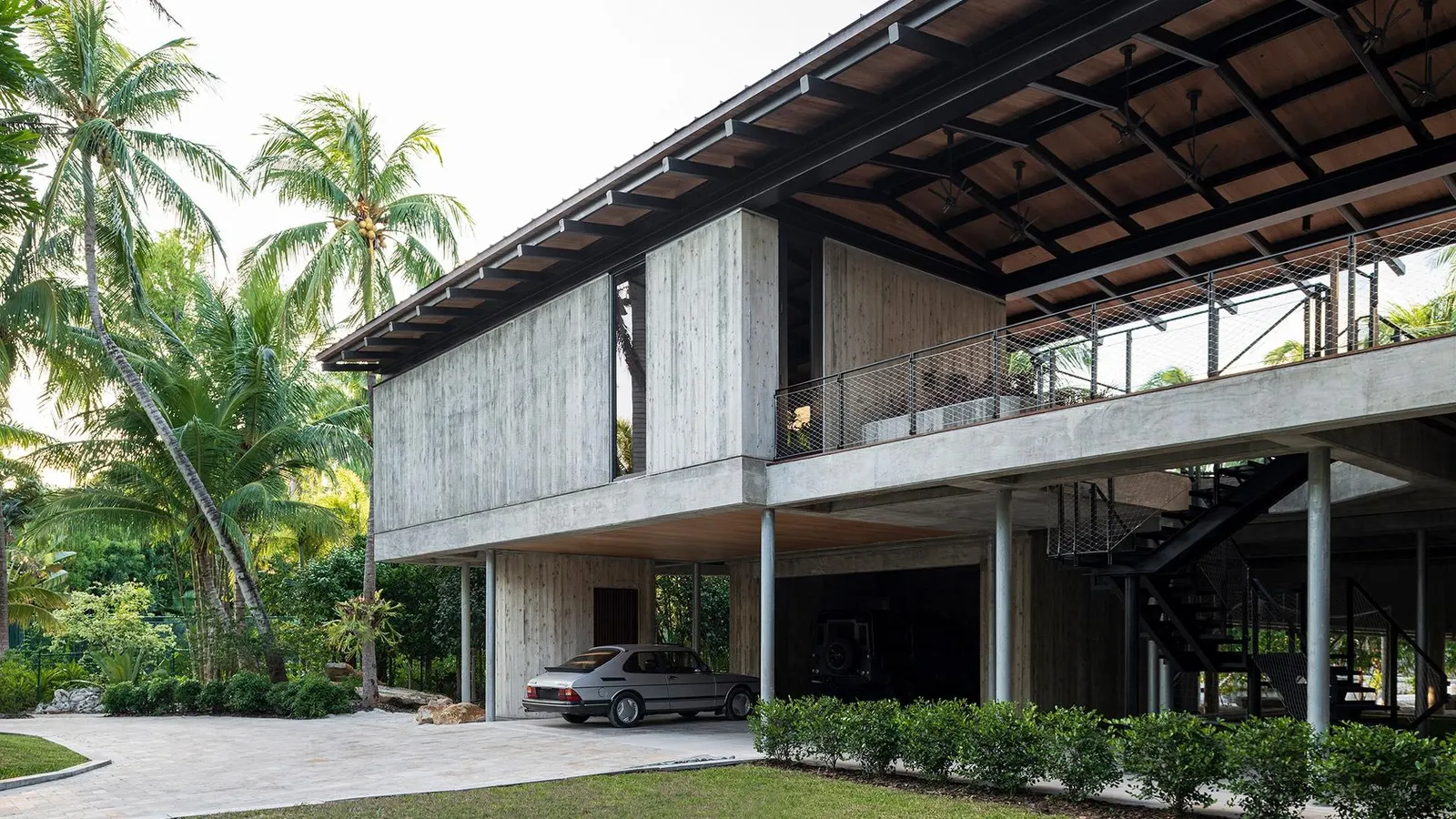
or years, a Miami homeowner watched helplessly as hurricanes and tropical storms reduced his 1920s house to a patchwork of ad hoc repairs. Tired of the endless loop of insurance claims and renovations, he asked Brillhart Architecture to design a replacement that could withstand the forces of nature. The resulting home consists of two perpendicular volumes perched atop an expansive triangular deck supported by a sculptural concrete base. The scheme allows floodwaters to pass underneath while still maintaining a strong flow between interior and exterior spaces—a hallmark of the firm’s site-responsive style of tropical modernism.
FRED ALBERT, Forbes Deputy Editor, Architecture: In terms of scale, scope and identity, how does this project fit into your overall body of residential work?
MELISSA BRILLHART: This project is pretty typical in scale for us, and consistent with our approach of prioritizing structure as architecture across a range of materials and construction assemblies. Like our broader body of work, it is contemporary, yet rooted in tropical vernacular traditions: narrow footprints, large overhangs and natural, weather-resistant materials.
ALBERT: Creatively, from a design problem-solving viewpoint, what are a few of the most satisfying solutions that came together here?
BRILLHART: We’re always pushing past industry defaults to find more creative solutions, and this project reflects that. Here, the core challenge was making an elevated residential structure actually look good—something the building industry hasn’t really solved. We approached it three ways: embracing the understory as a celebrated part of the architecture rather than dead space; reconstituting a new ground plane in the sky; and breaking up the massing to make the building feel less imposing and more tropical.
ALBERT: What’s next for the studio?
BRILLHART: We’re primarily focused on the tropics, but really appreciate any site where the surrounding landscape takes center stage. That’s led us to some unexpected places—Belgium, Santa Fe, California—wherever the topography, climate or natural features demand a thoughtful dialogue between building and landscape. We’re always looking to expand into new places—the more interesting the site, the better.
ABOVE: Since the house is in a high-risk flood zone, living spaces must be elevated 12 feet above sea level. The house was divided into two perpendicular structures: a one-story volume for entertaining and a two-story volume containing the kitchen, dining room, living room and sleeping spaces.
Stephan Goettlicher
ABOVE: “Rather than simply placing a conventional house on stilts,” architect Melissa Brillhart says, “we fundamentally rethought elevated residential design by celebrating the understory space, reconstituting a new ground plane in the sky, and breaking up the massing for a less imposing, more tropical result.” A covered breezeway connects the two parts of the house and shelters the stairwell leading up to the living spaces.
Stephan Goettlicher
ABOVE: “Structure is architecture here,” says Brillhart. “Board-formed concrete and steel define the building, while exposed steel roof joists and tongue-and-groove cypress decking are visible inside and out.” These strong, unadorned materials feel quietly at home in the landscape.
Stephan Goettlicher
ABOVE: “Sculptural concrete forms—which serve as storage rooms and a garage—root the house to the ground,” says Brillhart. “Slender galvanized-steel pipe columns, set at varying angles, provide additional structural support. Together, these organic forms stand in deliberate contrast to the rectilinear architecture above.” A curvilinear cutout in the deck offers a preview of the house overhead.
Brillhart Architecture
ABOVE: To re-create the feeling of a yard 12 feet off the ground, the architects surrounded the home’s first floor with a 3,000-square-foot deck, providing a seamless transition between indoor and outdoor spaces. An elevated pool enhances the illusion.
Stephan Goettlicher
ABOVE: The shower in the primary bathroom enjoys treetop views of the surrounding palms.
STEPHAN GOETTLICHER
ABOVE: The kitchen, dining and living areas share a single space on the home’s first floor. A wood ceiling helps define the kitchen area within the open plan and adds a warm counterpoint to the steel appliances and staircase.
Michael Stavaridis
ABOVE: “Preservation of all of the existing palm trees makes it feel like the project has always been there,” Brillhart says.
Michael Stavaridis
FIRST FLOOR
Brillhart Architecture
SECOND FLOOR
Brillhart Architecture