




Science can be a slog: tedious, repetitive and maddening. Good days — the first moments after a newly discovered insight, holding an undescribed species or a student overturning a long-held assumption — are few and far between. But it’s these singular moments that remind researchers why they chose their career.
Nature’s careers team asked scientists what a good day in science looked like to them. Some anecdotes came through social media; others, we sought out. Good science days come in all shapes and sizes — from finding a dreamy location for a natural experiment to setting schoolchildren’s curiosity ablaze.
RAQUEL PEIXOTO: Finding the perfect test bed
Coral-reef biologist at the King Abdullah University of Science and Technology in Thuwal, Saudi Arabia.
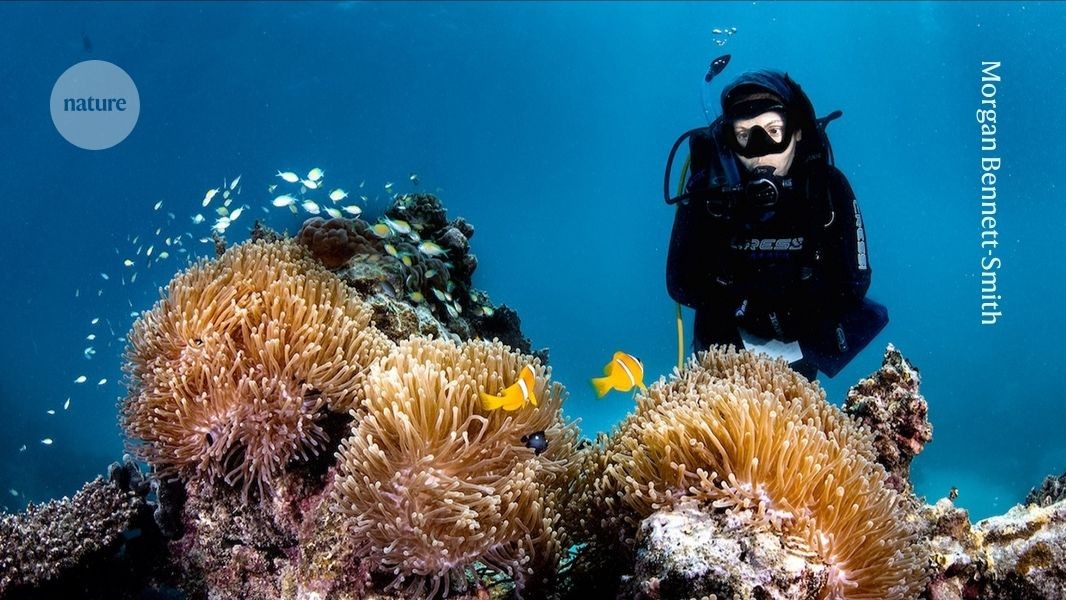
When I first moved to Saudi Arabia, I wanted to test whether applying beneficial microorganisms to the surface of corals could improve reef health in the field. In my mind, I knew the perfect design for an ideal, natural experimental reefscape. I wanted it to be a series of patchy reefs with a sandy bottom, so that each patch could serve to replicate my experiments. It also needed to be in shallow water, but protected so my colleagues and I didn’t have to worry about currents, and to have a wide diversity of coral species. We spent three months exploring different spots, searching for the best location. At one point, I even drew what I had in mind for colleagues.
14 things our PhD supervisors got right and why it mattered
One day, several of us were diving together in the search for the experimental location. There were two groups exploring from different directions, but we met at a place that was exactly what I had in my mind. When we came up, we all looked at each other and knew that this was the place we needed. It was a magical moment. For the past five years, we’ve conducted many experiments in what is now called the Coral Probiotics Village, including testing how a slow-release pill can steadily deliver beneficial microbes. It looks like an underwater city — we’ve even added street names such as Anemone and Doctor Octopus.
MONICA MUGNIER: Collaboration to catch a shapeshifter
Public-health researcher at Johns Hopkins University in Baltimore, Maryland.
In my laboratory, we study a parasite, Trypanosoma brucei, that causes African sleeping sickness. It’s a big problem in sub-Saharan Africa, where large tracts of fertile land can’t be used for farming because of the parasite burden. The parasite is incredible at wreaking havoc because it is a literal shapeshifter. Its surface is densely coated with ten million copies of a single protein, but once a host immune system starts to clear it out, the parasite’s genome switches to one of thousands of other genes to express a new outer coat. We knew that the parasite stitches together individual genes to make new variants using a process called recombination, but it was really difficult to work out how it did this stitching, for a variety of reasons. This included the relatively poor quality of the reference genome sequence owing to extremely high repetitiveness that makes it difficult to accurately assemble.
In 2023, a PhD student in my group, Jaclyn Smith, used the gene-editing tool CRISPR–Cas9 to artificially trigger the recombination process, pairing it with a targeted sequencing approach to see how genes recombined in the parasite. These experiments helped to confirm that the sequencing tool was measuring a real signal in infectious parasites. While Jaclyn was at a conference, she saw another group present similar results — but without a specific mechanism to explain them. Together, Jaclyn and those researchers dug through their data and genome sequences to determine the other group was also seeing new surface coats generated through recombination. We were definitely worried about getting scooped, but she knew it was the right thing to do. We coordinated with the other lab to put papers up on the bioRxiv preprint server at the same time. They published first in Nature1, but Jaclyn’s paper was also published in Nature a year later2. By understanding the recombination process, we might be able to identify new drug targets or treatment strategies. It was a productive collaboration. Everybody won.

Researcher Nicole Ackermans’ good day was a moment alone in the lab, when she made a discovery about brain injuries in head-butting musk oxen.Credit: Nicole Ackermans
NICOLE ACKERMANS: Savouring the moment of discovery
Traumatic-brain-injury researcher at the University of Alabama in Tuscaloosa, also known as Dr. Headbutt on social media.
To study traumatic brain injury, I work on musk oxen (Ovibos moschatus) and bighorn sheep (Ovis canadensis) — species that start headbutting as early as a few hours after birth, initially as play, and later to establish dominance among both males and females. I went into my postdoc at the Icahn School of Medicine at Mount Sinai in New York City thinking that these species had evolved to protect their brains from damage, so I looked at slices of their brains under the microscope to see what was actually going on. Every day for more than a year, I stained cells with a marker to attempt to find degrading or dying neurons — signs that these animals also sustain brain injuries. If neurons are healthy, they don’t stain. I wasn’t sure if my protocol was working in musk oxen. Then, one day, I saw this huge, stained neuron that took up the whole screen. It was the first indication that I was on the right path.
When I first saw it, I sat with it for a second. No one else was in the lab, because it was 5 p.m. during the COVID-19 pandemic. I realized I was the only person who had ever seen this: these animals have brain damage and they give it to themselves. For a brief period, that knowledge was just for me — at least for a few hours, before I told my supervisor. Afterwards, we confirmed with more stains that this resembles early chronic traumatic encephalopathy, or CTE, the same condition that affects American football players. The damage pattern is unequivocally caused by repetitive impact. Our 2022 study proved these animals get brain damage and they are not as magical or protected as we thought3. This is why I like science — the small joys of discovery and unravelling mysteries.
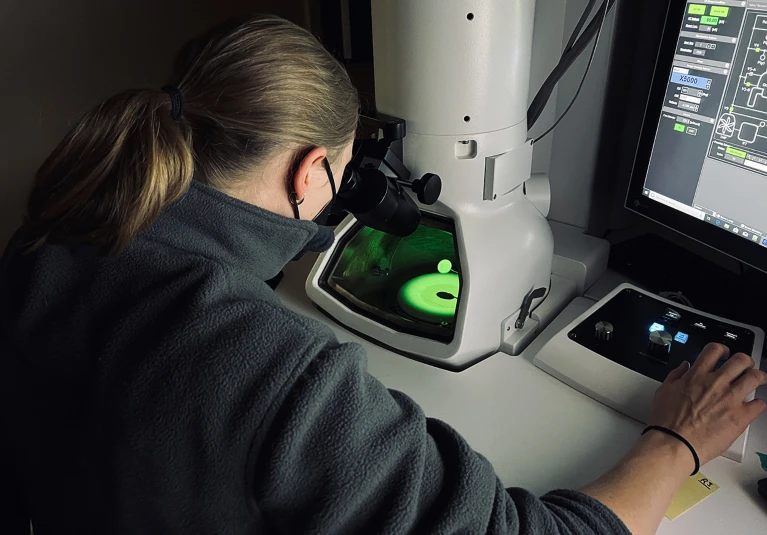
Rebecca Pfeiffer showed Bryan W. Jones an exciting find about retinal degeneration.Credit: Bryan William Jones
BRYAN W. JONES: ‘Want to see something cool?’
Retinal neuroscientist at the University of Pittsburgh in Pennsylvania.
One morning in 2020, Rebecca Pfeiffer, then a postdoc and now a researcher at the University of Pittsburgh, Pennsylvania, walked into my office and asked if I wanted to see something cool. “Always,” I said.
We research how retinas are wired and how retinal degenerative disease breaks that wiring. Three main retinal bipolar cell classes — rod, ON cone and OFF cone — help our eyes to process visual information. Normally, the neurotransmitter glycine can appear only in ON cone bipolar cells, because they are coupled to other cells that enable low-light vision by means of gap junctions (intercellular connections that allow small molecules such as glycine to pass between two cell types).
When Rebecca came into my office that morning, she had detected gap junctions in other bipolar cells besides ON cone cells. These gap junctions that formed between the wrong cell types turn out to be a hallmark of early retinal disease. Because glycine flows through gap junctions, her finding also explained why we had previously found glycine in all bipolar cell types early in retinal degeneration. The cool thing is that this might reveal fundamental mechanisms by which all neural systems start to fall apart. If that’s true, we might be able to identify potential therapeutic targets for some terrible diseases. If we can slow the decline down even a little bit, we can buy people many years of a more functional life.
I legitimately felt a pang of jealousy. We get into this game to discover, but as science funding gets harder to secure, principal investigators are in their office writing grants while the trainees get to do the cool stuff.
AISHIK GHOSH: Students overturn long-held assumption
Fundamental physicist at the Georgia Institute of Technology in Atlanta.
I have worked on experimental particle physics since 2015, searching for Higgs bosons at CERN, Europe’s particle-physics lab near Geneva, Switzerland, and now also working on the Deep Underground Neutrino Experiment (DUNE) in the United States. For this research, there’s one statistical test we’ve used for decades to confirm the existence of a new particle — the generalized likelihood ratio test (GLRT). This compares two models — a simple null hypothesis, which includes no new particle or matter being discovered, and a more complicated alternative model, which includes a new particle with many possible values of strength.
Don’t talk science, play science: translate your data into music to improve its reach
In December 2024, a couple of PhD students working with my collaborator, Ann Lee, a data scientist at Carnegie Mellon University in Pittsburgh, Pennsylvania, were confident they could disprove the assumption that the GLRT was optimal. In the corner of my mind, I hoped they would prove us wrong. I gave them one of the most famous Higgs boson data sets to play around with. By early 2025, they showed that, although our previous physics results weren’t wrong, our use of the GLRT wasn’t ideal because it assumed large sample sizes are always generated, which is often not the case. Instead, the test left valuable information on the table. That day was special. I was still sceptical and I went through a battery of checks because I had to go back to my community and defend the PhD students’ work, but it was all correct. The paper is currently in review, receiving a great deal of scrutiny.
Together, we produced a statistical test that will drastically improve our ability to make discoveries in particle physics, for example in searches for a new particle such as dark matter, where we expect to see only a few signal events at best. As a scientist, I want deeply held beliefs to be questioned. It was a real shock to the particle-physics community. Young people find it exciting. Senior members are still highly sceptical, as they should be, but they are coming around. As the DUNE experiment comes online, with this new statistical model in place, we hope to make precise measurements about neutrinos much sooner than anticipated.
RAFIK TAREK NEME GARRIDO: Shocking coral find
Evolutionary biologist at the University of the North in Barranquilla, Colombia.
A couple of years ago, after a day of pouring rain, the water on the Caribbean coast of Colombia was crystal clear and my master’s student, Jorge Mareno, managed to take pictures of corals that no one knew existed here. We could find no scientific reports of corals in the area. Typically, the water is pretty turbid because the Magdalena River, which flows from the south of the country to the Caribbean Sea, brings chemicals and pollutants. It’s an ongoing ecological and social challenge, but these corals must be adapting to these conditions. We did a sampling campaign across three days with a boat, using environmental DNA to find areas where corals, sponges and fish successfully survive the conditions. Most of the records are completely new for the region. It’s super gratifying.
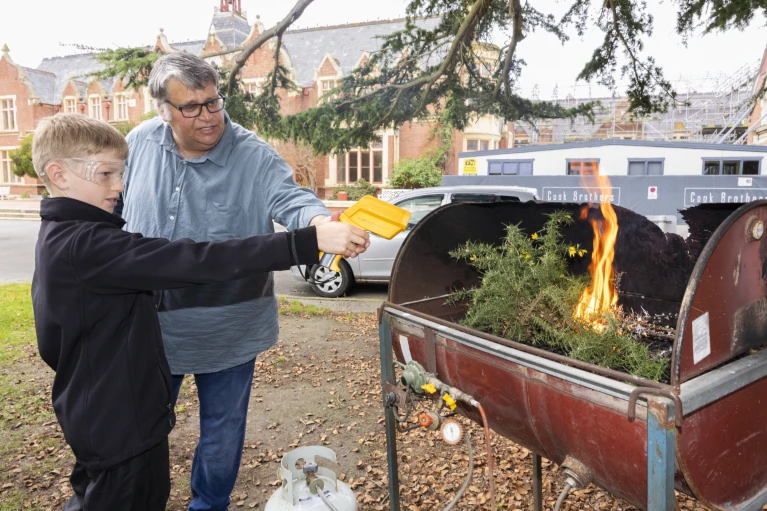
Ecologist Tim Curran helps a student to measure flammability in a gorse plant.Credit: Nomadic Planet Ltd
TIM CURRAN: Burn predictions
Fire ecologist at Lincoln University in New Zealand.
In my group, we test the flammability of plant species using a barbecue. The results can help with fire-mitigation policies and with understanding the evolution of flammability. As part of an outreach activity, we host schoolchildren at the university who haven’t had much exposure to academia before. We ask the kids to predict how a particular plant species will behave — for example, what characteristics will make it burn less or more — and then we see who is right. The kids get really into it. They ask amazing questions, the same kind that peer reviewers have asked us, including questioning our methodological assumptions, such as “why do you only blowtorch them for ten seconds?”