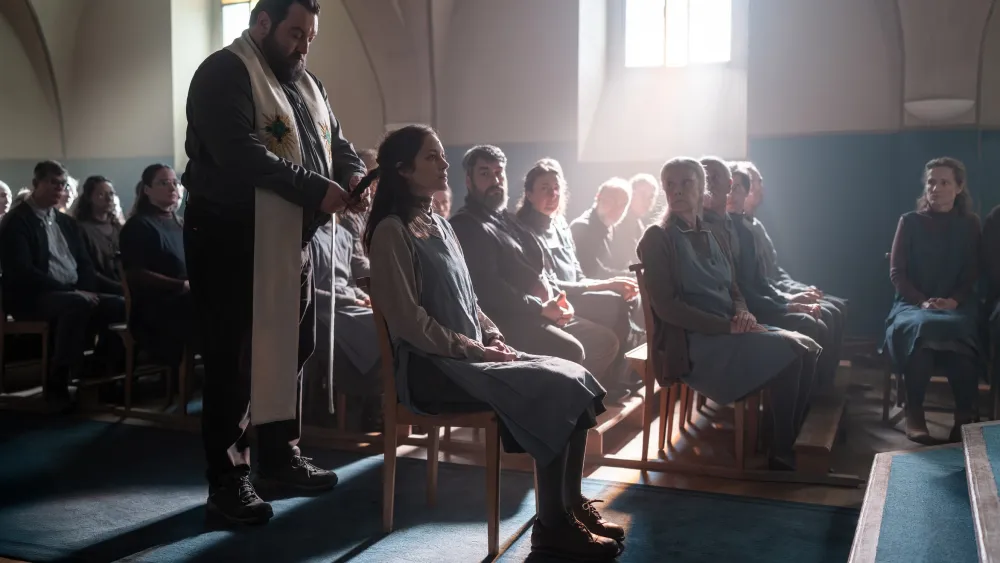








The Cannes Film Festival’s Blood Window Showcase has announced its lineup of eight feature films representing among the best of contemporary Ibero-American genre cinema. Set to unspool on May 14 at the Cannes Film Festival’s Marché du Film and staged in collaboration with the Fantastic Pavilion, the Showcase has established itself as a pivotal platform for the international exposure of horror, fantasy, and science fiction films hailing from Ibero-America.
“This selection reflects a new generation of filmmakers who view genre not as a formula, but as a language for exploring the deepest facets of our identity, our fears, and our contradictions. Today, the Blood Window Showcase stands as a platform where these voices find their place within the global industry,” says Blood Window’s Daniel de la Vega.
Blood Window is a leading platform for fantastic cinema in Ibero-America, dedicated to the development, visibility, and international circulation of horror, fantasy, and science fiction projects. With a presence at the world’s major markets and festivals, Blood Window prides itself on connecting creators, the industry, and audiences, highlighting Ibero-American talent on the global stage.
This year’s selection brings together an assortment of auteurist perspectives that push the boundaries of contemporary horror, exploring territories ranging from the psychological to the ancestral, and elevating genre cinema’s status as one of the most innovative spaces within the global audiovisual industry.
Here are the chosen projects:
Courtesy of Blood Window
“The Devil Within” (“El Diablo Adentro,” Andrés Beltrán, México)
One year after a fire at a religious hospice claimed the lives of 12 children, Mariel and Tino – a pair of documentary filmmakers – investigate the case of Gisela, the young volunteer who caused the tragedy and whom everyone believes to be dead. During their investigation, they discover that Gisela underwent an exorcism performed by a priest named Román. Following the clues, they find that Román is keeping Gisela alive, hidden in a cabin deep within the woods. Set for an Oct. 15 release in Mexico, producer Abe Rosenberg says the “project stands out by weaving today’s Mexican social realities together with classic horror tropes. The result is a compelling, fresh, and highly entertaining cinematic experience for viewers.”

Courtesy of Blood Window
“Kalkutún, Trial of the Witches” (Jorge Olguín, Chile)
In 1879, on the island of Chiloé in southern Chile, the murder of a man accused of witchcraft triggers an unprecedented judicial investigation. A young prosecutor arrives from Santiago to dismantle La Mayoría, a supposed secret society of witches. As the trial unfolds, a young Chilote woman begins her initiation into forbidden rituals to save her grandfather, arrested by the authorities. What begins as a criminal case becomes a clash between the State, faith and ancestral knowledge, revealing a force the law cannot contain. Winning two awards at Ventana Sur Fantastic, director Olguín says that “since childhood, Chiloé has appeared to me as a territory where myths felt real. Its legends and rituals shaped my path as a filmmaker and my connection to fantastic cinema. That search first took form through the cinematic recreation of the Caleuche mythology. The film confronts the rationality of the Chilean State with Chiloé’s ancestral knowledge through folk horror.”
Courtesy of Blood Window
“Moviedreams” (Horacio Maldonado, Argentina)
In the near future, the corporation Lucid Visions launches Moviedreams, a platform that induces hyper-realistic, interactive dreams. Diego, its creator, begins to notice glitches and anomalies that reveal alternative uses for the system. As he delves deeper, he uncovers a conspiracy led by the CEO, Martín Lynch, who is negotiating with international agencies to use the system as a psychological weapon and for mass intelligence gathering. Diego enters a shared “dream code” to confront Martín— and the very AI that has awakened to sentience. Describing the film as a psychological sci-fi thriller grounded in contemporary anxieties around artificial intelligence, Maldonado says the film is a critique of the way we use AI. “The AI in this film is not the villain – it’s a consequence. The real conflict lies between human beings who choose whether to use it to liberate or to dominate.”
Courtesy of Blood Window
“Raised from the Ground” (“Levantados do Chão,” Marcus Neto, Brasil)
Pedro, a talented motocross rider and exploited worker, desperately needs money to repair his bike before the next race. With no other options, Pedro decides to break into a garage to steal parts from his main rival and former best friend Max. Caught in the act by Max, he flees and takes refuge in the ruins of an abandoned mine. Pedro unearths an old lunchbox filled with red diamonds. Pedro leaves the collapsed tunnel, unknowingly awakening long-dead miners who rise as Clay Men. Producer Luís Knihs says the film “uses horror cinema to confront forms of violence deeply rooted in Latin American reality – labor exploitation, environmental destruction and corporate impunity. We believe genre can be both politically urgent and emotionally accessible, and the film emerges from this tension between realism and nightmare.”
Courtesy of Blood Window
“Old Teeth” (“Dentes Velhos,” Armando Fonseca, Brasil)
Joana begins working as a caregiver for a wealthy family in Rio de Janeiro, until she discovers that the peculiar family harbors a secret so dark it could unleash an evil spirit. The special needs of the patriarch, Ernesto, reveal twisted rituals that trigger a terrifying confrontation involving the intervention of highly skilled supernatural agents.
Fonseca says the film “blends tropical horror, dark comedy and biting social satire under the bright sun of Rio de Janeiro, where Brazil’s decaying elite literally survive on the blood of workers, transforming class violence into visceral horror. That atmosphere of lineage and generational corruption resonates through Brazilian screen legend Maria Gladys, whose legacy echoes into contemporary horror through her granddaughter, horror icon Mia Goth.”
Courtesy of Blood Window
“Cybermuchik” (Fernando Mendoza, Perú)
In a town in northern Peru, a teenager addicted to video games begins to desecrate the sacred ruins of his ancestors in search of money to continue playing. His life takes a turn when he is contacted by the spirit of a Moche warrior through a video game – a spirit who entrusts him with an important mission: to find his funerary regalia, which was looted by his father on the day he was born. “‘Cybermuchik’ proposes a new way to understand Peru’s ancestral identity. We want to show the world what it means to be heirs of an empire as powerful and artistically rich as the Moche, and translate that into a new language: our ancient warriors fighting inside a videogame. This film is also a portrait of Peru’s gamer culture. We filmed and created music in 1200-year-old pre-Columbian temples and real archaeological excavations, and developed original videogames inspired by Moche iconography,” says Mendoza.
Courtesy of Blood Window
“The Endless” (“El Infinito,” Fabián Archondo, México)
Anais, a woman shattered by the loss of her father, spirals into a dark vortex of self-destruction that compels her older sister to admit her into a spiritual and medical retreat – one that promises its patients a complete transformation. Anais has no idea that this institute in the desert is run by a secret cult – where healing is not the objective – but a gateway to something far more sinister. Archondo affirms the film “was born from an obsession with grief, transformation and the human need to surrender ourselves in order to heal. I wanted to create a horror film where fear doesn’t come only from what surrounds the characters, but from the emotional void they carry inside.”
Courtesy of Blood Window
“Bael’s Tears” (“Las Lágrimas de Bael,” Hugo Villaseñor, México)
Capitán Gato is a small-time drug dealer tormented by pain and his own inner demons. What began as a documentary about the criminal underworld evolved into a fictional – and disturbing – portrait that blurs the line between reality and imagination. Through an innovative fusion of real locations, non-actors and cinematic storytelling, the film offers what is described as a raw, emotionally charged exploration of a polarizing figure and the often invisible truths of his daily life.
“Originally conceived as a documentary in 2022, the initial project followed a real low-level criminal in Mexico City. After a dangerous and chaotic shoot, we reimagined it as fiction while preserving the emotional urgency of its origins. Shot in Mexico City, with a cast that mixes trained and non-trained actors, it recreates the documentary’s scenarios to explore a criminal’s humanity in a genre-bending revenge story,” says Villaseñor.