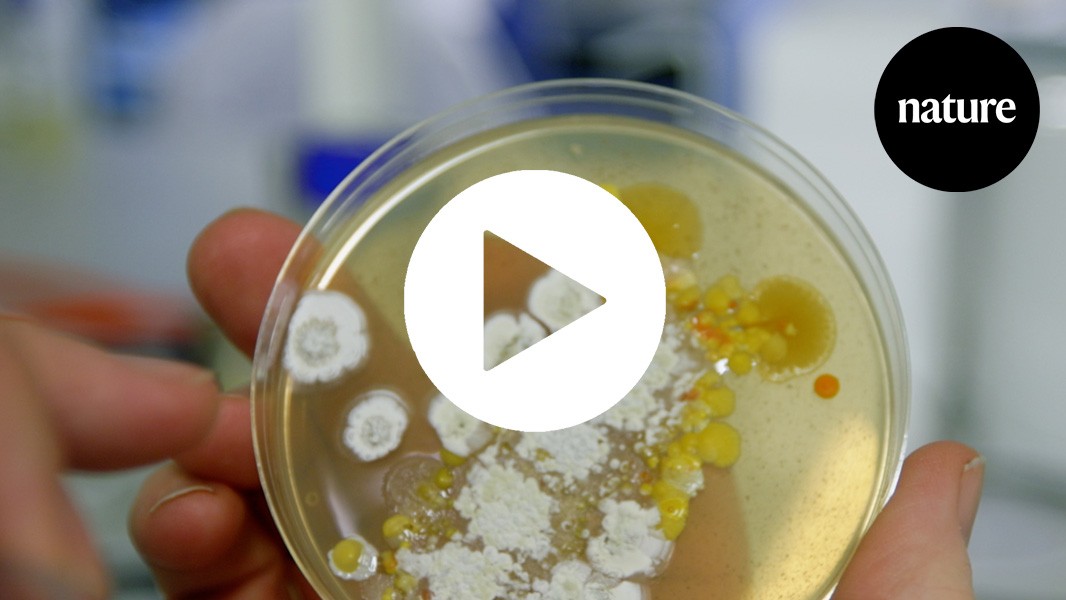




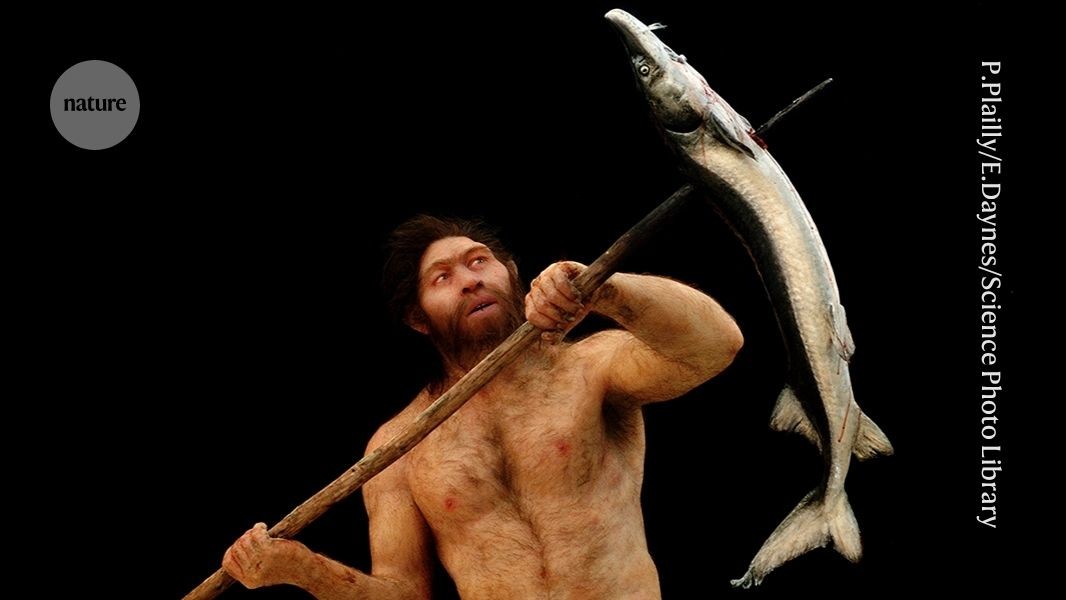
Ancient proteins were extracted from the tooth enamel from several Homo erectus individuals, including ‘Peking man’, illustrated above.Credit: P.Plailly/E.Daynes/Science Photo Library
It is well known that human relatives interbred: Homo sapiens with Neanderthals, Neanderthals with Denisovans, Denisovans with Homo sapiens. Now there is evidence for another ancient tryst, between Denisovans and Homo erectus. That’s according to an analysis of ancient proteins extracted from the teeth of six H. erectus individuals that lived in China 400,000 years ago. The work, published in Nature today, is the first genetic evidence of the pairing1.
H. erectus played a pivotal part in human history. The species lived over a period from 1.9 million to just 100,000 years ago, a time when Neanderthals, their relatives the Denisovans, and early modern humans all roamed the Earth. H. erectus was also the first human relative to venture out of Africa and into Eurasia, and as far afield as the Indonesian island of Java in southeast Asia.
Genetic data has been obtained from just a single H. erectus specimen from Georgia, dating to 1.8 million years ago2. But researchers were unable to identify any unique genetic variants that might distinguish H. erectus from other human relatives.
In China, researchers have found H. erectus remains of varying ages at more than a dozen sites, making it a potential treasure trove for uncovering genetic data for the species. For the new work, Qiaomei Fu, a palaeogeneticist at the Institute of Vertebrate Paleontology and Paleoanthropology in Beijing and her colleagues focused on teeth from three of those sites. These include the Zhoukoudian site in Beijing, where the famous ‘Peking Man’ remains were discovered in the 1920s, and sites in Hexian in southern China and Sunjiadong in central China. All the teeth analysed date to a similar period in the Middle Pleistocene, around 400,000 years ago.
East Asian marker
Fu and her colleagues extracted protein from the enamel of six H. erectus teeth — five from male and one from female specimens. Scientists have increasingly been looking for ancient proteins in fossil samples because they have been found in specimens that no longer contain DNA. Like DNA, protein sequences can be used to infer relationships between ancient humans.
The team sequenced protein fragments belonging to nine proteins. In one of the proteins — an enamel matrix protein called ameloblastin — the team identified two important amino-acid sequence variants shared by all six H. erectus specimens that set them apart from other human relatives.
“It’s challenging to get that kind of data from ancient enamel, so to have a consistency of results across six teeth was very cool,” says John Hawks, an anthropologist at the University of Wisconsin–Madison.
At position 253, the six H. erectus teeth have the amino acid glycine instead of alanine, which occurs in humans and all other human relatives tested so far, including the H. erectus fossil from Georgia. This suggests that the glycine variant could be specific to H. erectus populations in East Asia.
Denisovan trysts
The team also identified a variant at position 273, a valine instead of methionine. Researchers have previously identified this variant in two Denisovans: a 70,000-year-old specimen from the Denisova cave in Siberia, and a specimen from near Taiwan, the age of which is unclear. This indicates that the East Asian H. erectus populations, or a closely related group, passed the variant onto Denisovans through interbreeding.
“Given that both groups were close in space and time it is a reasonable suggestion,” says Tanya Smith, an evolutionary biologist at Griffith University in Southport, Australia.
That scenario is supported by data from older Denisovans that lived closer to the time that the interbreeding probably occurred. The team extracted enamel proteins from a more than 150,000-year-old Denisovan from Harbin in northern China and obtained data for a 200,000-year-old Denisovan from Siberia3. These Denisovans had both methionine (M) and valine (V) variants, inherited from each of their parents.