







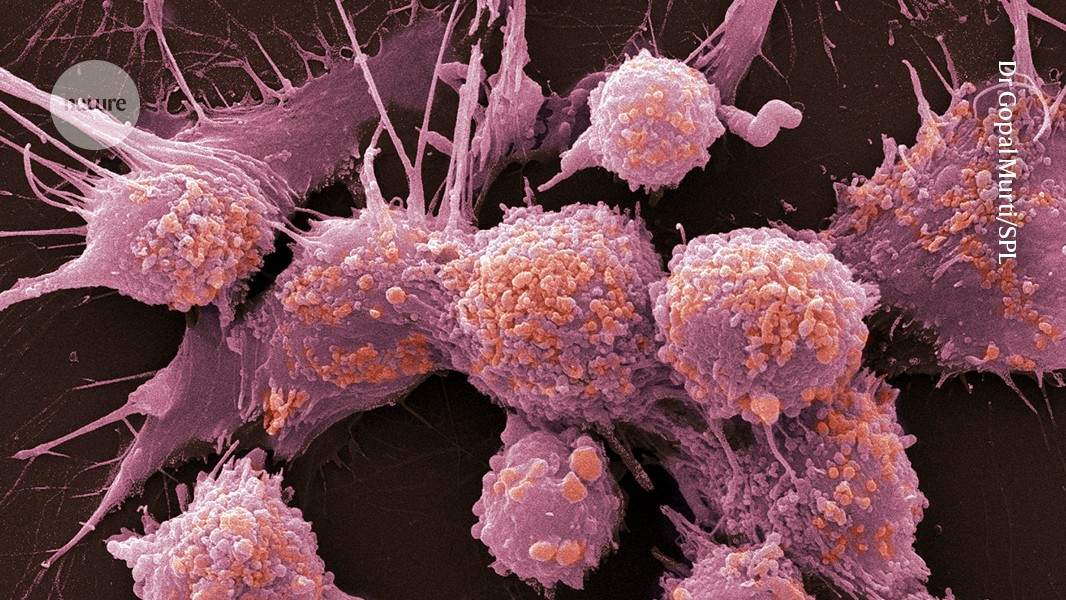
Prostate cancer (cells, artificially coloured) affected 1.5 million people worldwide in 2022.Credit: Dr Gopal Murti/Science Photo Library
Does prostate-cancer screening with the common ‘PSA’ blood test save lives? The Cochrane, an influential group renowned for its gold-standard medical reviews, has previously addressed that question twice, and twice the answer was ‘no.’
Now, data from nearly 800,000 people has prompted a U-turn. A Cochrane review published today1 suggests that testing for prostate-specific antigen (PSA) “likely reduces the risk of dying” from prostate cancer – and without increasing the likelihood of negative side effects caused by prostate biopsies or prostate cancer treatment.

Early-onset cancer fuels calls for wider screening — but at what cost?
The number of lives saved is small, the group found, but the latest finding still marks a reversal of Cochrane reviews published in 20062 and 20133. The authors of the most recent version say that that their findings were driven in part by data from two new trials4,5 encompassing more than 250,000 people and from extra years of data from four older trials.
The report comes as several policy bodies around the world are reviewing guidelines for medics on the use of PSA testing.
“This finding is a milestone. I think it will make a difference for a lot of policy makers,” says Philipp Dahm, a urologist at the University of Minnesota in Minneapolis and corresponding author of the review.
Common cancer
In the 1980s, scientists discovered that a blood test for PSA, a protein produced by the prostate, could detect prostate cancer. Prostate cancer is one of the most common types of cancers in men, affecting 1.5 million worldwide in 2022. Most men diagnosed with prostate cancer do not die from the disease. (This article uses the word “men” to reflect wording in cited studies and reports.)
The introduction of a blood test made screening for prostate cancer more common, and the number of recorded cases skyrocketed. But the test can flag people with very slow-growing tumours or those with prostates that are enlarged but cancer-free. Such results raise the possibility that people who test positive but do not have life-threatening cancer will undergo invasive biopsies and treatment, leaving some scientists uncertain about the wider benefits of testing.

More than one-third of cancer cases are preventable, massive study finds
In the 1990s, scientists in the United States and Europe launched huge, randomised trials to try to gain clarity, only to be left more confused. The US trial, called the Prostate, Lung, Colorectal and Ovarian Cancer Screening Trial (PLCO), followed participants for 7-10 years and found no significant difference in death rates between those screened with the PSA test and those who were not tested6. By contrast, the European trial, called the European Randomised Study of Screening for Prostate Cancer (ERSPC)7, followed participants for 9 years and found that screening reduced the rate of prostate cancer death by 20%.
Policies on screening for PSA around the world are also a mixed bag. Medical groups in the United States, for example, do not agree on the age at which testing should begin or whether testing should be routinely offered. The UK’s National Institute of Clinical Excellence, which sets recommendations for doctors nationwide, does not recommend routine testing for those without symptoms, but tests are often available upon request.
A 2006 Cochrane review3 of the PLCO and ERSPC studies and others found no evidence to support the measure. An update in 2013, which incorporated data from three additional studies as well as the earlier two, concluded that screening helped to detect more prostate cancer but did not reduce deaths from the disease.