







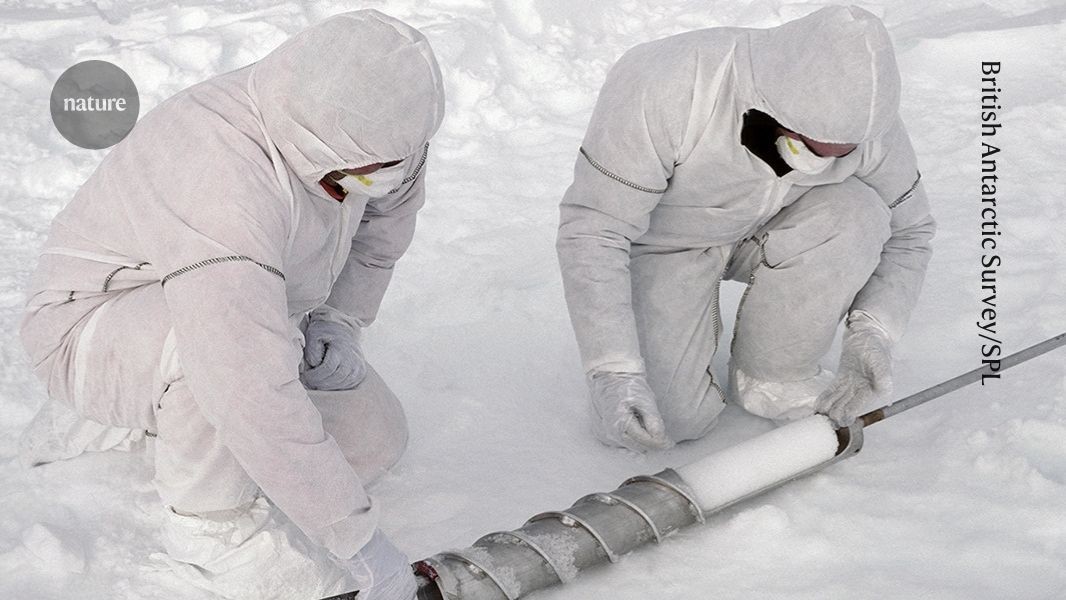
Antarctic ice cores preserve tiny bubbles of ancient air, offering a record of Earth’s past atmosphere.Credit: British Antarctic Survey/Science Photo Library
A Europe-wide collaboration has unveiled the longest continuous record of Earth’s climate and atmospheric conditions, stretching back 1.2 million years. The data were extracted from a 2.8-kilometre-deep ice core drilled in Antarctica, and show how the concentration of carbon dioxide in the atmosphere tracked changes in global temperatures across multiple cycles of climate change.
Researchers still have a great deal of information to extract from the ice, but “what they’ve got so far is pretty amazing”, says Edward Brook, a palaeoclimatologist at Oregon State University in Corvallis. “We can now look at each cycle, see how they are different in CO2 concentration. We really didn’t know that before.”
The Beyond EPICA collaboration — which involves laboratories in ten European countries — presented the findings last week at the general assembly of the European Geosciences Union in Vienna. They have not yet been peer reviewed.
Ice age mystery
The core covers a period during which Earth’s ice ages mysteriously became less frequent, but more intense. Until about a million years ago — in the middle of the Pleistocene epoch — ice ages occurred every 40,000 years, apparently caused by periodic wobbles in the Earth’s orbit and axis of rotation. But during the ‘Mid-Pleistocene transition’, the periodicity switched to once every 100,000 years. The severity of natural climate cycles also increased, producing longer, colder glaciations with thicker ice sheets.
Researchers don’t know exactly why this happened. One hypothesis is that something caused a sharp drop in atmospheric CO2 concentrations, which then led to longer, more severe ice ages. “It is thought that greenhouse gases had a minor role before the transition compared to after — but what caused the change is not firmly established,” says Beyond EPICA project coordinator Carlo Barbante, a glaciologist at the Ca’Foscari University of Venice, Italy. “That’s why we need a record from which we can extract both gas concentrations and temperatures.”