







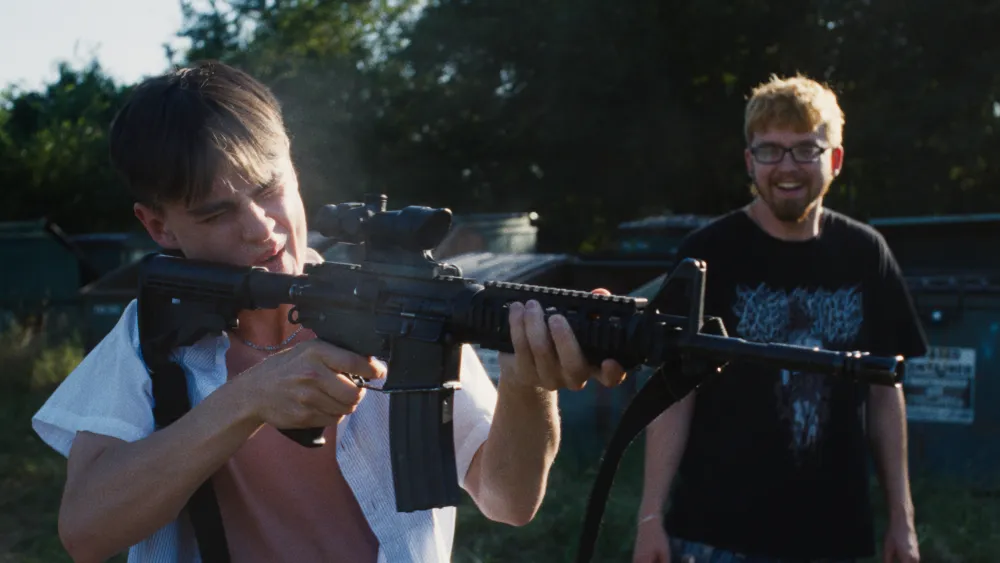
The social satire “Our Hero, Balthazar” has an incredibly dark logline: A young man named Balthazar (Jaeden Martell), who spends time forcing tears for online videos lamenting gun violence, travels to Texas to intervene with a person who he believes to be a potential school shooter (Asa Butterfield).
Despite the pitch-black premise, co-writer and director Oscar Boyson‘s film has been steadily finding new audiences. After debuting at the Tribeca Festival in 2025, Picturehouse and WG Pictures took a chance on distribution, and a measured rollout began on March 26. Audiences have been steadily growing, and the film begins a nationwide rollout Friday. Not bad for a tonally tricky film about school shootings — one that was challenging to fund, but could find increased word-of-mouth success in a year where A24’s thematically-adjacent “The Drama” became a box office hit.
“When you come up with an idea, and you get excited about it, you have to believe that it’s going to be great,” Boyson says. “I think the more that the industry rejected it in the money-raising phase, the more it became my thing, and the more I thought, ‘Well, if everyone’s saying no to this, it’s going to stand out.’”
Boyson and his co-writer Ricky Camilleri were inspired by a specific tale of recent online history, when in 2022, Uvalde shooter Salvador Ramos texted a 15-year-old online friend in Germany right before he went on his spree.
“People dragged her on social media as if she could have done something,” Boyson says. “It felt like a microcosm for what it means to be a kid. On social media, you’re exposed to and burdened with all the terrible things in the world, as if you are the one who should be doing something about them. Because Ricky and I are not capable of writing a pure hero, we gave him this performative character. What he does online undercuts any pure motivation to stop this shooting.”
Beyond the premise, what makes “Balthazar” unique is a handling of online youth culture that feels authentic, which speaks to some of the teen crime films Boyson and Camilleri reflected on for inspiration, like Larry Clark’s 2001 feature “Bully” and Tim Hunter’s 1986 drama “River’s Edge.”
Oscar Boyson at the “Our Hero, Balthazar” Los Angeles Premiere
River Callaway/Variety
While “Balthazar” is Boyson’s feature directorial debut, he is no stranger to filmmaking that values authenticity. In his 20s, Boyson moved to New York City and, after answering a fateful Craigslist ad, found himself working with early YouTube stars and filmmakers Casey and Van Neistat. The brothers had a studio in SoHo hotspot 368 Broadway, which was an incubator for many other young creatives, including Greta Gerwig, Lena Dunham and the Safdie brothers.
Through networking, hard work and doing nearly every job on DIY film sets, Boyson eventually produced the Safdies’ three most recent joint directorial efforts — “Heaven Knows What,” “Good Time” and “Uncut Gems” — and cites his time working as a co-producer on Noah Baumbach and Greta Gerwig’s 2012 indie hit “Frances Ha” as a turning point in his creative life.
“I saw how well that movie did and how it resonated with audiences, and nobody was talking at all about how small the budget was,” he says. “People were only talking about the emotional experience they had. That was the most empowering experience of my professional life up until that point, to see that it was possible. It’s absolutely shaped everything I’ve done since then.”
That passion has carried “Balthazar” to have a robust rollout for an indie. In an intriguingly meta move, the film’s social Instagram account (@bboymalone212) is filled with posts of Martell in character as a very emotional Balthazar, and has grown to over 85,000 followers, which has earned the label of the third-most followed social media account for an independent film.
Given Boyson’s focus on authenticity, it’s no surprise the in-film and real-life social media can blur the lines of reality, and is a glimpse into a generation he thinks is underrepresented in Hollywood.
“Young people have grown up on these platforms,” Boyson says. “They know when it’s AI. They know when it’s fake news. They know when they’re getting sold something. I think they’ve been totally underrepresented by the movie industry. When kids come up after screening at a Q&A and feel seen, that’s super rewarding. Why aren’t we making more of these movies? We’re expecting them all to show up to these movies, but we’re not thinking about their perspective at all.”
Watch the “Our Hero, Balthazar” trailer below.