







Systems
Tech investment giant wants batteries for its own AI datacenters, and lots of them
SoftBank is getting into the datacenter battery business and
plans to start manufacturing them on the scale of gigawatt-hours per year of capacity
to support the power needs of AI infrastructure, including its own.
The Japan-based tech investment biz says it aims to deploy
the battery systems it is developing at its own large-scale AI server farms initially,
but plans to make them more widely available in future.
It hopes to begin mass production in financial year 2027,
and expects the operation to generate revenue of ¥100 billion (over $600 million)
per year by 2030.
SoftBank is working with two South Korean firms that
have a track record in advanced battery-related technologies. One is Cosmos Lab, developer of zinc-halogen batteries that use pure
water as an electrolyte, making them non-flammable, and the other is DeltaX,
which designs and manufactures battery-based energy storage systems (BESS).
Reg readers may recall that SoftBank last year
bought the rights to a former Sharp LCD panel factory in Sakai City, Osaka prefecture
in Japan, and said it
planned to convert it into a datacenter to operate AI agents developed
jointly with ChatGPT creator OpenAI.
The site will now become an industrial cluster,
home to its battery manufacturing facility as well. SoftBank referred to it as a core hub to establish its AX Factory (a center for datacenter operations and AI infrastructure hardware manufacturing), and GX Factory (serving as a manufacturing facility for next-gen batteries, solar panels, and related products).
One detail missing is how much cash the investment biz is pouring
into this venture.
We asked how much the project is costing to get off the ground, but a SoftBank spokesperson
told us it was not able to comment.
SoftBank plans to start by deploying the battery systems
produced at its GX Factory in its own server halls, but will then provide them
for grid applications in Japan, plus factories and other industrial uses. It hopes
to take the technology into global markets over the medium term.
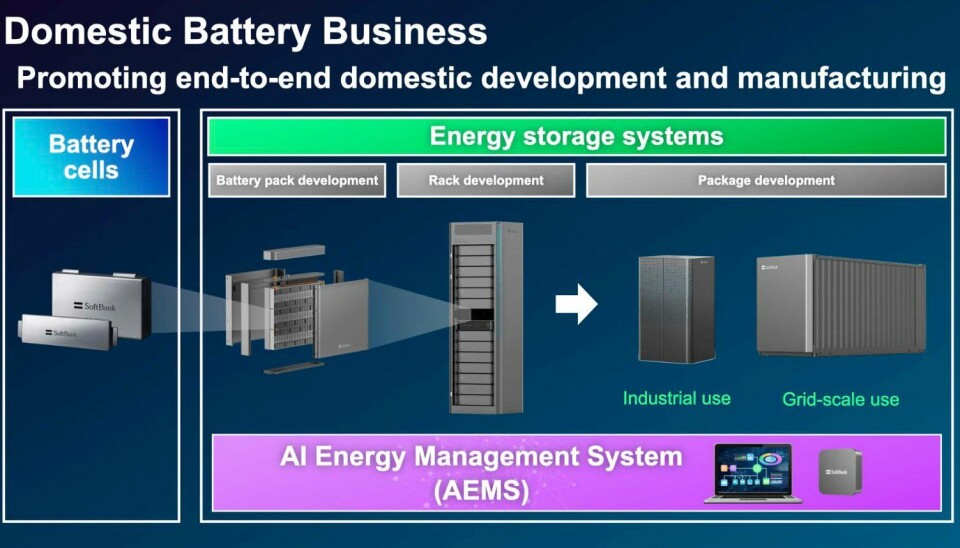
In presentation slides seen by The Register, the firm
says BESS for commercial and industrial use will have a capacity of 140
kWh to 560 kWh, while those for large-scale or grid-scale use will come in at
2,240 kWh to 5,380 kWH.
According to SoftBank, DeltaX has developed BESS capable of energy
densities exceeding 5 MWh in a standard commercial container format (a 20-foot
shipping container).
The way DeltaX packs together and connects
the battery cells in its BESS maximizes their performance, Softbank claims, and by applying
these technologies to next-generation battery cells (presumably referring to
those of Cosmos Lab), further improvements in energy storage can be achieved.
Those battery cells, which SoftBank calls Innovative batteries,
use a halogen-based material for the cathode and zinc for the anode, which it
says offers charge-discharge characteristics with minimal energy loss and energy
efficiency comparable to existing lithium-ion batteries.
As they use pure water as the electrolyte, SoftBank claims these batteries are inherently
safer and won’t catch fire, unlike lithium-ion
batteries, which have a well-documented tendency to do exactly that.
SoftBank has its finger in a number of pies when it comes to
AI projects. The firm was aiming to pump
$22.5 billion into LLM developer OpenAI before the end of 2025, and more
recently announced plans for a massive
10 GW datacenter campus on US Department of Energy (DoE) land in Ohio.
The company is also majority shareholder of chip designer
Arm, which recently revealed its first Arm-branded
datacenter processor targeting AI, and owns Ampere
Computing, which makes Arm-based server chips.
®