








Spanish cinema is flourishing, thanks in large part to a dynamic film industry bolstered by strong national and regional support, a rich and expansive creative talent and diverse natural, cultural and urban landscapes.
Those elements are on dazzling display in the seven films showcased at the Goya Goes To – New Spanish Films showcase, which runs April 16-19 in New York City, organized by Spain’s Academy of Cinematographic Arts and Sciences, its ICAA film agency and export and investment board ICEX, which has launched a drive, Where Talent Ignites – Audiovisual From Spain, to focus on Spanish talent.
The titles, all nominated or honored at this year’s Goya Awards, include Oliver Laxe’s Moroccan desert odyssey “Sirāt,” which cleaned up in the craft categories.
Decorado
Also screening is Alberto Vásquez’s black comedy “Decorado,” about a middle-aged mouse caught in an existential crisis, which won best animated film, and Albert Serra’s “Afternoons of Solitude,” an exploration of bullfighting that took the documentary feature prize..
Likewise unspooling are best picture winner “Sundays,” by Alauda Ruiz de Azúa,
The lineup also includes Manuel Gomez Pereira’s post-Civil War tragicomedy “The Dinner”; Aitor Arregi and Jose Mari Goenaga’s “Maspalomas,” about an aging gay man facing dramatic life changes; and Eva Libertad’s family drama “Deaf.”
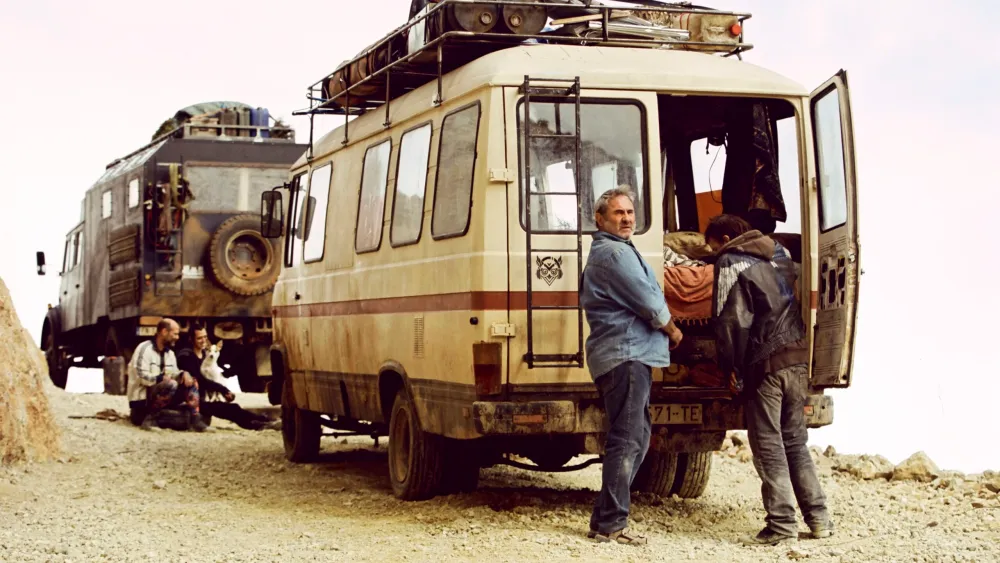
“Sirat,” which follows a man on a trek through desolate Moroccan landscape in search of his daughter, who disappeared while attending a desert rave, shot largely in the northeastern Spanish region of Aragón, where it received significant support.
“Spain is a country with a wealth of spectacular locations for filming, and it also boasts highly skilled professionals who are deeply committed, talented, and professional,” “Sirāt” producer Oriol Maymó tells Variety. “Tax incentives are helping to make this industry increasingly robust.”
“For financial and logistical reasons, we had to film in Spain,” he adds. “This is essential in order to be eligible for public funding in this country.”
The key location of Rambla de Barrachina, a spectacular gorge in the Aragón province of Teruel, bares more than just a resemblance to Morocco’s picturesque landscape.
“Aragón and Morocco form part of a network of faults linked within the same tectonic system, and some areas resemble one another because they are composed of similar geological materials: clays, gypsum, limestone and other types of rock which, in a similar climate, erode in a similar way,” Maymó explains. “This creates a visual continuity between the two countries, which we were able to make good use of in the film.”
The Aragón Film Commission provided a great deal of support to make the production in Teruel possible, he adds. “These organizations are often crucial to ensuring that film shoots can go ahead. They know the area very well and are able to understand the needs of a film shoot.”
Indeed, “Sirāt” received significant support from various public institutions in Spain, including the Institute of Cinematography and Audiovisual Arts (ICAA), the Catalan Institute of Cultural Companies (ICEC) and the Galician Agency for Cultural Industries (AGADIC), a department of the regional government of Galicia – home to director Laxe’s production shingle Filmes da Ermida. As a Spanish-French co-production, the film also secured funding from the French National Center of Cinema (CNC) as well as European coin from Eurimages and the Media program.
Going the international co-production route has its advantages, Maymó says.
“On the one hand, an international co-production allows you to secure more substantial funding; on the other, it gives the film greater reach during the distribution phase. Having France on board was a key factor. France is a country that clearly supports Oliver Laxe’s style of filmmaking and has been involved from the very beginning.”
Maymó is currently working on the development of a couple of TV series and a feature film that will soon shoot in Barcelona and Madrid, “two cities that are clearly committed to supporting the audiovisual industry,” he notes.
While a very different type of production, the animated film “Decorado,” a Spanish-Portuguese co-production, enjoyed a similar level of support from Spanish funders and the country’s creative community.
“Spain has become a very attractive territory for animation production in recent years,” says producer Ivan Miñambres of Bilbao-based animation house Uniko.
“There is a solid financing structure that combines public funding schemes with tax incentives that make projects viable.
“But beyond financing, one of the greatest strengths is the creative ecosystem,” Miñambres stresses. “There are outstanding artists and technicians, and a strong tradition of auteur animation, with filmmakers developing highly distinctive voices.
“All of this has fostered projects that take creative risks, achieve recognition, and have strong international projection.”
Produced in Galicia, Extremadura and Portugal, the production similarly tapped funding from various sources in what has become a typical financing structure in the country.
“It is quite common in Spain, especially in animation,” Miñambres notes. “Projects are usually structured by combining different regional partners. Developing ambitious projects independently is very difficult, co-production is essential.
“In the case of ‘Decorado,’ working across different regions allowed us to build a solid financial structure while also collaborating with a diverse creative network spanning Portugal, Extremadura, Galicia and the Basque Country. It’s a model that requires coordination, but makes possible projects that otherwise wouldn’t exist.”
Funding from Spain’s ICAA is key, he adds, “especially for independent and auteur-driven projects. It often acts as one of the main pillars of the financing plan.
“The tax rebate is equally crucial, as it provides financial stability and makes Spain competitive internationally. In our case, in the Basque Country, incentives can reach up to 60%, and up to 70% for projects produced in Basque. The combination of these tools is what allows many projects to move forward.”
For animation, co-producing with international partners is likewise the way to go, he adds.
“International co-production is a natural step in animation, just like regional co-production, both for financial reasons and for the creative and distribution potential it brings. We are currently developing projects with partners in Europe and Latin America.”
Uniko is currently developing the new animated feature film “Nora y la Dama de Anboto,” directed by Uxue Artetxe, described as a family film with strong international potential.
“We are co-producing with Matte in Ecuador and collaborating with an international sales agent, Pink Parrot, to position the project as strongly as possible in the global market.”

Afternoons of Solitude
Courtesy of Andergraun Films
With its intimate portrait of the young star matador Andrés Roca Rey, who embraces risk as a personal duty out of respect for tradition but also as an aesthetic challenge, “Afternoons of Solitude” is likewise well positioned for an international rollout.
Produced by Barcelona-based LaCima Producciones and Andergraun Films, Serra’s documentary tapped regional and national subsidies and similarly benefited as an international co-production with France’s Idéale Audience and Rosa Filmes in Portugal.
In addition to funding from the ICAA and ICEC, “Afternoons of Solitude” also secured early backing from key broadcasters.
“In Spain, [Catalonia’s] 3Cat was the first to invest,” says LaCima’s Pedro Palacios. “RTVE came on board a little later, but their support has been fundamental.”
The involvement of Spanish streamer Movistar Plus+ has also made it possible to reach a wider audience, Palacios adds.
France’s Arte and RTP in Portugal later joined the project.
“Internationally, I think they valued Albert’s aesthetic approach to a subject that is both aesthetic and, at the same time, unique and unknown to many: bullfighting. This convinced the networks. In France and Portugal, there’s also an audience interested in this world. Then, undoubtedly, winning the Golden Shell at San Sebastián boosted interest from networks in other countries.”
The documentary began as a very ambitious project, the producer notes. “It dealt with a controversial topic like bullfighting, and we had to overcome many prejudices that networks, platforms, and distributors might have, as well as the potential skepticism within the bullfighting world. However, when we explained the project to both groups, they were enthusiastic and readily agreed to collaborate.”
The project had the support of the Catalan government’s ICEC cultural industry agency from the beginning.
“We presented a proposal by a Catalan artist, Albert Serra, and I think they valued the film proposal beyond its subject matter. They were among the first to support it, as were ICAA and 3Cat. We felt their trust, and that helped us a great deal.”
Collaborating with French and Portuguese partners also proved vital.
“For us, it was essential to promote the film beyond our borders to make it more relevant. In France, there is a large audience interested in bullfighting, who studies and follows it. Our proposal is to unite two artistic worlds: bullfighting and Albert’s aesthetic cinema.
“France was crucial in securing the collaboration with Arte, and Portugal allowed us to collaborate with RTP. Bullfighting is experienced differently there, but it is a world that also reflects Portuguese society, and Albert’s films have an audience there as well.”
Overall, Palacios praises Spain’s audiovisual incentives but he would unsurprisingly welcome more funding.
“Spain is an attractive place to make films. Naturally, we believe that public support in terms of funding should be greater, but the tax incentive system is attractive and working.
“In my opinion, a documentary in Spain has a good chance of being produced because it has public interest, some slots on streaming platforms and TV channels, and public support. Even so, it’s not easy to get it off the ground. It’s very difficult to get a film released in theaters due to competition with fiction films, and distributors aren’t as keen to include them in their catalogs, but if you have an interesting project, you have to find a place for it.”
LaCima is currently finalizing post-production on Luis E. Parés’s documentary, “Dancing with Death,” and José del Río’s “Edgar Neville: The Spaniard Who Came from Hollywood.”
The company is also preparing to film the documentary “Carapirú” by Pablo Vidal and Aner Etxebarria, a co-production with Brazil.