





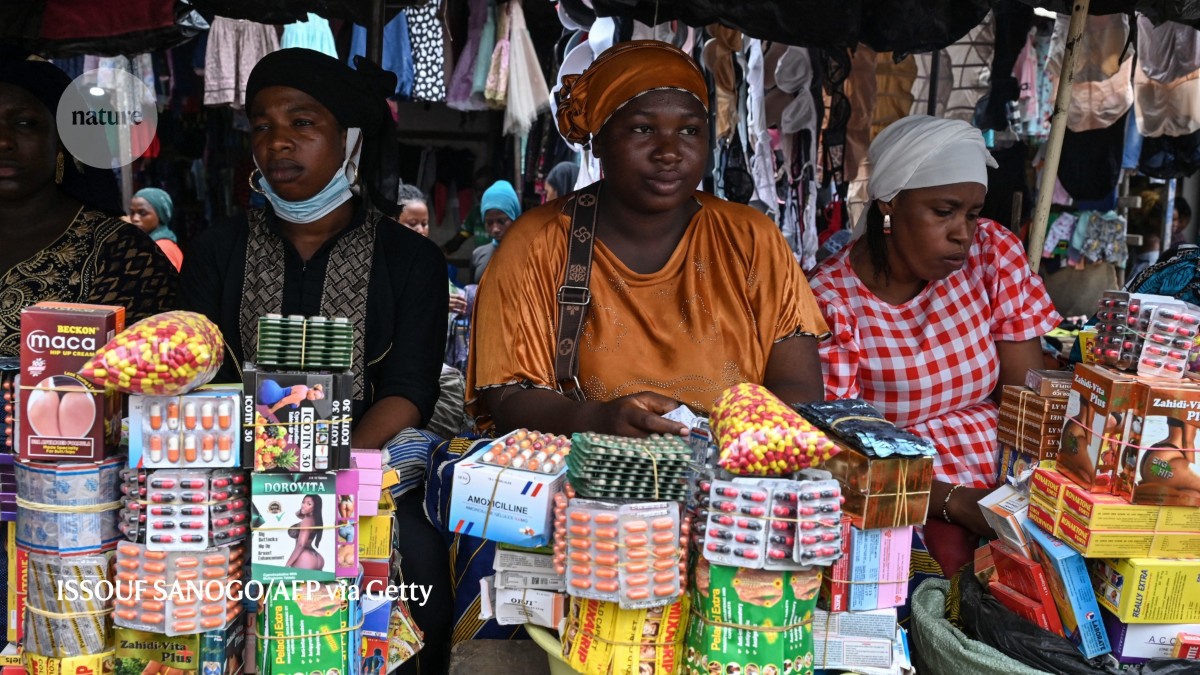
Street vendors sell medicines at a market in Abobo, Côte d’Ivoire. Credit: Issouf Sanogo/AFP via Getty
At Ghana’s biggest hospital, even the strongest antibiotics are starting to fail. A big part of the reason is the rampant overprescription and overuse of these drugs in the West African country of 35 million people.
Because many Ghanaians lack access to physicians, those who fall ill often end up buying antibiotics from unauthorized sellers instead. “We have people who go around carrying all sorts of things, who would mix them as concoctions and give them to patients who have no clue what is going on,” explains Antoinette Bediako-Bowan, a surgeon at the Korle Bu Teaching Hospital in Accra. By the time a person presents at the hospital, “they really have taken quite a number of antibiotics”, Bediako-Bowan says. Such liberal use of the drugs gives bacteria the opportunity to adapt, driving resistance.
Nature Outlook: Antimicrobial resistance
The World Health Organization (WHO) divides antibiotics into three categories under its Access, Watch and Reserve (AWaRe) system. Access antibiotics are used against common infections, watch antibiotics can fight a wider range of bacteria and reserve antibiotics are held back for the most dangerous pathogens.
Bediako-Bowan says that in the hospital where she works, around 60% of patients have infections that can resist common access antibiotics, such as penicillins and first-generation cephalosporins. More worryingly, she says, around 4% of these are resistant to carbapenems, which are on the watch and reserve lists. Carbapenems are often the strongest option available in Bediako-Bowan’s hospital, so “even a small percentage is a big thing”.
In 2023, according to the WHO, one in six laboratory-confirmed bacterial infections worldwide were caused by bacteria that are resistant to antibiotics1. The burden of antibiotic resistance is highest in low- and middle-income countries (LMICs), and growing rapidly. Between 2018 and 2023, resistance to imipenem — a carbapenem antibiotic — in Acinetobacter bacteria grew faster in the eastern Mediterranean and in southeast Asia than it did anywhere else. These Gram-negative bacteria (a typing that also applies to other stubborn foes such as Escherichia coli and Klebsiella pneumoniae) are a common cause of hospital-acquired bloodstream infections.
“When resistance to carbapenems is encountered, treatment options for Gram-negative bacterial pathogens are often limited to antibiotics in the AWaRe reserve group, which are frequently unaffordable, more toxic, inconsistently available and require diagnostic confirmation that is rarely feasible in resource-limited settings,” says Silvia Bertagnolio, head of the WHO’s antimicrobial resistance surveillance, evidence and laboratory strengthening unit in Geneva, Switzerland.
Deaths attributable to antimicrobial resistance occur around the world (see ‘A global threat’). But they are close to twice as common in West Africa, at around 20 per 100,000 people, as they are in high-income countries of North America and Europe, according to data from the Institute for Health Metrics and Evaluation at the University of Washington in Seattle.
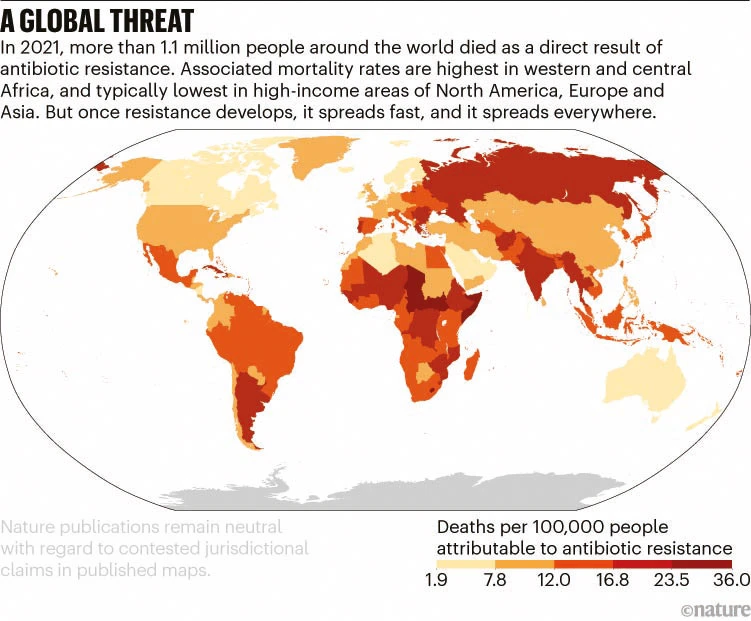
Source: Inst. for Health Metrics and Evaluation
Antibiotic overuse is driven by unlicensed street sellers, improperly trained pharmacists and physicians who overprescribe medicines to keep their patients happy, as well as by a lack of access to diagnostic tests. Global-health specialists are trying to tackle the problems through a variety of means, including education programmes, smartphone apps and even investigations involving undercover patients.
Market traders
One problem in low-resource settings is that street sellers often hand out antibiotics that are on the WHO’s watch list when common antibiotics would do — a practice that increases the chances of bacteria building up resistance.
The vast majority of common infections can be treated with amoxicillin or amoxicillin clavulanate (the latter contains clavulanic acid to overcome resistance to amoxicillin alone). “You only need to really think about two or three antibiotics for infections out of hospitals in most countries,” says Marc Mendelson, a specialist in antibiotic resistance at the University of Cape Town, South Africa. But “if you go to a market-stall seller, they’ll have there multiple different antibiotics, some with combinations of antibiotics in each tablet”.
Countries such as Nigeria and Uganda have called for the strict implementation of laws banning the sale of antibiotics without a prescription, as part of their national antimicrobial-resistance plans. However, Mendelson does not want to make it difficult for people to access antibiotics when they really need them. He contends that the best way to tackle the problem would be for regulators to work with informal drug sellers, as opposed to trying to ban them, while also educating the public. “We vilify these providers as part of the problem and try to get rid of them, instead of actually trying to understand how to make them part of the solution,” he says.
One example of such an approach is an app called Antibiotic Bandhu (meaning friend of antibiotics in Bengali), which was among the winners of the 2024 Trinity Challenge on Antimicrobial Resistance, organized by a charity at Trinity College Cambridge, UK. The app, developed by a team led by Meenakshi Gautham at the London School of Hygiene and Tropical Medicine, gives informal rural health-care providers in India access to information about antimicrobial resistance and helps them to decide when to give out antibiotics.
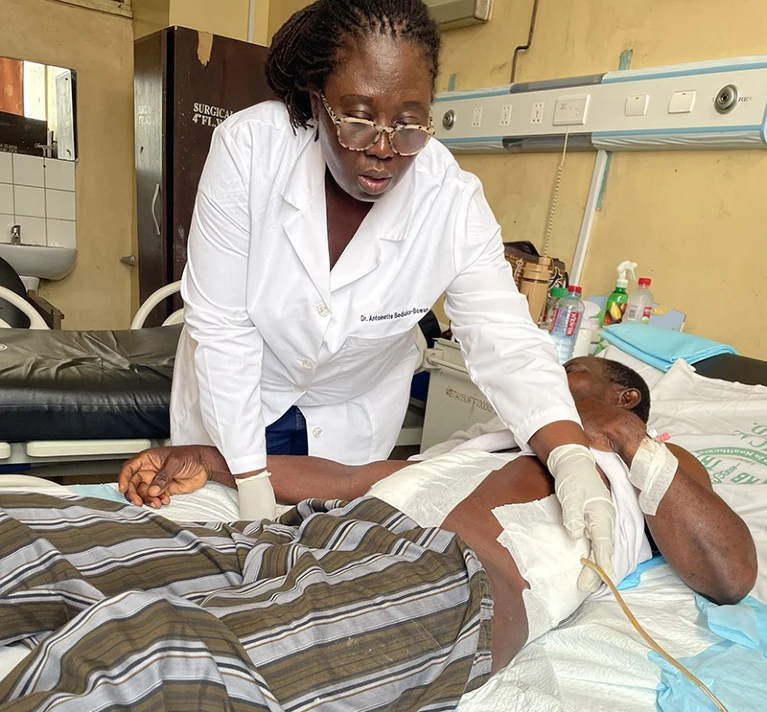
Surgeon Antoinette Bediako-Bowan examines a patient who developed a post-surgery infection.Credit: Narious Naalane
Giorgia Sulis, an infectious-disease epidemiologist at the University of Ottawa, is working on a project in Nigeria aimed at developing training and guidelines for pharmacists and medicine vendors. The training packages are designed for “those left outside of government interventions most of the time”, Sulis says, and would include “non-monetary incentives”, such as local recognition to encourage sellers to avoid giving out antibiotics unnecessarily.
The idea is to focus on four ailments for which antibiotics are known to be overused, and then send out ‘mystery shoppers’ who pretend to have the condition to see whether vendors who have had training still give them antibiotics. Sulis hopes that the training can be sustained in the long term. After all, she says, “it’s not something that requires major infrastructure or resources to be kept in place”.
Force of habit
Overprescription isn’t just down to street sellers. Mylene Lagarde, a specialist in health economics at the London School of Economics and Political Science, and health-policy researcher Duane Blaauw at the University of the Witwatersrand in Johannesburg, recruited healthy people and asked them to say they had the symptoms of a viral respiratory infection — which can’t be treated using antibiotics — and sent them to clinics in South Africa to see how many of them were given antibiotics2.
Practitioners recommended antibiotics in a staggering 73% of the 201 visits. In 12% of consultations, they strayed even further from the correct path and suggested an antibiotic from the WHO’s watch list. And this was in a country in which the medical workforce is generally considered to be well trained, Lagarde says. “It definitely did surprise us.”
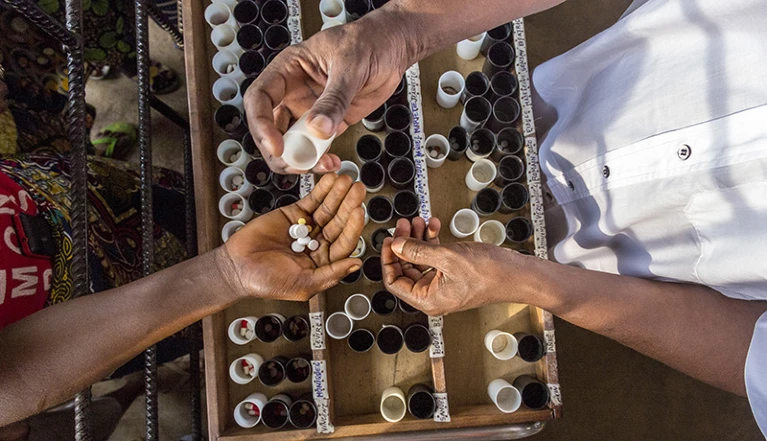
Pharmacists need training and clear guidelines for appropriate dispensing of antibiotics.Credit: Andrew Esiebo/Panos Pictures
Follow-up interviews revealed that most public-sector nurses who gave out antibiotics did so because they wrongly thought that the drugs would speed up recovery. However, in the private sector, in which patients are more likely to see a physician than a nurse, the interviews showed that overprescription was a more deliberate choice. Most private physicians feared that their patients might not return unless they were given antibiotics.
Lagarde thinks that prescribing antibiotics is an entrenched habit among physicians. In unpublished work by her team, undercover patients specifically told physicians that they did not want antibiotics unless necessary. Even then, almost half were still recommended antibiotics unnecessarily, Lagarde says.
Taking action
One of the reasons that physicians in low-resource settings overprescribe antibiotics is that they lack access to tests that would help them to decide whether an infection is bacterial or viral, or access to diagnostic facilities that could indicate which drug would work best.
This means that they are “flying blind”, according to Idemudia Otaigbe, an infectious-disease specialist at Babcock University Teaching Hospital in Ilishan Remo, Nigeria. “The doctor will try this antibiotic; if it doesn’t work he switches to another antibiotic — without laboratory tests done in between,” he says.
Yet behaviours can change once diagnostic tests are introduced. Sujith Chandy, the former executive director of the International Centre for Antimicrobial Resistance Solutions (ICARS) in Copenhagen, gives Kyrgyzstan as an example. In the country, a lack of testing labs and experienced staff was leading to antibiotics being prescribed for respiratory infections in children — despite the fact that most are viral.
ICARS funded a study showing that a point-of-care test checking for levels of what’s known as a C-reactive Protein (CRP) led to a significant reduction in antibiotic use3. “Anecdotally, following completion of the study, caregivers were requesting CRP testing,” says Chandy.
In many countries, diagnostic testing forms part of plans to tackle antimicrobial resistance, along with measures such as training, education and surveillance. Yet according to Sulis, many of the measures outlined in countries’ action plans have not been implemented. “Usually national action plans include regulatory actions,” she says. “Most of the time it’s only on paper.”
Otaigbe thinks that visibility is part of the issue. “Antimicrobial resistance is like a shadow,” he says. Unlike diseases such as Ebola and Lassa fever, antimicrobial resistance does not have clear symptoms that people can easily understand. Curtailing the rise of resistance, not only in low-resource settings but globally, will require antibiotics to be developed. But this must happen alongside improvements to diagnostics and understanding — among policymakers, practitioners and patients alike.