






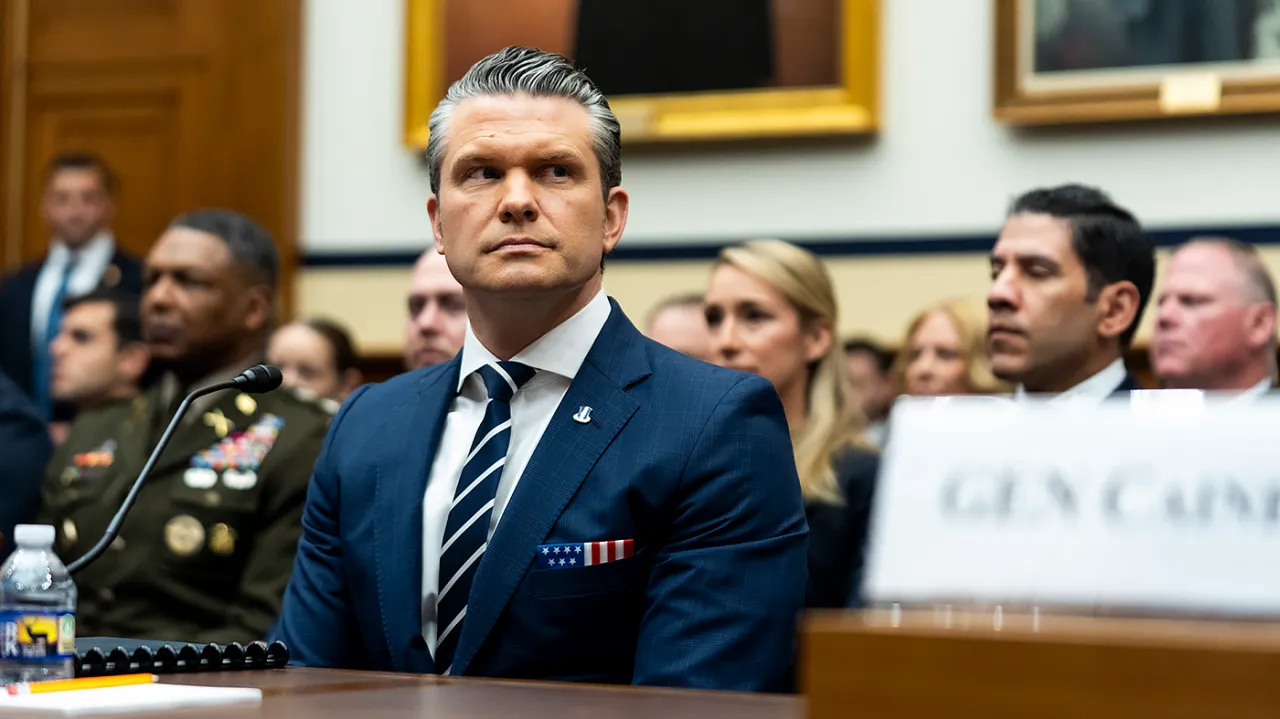

House Democrats came out firing during Defense Secretary Pete Hegseth’s first hearing since the Iran war started, peppering the Pentagon chief with questions on his characterization of the conflict and recent high-profile firings of top military officials.
Their Republican counterparts were notably conflict-averse, apart from a couple of supportive comments toward Gen. Randy Goerge, the accomplished Army chief of staff sacked by Hegseth earlier this month.
Hegseth got the hearing off to a combative start when he said, “the biggest adversary we face at this point are the reckless, feckless and defeatist words of congressional Democrats and some Republicans.”
That tone continued throughout his exchanges with Democrats, who accused him of being incompetent, a yes-man to President Trump and unfit to serve in such an important role.
Here are six key takeaways from the six-hour hearing at the House Armed Services Committee:
Republicans keep it friendly
In the weeks leading up to Wednesday’s hearing, Republican frustration toward Hegseth and the Trump administration’s handling of the Iran war appeared to be mounting.
Following a classified House Armed Services Committee briefing last month, Committee Chair Mike Rogers (R-Ala.) was among the members who complained about the lack of answers on strategy and potential troop movements.
But if the committee’s GOP members were still frustrated, they mostly didn’t show it on Wednesday.
Rep. Mike Turner (R-Ohio), who ripped Pentagon policy chief Elbridge Colby during a hearing last month, took a more indirect tack this time around, directing most of his questions to Joint Chiefs Chair Gen. Dan Caine, who appeared alongside Hegseth.
Turner asked Caine to talk about the importance of America’s allies in the war against Iran, apparently seeking to draw a contrast with Hegseth, who has railed against allies for not joining America’s war.
Rep. Don Bacon (R-Neb.), one of the few House Republicans who has publicly said he might support a war powers resolution if the Iran conflict extends beyond 60 days, was the most critical GOP committee member.
He expressed concern about the firings of service chiefs, specifically referencing ousted Coast Guard Commandant Adm. Linda Fagan. And he noted the “huge bipartisan majority” that supported both George and former Navy Secretary John Phelan, who was sacked by Hegseth last week.
“I would just point out it may be constitutionally right — you have the constitutional right to do these things — but it doesn’t make it right or wise,” he said.
Hegseth grilled on Gen. George’s firing
Hegseth was pressed by multiple lawmakers over his order to oust George, who spent more than four decades in the Army.
“Why was he fired?” asked Rep. Chrissy Houlahan (D-Pa.).
“Ultimately, out of respect to these officers. We don’t reveal it. However, I will note it’s very difficult to change the culture of a department that has been destroyed by the wrong perspectives,” Hegseth responded.
“We’ve gotten rid of many general officers in this administration because we need new leadership,” Hegseth told the Pennsylvania Democrat.
“You have no way of explaining why you fired one of the most decorated and remarkable men who we needed new leadership, and your answer is a very immature way of responding to my request,” Houlahan told the Pentagon chief.
The displeasure about George’s removal was voiced on the other side of the aisle too, by both Bacon and Rep. Austin Scott (R-Ga.).
“I do want you to know I disagree with the firing” of George, Scott said.
“I sent you a letter. I hope you’ll [at it]. I look forward to seeing the responses on that,” added Scott, who earlier this month said George’s removal will have a chilling effect on the military.
George’s firing came amid an escalating turf war between Hegseth and Army Secretary Dan Driscoll, a close ally of Vice President Vance.
Rep. Derek Tran (D-Calif.) asked if Hegseth and Driscoll have a “good working” relationship — to which Hegseth said “I appreciate the work he’s doing for” for the Army.
“Would you agree that Secretary Driscoll is doing a great job,” Tran then asked.
“I appreciate the work that the Secretary is doing and made the personnel change based on the chief of the army,” Hegseth said in response.
Rep. Jennifer Kiggans (R-Va.) asked Hegseth about the firing of Phelan, which was linked to Trump’s frustrations about the pace of shipbuilding.
In response, Hegseth thanked Phelan, a Trump donor and art collector, for his service, but noted that “ultimately, it was time for a new leadership and a new direction as far as running fast toward those objectives and so we made a change.”
Rep. Nancy Mace (R-S.C.) praised Hegseth for the string of firings at the Pentagon, arguing “there are people there that are getting in your way. They need to go.”
Hegseth defends cost of Iran war
Hegseth repeatedly defended the cost of the U.S. war with Iran, emphasizing that the short-term pain was worth keeping a nuclear weapon out of Iran’s hands.
“President Trump, unlike other president, has had the courage to ensure Iran never gets a nuclear weapon, and he’s ironclad in that we had the best negotiator in the world driving that deal,” Hegseth said during his opening remarks.
The cost of war has now surpassed $25 billion, according to the Pentagon’s acting chief financial officer, Jules Hurst III.
Several Democrats zeroed in on the cost of the conflict in light of Iran’s decision to close the Strait of Hormuz, causing gas prices to shoot up.
“Do you know how much it will cost Americans in terms of their increased cost in gas and food over the next year because of Iran?” Rep. Ro Khanna (D-Calif.) asked.
Hegseth said it was a “gotcha” question, asking the progressive Democrat, “What would you pay to ensure Iran does not get a nuclear bomb?”
Khanna then cited estimates that the conflict could cost about $631 billion to the U.S. economy, or around $5,000 per household.
“Will you acknowledge that there is an economic cost to the American people for doing what you believe is necessary to make Iran denuclear?” Khanna asked.
“We have an incredible economic team that’s managing this better than what the previous administration,” Hegseth said, before the California Democrat cut him off.
“You don’t know what we paid in terms of the missiles that hit the Iranian school. You don’t know what we’re paying in terms of gas. You don’t know what we’re paying in terms of food. Your $25 billion number is totally off,” Khanna said.
Rep. Seth Moulton (D-Mass.) said even that $25 billion figure would cost each American household an extra $600.
“The American taxpayers out there, my constituents, some of the constituents you wanted to represent in Minnesota, I’m just wondering if they have an extra 600 bucks lying around to pay for your war,” Moulton said, alluding to Hegseth’s unsuccessful Senate run in 2012.
Rep. Herb Conaway (D-N.J.) said the administration has “failed to transparently tell the Congress or the American people what the costs of the war are, and why we are at war, and expects Americans to keep footing the bill.”
Ryan goes hard on Kuwait strike
Rep. Pat Ryan (D-N.Y.) grilled Hegseth over an attack early in the Iran war that killed six service members working out of a makeshift office space in Kuwait’s port city of Shuaiba.
Ryan read from a CBS News report in which survivors of that attack described the grisly scene afterward. One of the injured soldiers told CBS the unit was “unprepared” for a strike.
“Before the war started, there was clear intelligence Shuaiba was high on Iran’s target list. Internal analysis had said the site was indefensible from aerial attack and should not be used. Yet you sent our soldiers from the 103rd Sustainment Command there anyway. Is that true or false?” Ryan asked.
“We took proactive measures from the beginning to ensure force protection was not compromised throughout the theater,” Hegseth said.
“Officers on the ground knew our troops were vulnerable. In fact, they requested additional force protection. Did they receive it?” Ryan asked.
“Whenever humanly possible, counter-UAS [unmanned aircraft systems] are always made available,” Hegseth responded.
“I’ll save you the time, they did not,” Ryan cut in. “In fact, when asked to describe the base’s defense, one survivor who’s come forward from the unit said, quote, ‘I mean, I would put it in the none category from a drone defense capability.’”
As Hegseth tried to describe how the U.S. had moved forces in advance of the war, Ryan repeatedly yelled “stop.”
“Just because you yell doesn’t make you right,” Hegseth said.
“I’m reclaiming my time on behalf of these survivors,” Ryan said. “You just said what they said is a falsehood.”
Ukraine funds released after McConnell op-ed
Hegseth said during the Wednesday hearing that the $400 million in Ukraine aid has been released on Tuesday, shortly following a scathing op-ed from Sen. Mitch McConnell (R-Ky.), who now heads the powerful Senate Appropriations Subcommittee on Defense.
The Pentagon chief, during questioning by Rep. Sarah Elfreth (D-Md.), said the Pentagon “recognizes that $400 million was allocated for European capacity building, and as of yesterday, it has been released.”
“Not under contract, but released to be put under contract,” Hurst, the Pentagon’s CFO, said.
“When will it actually be on the ground in Ukraine?” Elfreth asked.
“That depends on what they buy with the money. We’re going to take the advice of the EUCOM [U.S. European Command] commanders. We employ those funds for best use,” Hurst told Elfreth.
McConnell wrote in The Washington Post that the Ukraine aid, which was passed by Congress, was “collecting dust” at the Pentagon. Adding that “when Senate appropriators have sought an explanation from the department’s policy shop, led by Undersecretary Elbridge Colby, they’ve been stonewalled.”
The $900 billion National Defense Authorization Act passed by Congress for fiscal year 2026 autorized $400 million for Ukraine this year and $400 million in 2027 through the Ukraine Security Assistance Initiative.
Hegseth offered a rare show of support for Ukraine when asked by Rep. Adam Smith (D-Wash.), the ranking member of the panel, about its war against Russia.
“I think the Ukrainians have shown great courage, and I appreciate that Europe is now paying any weapons that we provide,” Hegseth said.
Crow puts spotlight on Tim Parlatore
Rep. Jason Crow (D-Colo.) focused his questions on Tim Parlatore, an attorney and special adviser to Hegseth.
Hegseth said Parlatore was a good friend and sometimes sits in on Pentagon meetings, but claimed little knowledge about his private practice or work for the Defense Department.
Hegseth told Crow he does not know whether Parlatore maintains an office in the Pentagon or what level of security clearance he has.
“I don’t know what you’re getting to, but Tim is a fantastic,” Hegseth said.
“Clearly, you’re concerned about my line of questioning, aren’t you, Mr. Secretary, because you know where it’s going, don’t you?” Crow said later.
He asked Hegseth if Parlatore represented foreign clients in his private law practice. Hegseth said he didn’t know.
Crow then asked if Parlatore represents senior military officers who are under consideration for a promotion by Hegseth’s office.
“No, I’m the one that makes decisions,” Hegseth said.
Asked for comment, Parlatore said Crow needs new staffers.
“In addition to several misstatements of fact, Rep. Crow’s line of questioning demonstrated a concerning lack of understanding of how the military reserves work,” he wrote in an email to The Hill.
Copyright 2026 Nexstar Media Inc. All rights reserved. This material may not be published, broadcast, rewritten, or redistributed.