








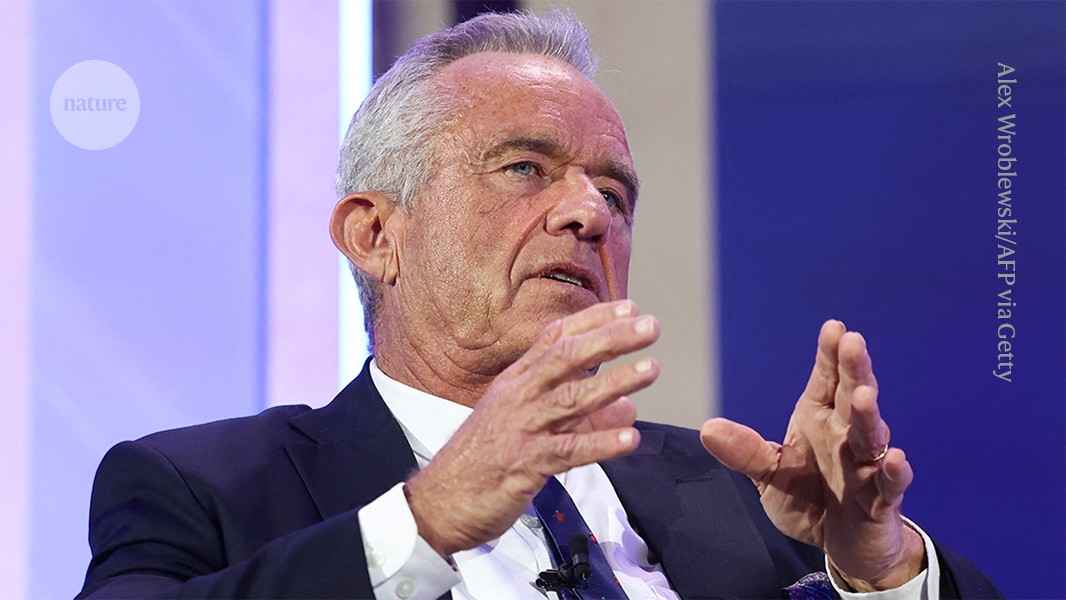
US health secretary Robert F. Kennedy Jr has been critical of antidepressant drugs.Credit: Alex Wroblewski/AFP via Getty
Overdiagnosis, overmedication and withdrawal: that’s the bleak picture of US mental-health treatment painted at a Make America Healthy Again (MAHA) wellness summit attended by US health secretary Robert F. Kennedy Jr, the driving force behind the MAHA movement.
The summit, which was held on 4 May in Washington DC, focused on what the group argues is the widespread overuse of drugs to treat mental-health conditions. Some speakers described agonizing withdrawal symptoms when they tried to wean off antidepressants. Others attacked what they characterized as an overdiagnosis of mental-health disorders in children.

Psychedelics and immortality: Nature went to a health summit starring RFK and JD Vance
“Our goal is straightforward: to reduce unnecessary dependence on medication, to improve patient outcomes and to return control to the patients,” Kennedy said at the summit, which was hosted by the MAHA Institute, a think tank in Washington DC that champions Kennedy’s work. “This is how we’re going to make America healthy again.”
The MAHA movement focuses on chronic disease, which it links to factors such as poor diet and exposure to environmental toxins. Its adherents have also taken aim at the pharmaceutical industry, and some are wary of vaccines and conventional drugs. Even so, Kennedy and others at the summit noted that medication remains an important component of treatment for some people with mental-health disorders.
Nature asked researchers to comment on MAHA advocates’ latest claims about mental-health treatment.
Are US doctors overprescribing mental-health medication?
On the day of the summit, the US Department of Health and Human Services (HHS), which Kennedy heads, released a letter to health-care providers urging them to consider alternatives to medication when treating mental-health conditions. One in six adults in the United States takes an antidepressant, Kennedy said at the summit, and one in ten children uses prescription medication for their mental health. “That’s not a marginal issue,” Kennedy said. “This is a system-level pattern.”
Or, put simply: America has “a pill culture,” says Timothy Westlake, chief of staff at the US Substance Abuse and Mental Health Services Administration in Rockville, Maryland.

The ‘bible for psychiatry’ is getting a rewrite: your guide to the next DSM
But Timothy Wilens, a clinical psychiatrist and president-elect of the American Academy of Child and Adolescent Psychiatry, says that most practitioners are careful and consider other options before handing over a prescription. “They’re trying to make things better for kids,” he says, and medication can be part of treatment.
The true problems, he says, are “underdiagnosis and undertreatment”. Wilens notes that as a result of uneven access to health care in the United States, at least half of US children with mental-health conditions are not diagnosed and therefore not treated with medication or anything else.
“Having good medication, diagnostics and treatment available: that’s more the public-health crisis,” he says.
Asked about Wilens’s comments, HHS press secretary Emily Hilliard said in a statement: “The overmedicalization of American children, characterized by escalating prescription rates, unwarranted interventions and declining health outcomes, signals a critical policy failure.”
Is attention deficit hyperactivity disorder a ‘gateway diagnosis’?
Some speakers at the summit expressed concerns about treatment for young children diagnosed with attention deficit hyperactivity disorder (ADHD). An estimated seven million children in the United States have been diagnosed with the condition, which is sometimes treated with stimulants. There has long been a debate as to whether some diagnoses of ADHD have pathologized normal childhood behaviour.

ADHD is on the rise, but why?
After an initial ADHD diagnosis, many children go on to be treated for other conditions, such as depression and behavioural disorders — a situation that Gretchen Watson, a speaker at the summit and a clinical psychologist with an academic affiliation at the University of South Carolina in Columbia, sees as a sign of overreach. “It’s now evident, with the benefit of hindsight, that ADHD is a gateway diagnosis that opened the door to the medicalization of childhood and to drug cocktails for children,” she said at the event.