





US President Donald Trump angrily rejected Tehran’s response to a US peace proposal as “totally unacceptable,” while Iranian state media listed what appeared to be no easing of the Islamic republic’s demands, including compensation for war damages and control over the Strait of Hormuz.
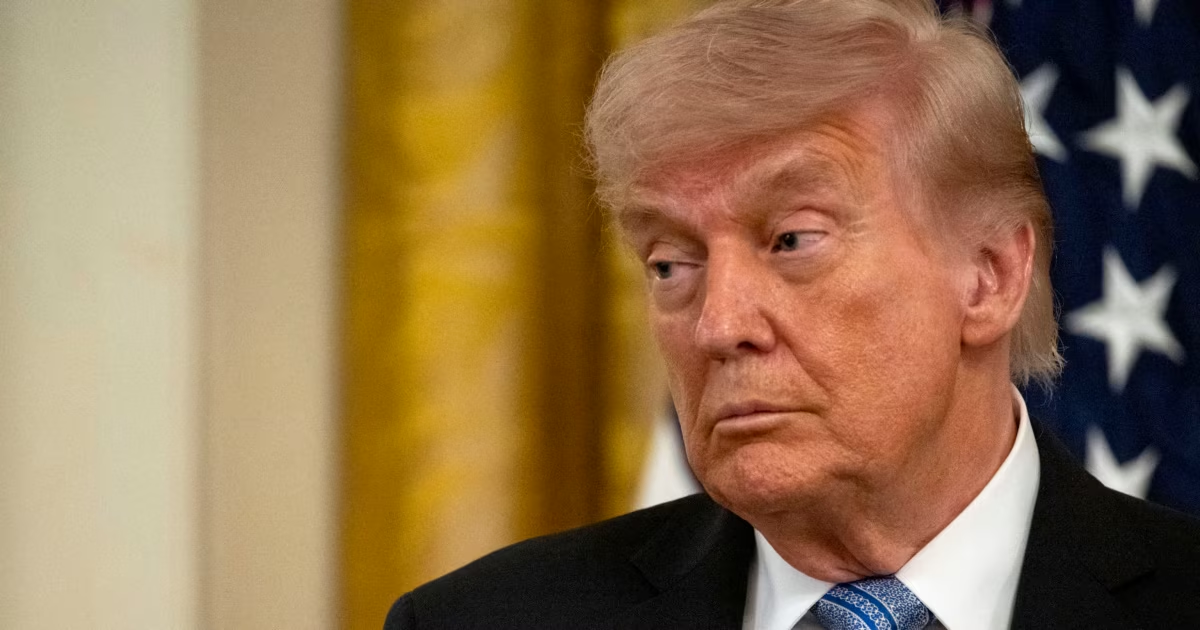
“I have just read the response from Iran’s so-called “Representatives.” I don’t like it — TOTALLY UNACCEPTABLE!” he wrote in a terse statement on Truth Social on May 10, without indicating if it would bring the return of air strikes over Iran.
The posting came shortly after Iran’s semiofficial Tasnim news agency laid out what it said were the terms of Tehran’s response, saying demands include the lifting of long-standing sanctions against Iran, the end of the US naval blockade, and guarantees against further attacks.
Tasnim, which is close to the hard-line Islamic Revolutionary Guards Corps (IRGC), reported that Tehran’s proposal also called for an end to fighting on “all fronts,” including Lebanon as well as in Iran.
Following Trump’s rejection, Iranian state media reported that the regime’s demands also included the need for the US to pay compensation for war damages and that Tehran’s control of the Strait of Hormuz be officially recognized, something the global community has rejected.
State media said that accepting the US conditions would amount to Iran’s “surrender” to what it called “excessive demands.”
Many reports have suggested the US plan is set out in a one-page memorandum that called for an end to fighting and the unblocking of the Strait of Hormuz but which left other key issues — including Iran’s right to enrich uranium — until later.
Earlier in the day, Trump had angrily lashed out at his predecessors for their policies toward Iran, saying the Middle East nation for 47 years “has been ‘tapping’ us along, keeping us waiting, killing our people with their roadside bombs, destroying protests, and recently wiping out 42,000 innocent, unarmed protestors, and laughing at our now GREAT AGAIN Country.”
“They will be laughing no longer!” he wrote.
Trump has taken a dual line in public statements, stressing the possibility of a diplomatic solution to the war while alternatively threatening massive new air strikes on Iran’s energy and power infrastructure.
In an interview with journalist Sharyl Attkisson broadcast on May 10, Trump said that American military operations against Iran may not be over, suggesting the US could still target additional sites if necessary.
Asked whether combat operations involving Iran had concluded, Trump responded: “No, I didn’t say that. I said they were defeated, but that doesn’t mean they’re done. We could go in for another two weeks and hit every single target.”
Trump added that US and Israeli strikes had already hit “probably 70 percent” of the intended targets.
“We have other targets that we could conceivably hit,” he said. “But even if we don’t, it will take years for them to rebuild.”
Trump also addressed Iran’s enriched uranium stockpiles, saying the United States was monitoring the sites closely.
“We have it under surveillance,” he said, adding that US space-based monitoring capabilities were tracking activity around the facilities.
Iran has repeatedly rejected proposals that would require it to transfer its stockpile of enriched uranium to the United States.