







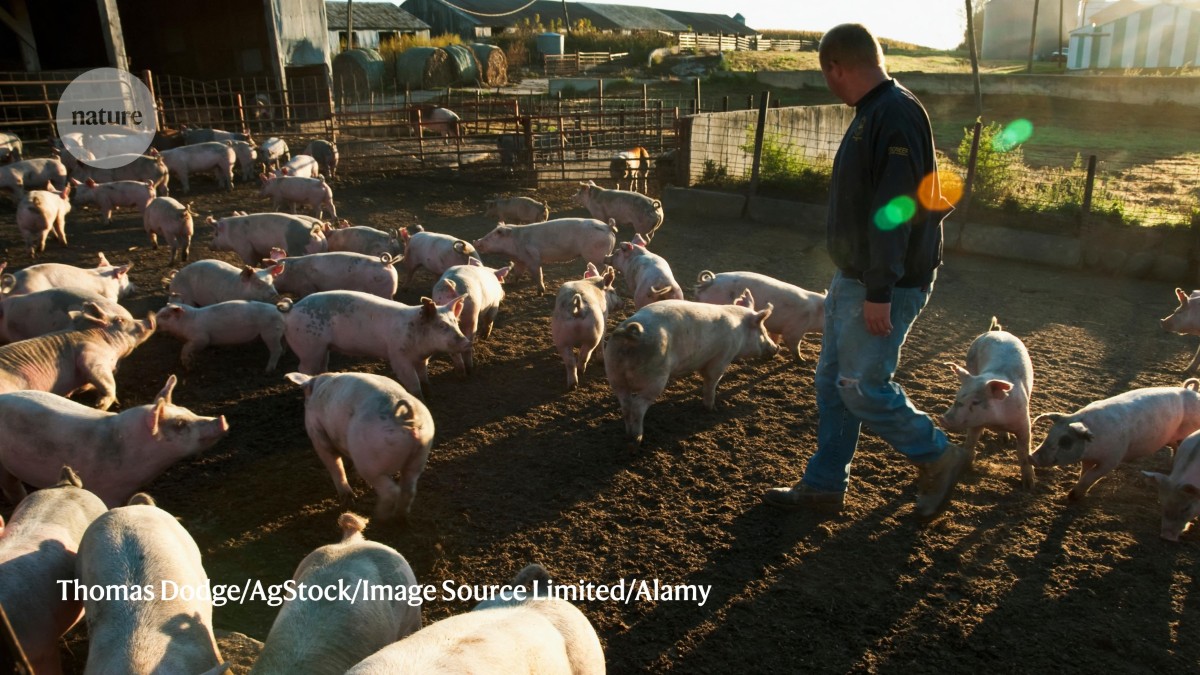
People who live in close proximity to pig farms are more likely to pick up antibiotic-resistant infections than are those who live farther away.Credit: Thomas Dodge/AgStock/Image Source Limited/Alamy
Livestock farms are producing more than they intend to. As well as raising chickens, cows and pigs, these farms are also unwittingly rearing dangerous microorganisms that are resistant to antibiotics. These microbes pose a threat not just to farmers’ livelihoods, but also to the health of farm workers and people in their wider community.
Public reaction to the use of antibiotics in agriculture has often focused on the welfare of animals and the people who consume their meat. Many health-conscious shoppers now try to avoid meat from animals that have been given antibiotics, even though there is conflicting data about whether this consumption presents a risk to humans. What is becoming clear, however, is that antibiotics endanger the health of people who work on farms.
Nature Outlook: Antimicrobial resistance
Liberal use of antimicrobial drugs on farms — including those that produce fruit rather than meat — can result in pathogens becoming impervious to these essential medications. These drug-resistant organisms can cause infections in farm workers that are difficult to treat and can spread to other people. This situation has raised concerns among workers’ rights groups and scientists studying the rise of antimicrobial resistance (AMR). “The use of antimicrobial drugs, in the quantities used in food animal production, poses a risk to human health,” says Christopher Heaney, an infectious-disease researcher at Johns Hopkins Bloomberg School of Public Health in Baltimore, Maryland. “Workers are at the front line of that.”
One of the earliest connections between antibiotic use and drug-resistant microbes was made by scientists studying methicillin-resistant Staphylococcus aureus (MRSA) bacteria. MRSA is highly contagious and spreads in hospitals and nursing homes worldwide. It typically infects the skin, causing varying degrees of tissue damage. However, if it reaches the blood, it can have a mortality rate of between 20% and 50%.
The dominant type of livestock-associated MRSA, called CC398, is becoming increasingly prevalent on farms. In Denmark, where surveillance of antimicrobial-resistant microbes in agriculture is particularly good, the proportion of pig farms with MRSA-positive herds jumped from less than 5% in 2008 to 90% in 20181.
CC398 is also increasingly infecting people — including those who do not have direct contact with farm animals. People who live in close proximity to farms are at greatest risk, but others are also affected. An analysis published last year reported that people living between 1.25 kilometres and 6.25 kilometres from pig farms in Denmark picked up infections when the wind blew from farms towards their communities2.
Because the threat posed by AMR in agriculture is invisible, it is often overlooked. Qamar Saeed, a microbiologist at Bahauddin Zakariya University in Multan, Pakistan, contrasts this threat with chemical hazards found in smoke from a fire. “People know there is smoke, and they get uncomfortable around it,” he says. “But antimicrobial resistance, it’s a silent hazard.”
Evidence of the scale of the hazard has nonetheless been mounting over the past couple of decades. One study published in 2007 found that people who worked on intensive poultry farms were 32 times more likely to be infected with an antibiotic-resistant strain of Escherichia coli — a leading cause of urinary tract infections (UTIs) — than were members of the general public3. And a 2022 study found a higher rate of antibiotic-resistant bacteria in sewage waste from poultry farm workers than in sewage from household toilets4.
The impact of AMR spread from farms to people is becoming harder to ignore. In September, scientists studying people who worked at two beef slaughterhouses in Turkey found an antibiotic-resistant variant of E. coli on the hands of one-quarter of workers5. One month later, a study of bacterial isolates from more than 23,000 people with UTIs in Southern California estimated that 18% of cases were caused by antibiotic-resistant microbes that could be traced back to meat sold in supermarkets6.
Given these stark findings, researchers and workers’ associations are calling on public officials to strengthen the surveillance of AMR in agriculture and to institute more protections against resistant bacteria for labourers. “The farm environment acts as a reservoir for resistant strains,” Saeed says. “The situation would improve if there were strict regulatory oversights.”
Surveillance for safety
Denmark is one of the world’s largest pork producers, and in 1995 it became the first country to build a robust surveillance system to monitor AMR in animals, food and people. Data from the programme have led to restrictions and even outright bans on the use of several antimicrobial agents in livestock in countries on the continent. The European Union now regulates antimicrobial use through veterinary prescriptions, and requires member states to report on the use of these drugs for livestock farming.
In other parts of the world, AMR monitoring has proved more challenging. Levels of surveillance in the United States, for example, vary from state to state. China has instituted prevention measures that restrict the use of important antibiotics in agriculture, but some researchers have noted a need to improve knowledge of AMR and the government’s policies in the country’s rural areas.
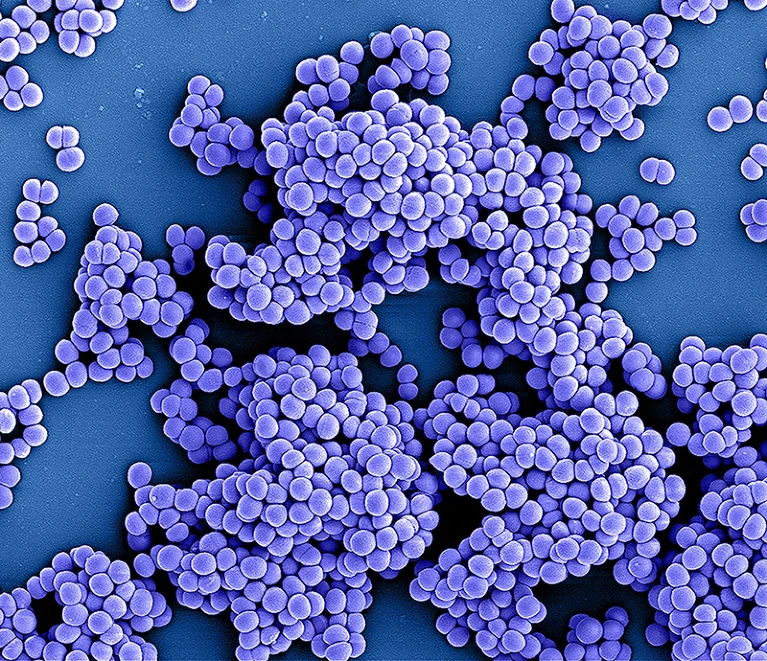
Methicillin-resistant Staphylococcus aureus bacteria are highly contagious. Credit: NIAID/Science Photo Library
At the global level, in 2024, the Food and Agriculture Organization (FAO) of the United Nations launched InFARM: a worldwide information system to support national programmes that monitor AMR in animals and food. The hope is that InFARM will help to bolster efforts to tally trends in AMR and keep tabs on all the data.
Thanks to advances in genetic sequencing, there are now many ways to detect the presence of drug-resistant microbes in water systems and see if they can be traced back to farms, says Heaney. Academics are developing ways to identify resistance in samples of surface waters, creeks, lakes, streams and beaches, he explains. These methods can detect not only the presence of DNA from resistant microbes, but also specific genetic markers that identify what animal the microbe came from.
Monitoring the rise of AMR and the use of antibiotics is not enough to reverse trends, however. For example, a US government report7 published in December showed that sales of medically important antimicrobials for food-producing livestock rose by 16% in just one year from 2023 to 2024. Agricultural sales of tetracyclines — which are used to treat a variety of conditions, including acne and pneumonia in people — rose by 20% during that period. Agricultural researchers are worried that the message that overuse of antibiotics can accelerate antibiotic resistance isn’t being heeded. By some estimates, about three-quarters of worldwide antibiotic use is devoted to agriculture.
“The antimicrobial resistance crisis is upon us,” Heaney says. “It’s not decades into the future. We are here. And we have evidence that the quantities of antimicrobial use in the food-animal producing sector dwarfs the quantities of use for human medicine.”
A range of solutions
Those who investigate the risk of AMR developing on farms say that the first step to addressing the problem is being more judicious about giving antibiotics to animals. “What we want to do is make sure that the only animals treated are ones that will actually benefit,” says Pamela Ruegg, a specialist in AMR in large animals at Michigan State University in East Lansing. The next clear step is to put measures in place that prevent people who work on farms from picking up infections from the animals. “We want to make sure that the farmers and the farm workers do everything they can to minimize even that small risk of exposure to any bacteria in the faeces — not just antibiotic-resistant bacteria,” says Ruegg.
Encouragingly, a simple solution should go a long way towards achieving this goal. As part of a study in 2018, Heaney and his colleagues swabbed the nostrils of 101 people who worked on pig farms and 79 members of their households to test for the presence of drug-resistant microbes8. Once the researchers crunched the data, they saw that consistent use of face masks was associated with a lower risk of exposure to drug-resistant S. aureus.
There are some nuances in how to equip farm workers with masks. Elizabeth Strater, national vice-president of the United Farm Workers of America labour union based in Keene, California, explains that dairy farmers often get sprayed in the face with cows’ milk, which would impair the function of any mask that they might wear to avoid pathogen exposure. “You can’t just have an N-95 [mask] out there getting wet,” Strater says. Wearing a plastic face shield over the mask could help.
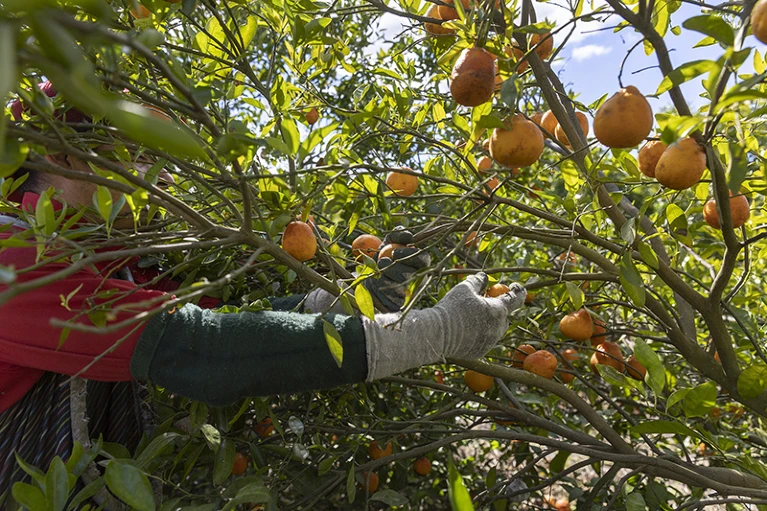
In Florida, antibiotics are used to treat a disease in oranges that produces stunted, green fruit.Credit: Joe Raedle/Getty
Other measures can also mitigate risk. Better ventilation of the indoor spaces on farms, where animals are often densely housed, might reduce the spread of drug-resistant microbes. Some scientists have also emphasized the benefit of having clothing for staff and visitors that is exclusively worn on the farms, so that microbes aren’t moved between farms and people’s homes.
There are also a number of approaches aiming to reduce the need for antibiotics on farms, and thereby minimize opportunities for drug resistance to evolve in the first place. These include quarantining animals when they are brought onto a farm, before they join the existing livestock, and using rapid diagnostic methods to identify and remove infected animals from the group. Vermin-control programmes could also help to reduce the spread of sicknesses on farms.
However, it is difficult to get many farms to adopt such interventions. Some researchers think that governments will need to make AMR-mitigation strategies mandatory to get producers to step up. “It adds to the cost, and their businesses are already running on very small margins,” Saeed says.
Protecting workers
Although livestock farming takes much of the focus of those trying to combat agricultural AMR, people who grow and harvest crops also face challenges. Oranges grown in Florida, for example, are often sprayed with streptomycin — an antibiotic that is also used to treat infections in people — to fight an insect-spread bacterial disease that causes the fruit to remain partly green rather than changing colour with ripening.
Advocates for workers say that the broad use of antibiotics to fight citrus greening puts labourers at risk. Streptomycin is a key treatment for tuberculosis, but even in areas in which tuberculosis is not common, the drug can be an important tool for treating certain rare infections. Agricultural practices that promote resistance to the drug could therefore put workers at risk. “To subject farm workers to that just because you see your crop as more important than people is really a crime as far as I’m concerned,” says Jeannie Economos, who coordinates the pesticide safety and environmental health project at the Farmworker Association of Florida in Apopka.
Late last year, more than a dozen public-health and farm-worker groups came together to sound the alarm about the risks associated with spraying antibiotics on crops. Those groups, which included non-profit organizations such as the Center for Biological Diversity and the Center for Food Safety, demanded that the US Environmental Protection Agency (EPA) halt this practice. “EPA’s risk assessments fail to take into consideration certain exposures that place farmworkers and their families at even greater risks,” according to the petition. “These exposures include pesticide residues on boots, tools, work clothes, and skin of a family member who handles pesticides or works in areas where they are applied and then returns home.”
These concerns are echoed by Laszlo Madaras, who is based in Greencastle, Pennsylvania, and oversees the clinical programmes of the Migrant Clinicians Network — a non-profit organization that supports physicians who provide medical care for migrants, asylum seekers and other marginalized groups. “The Migrant Clinicians Network is concerned about using antibiotics as pesticides and particularly alarmed that the EPA is not taking a precautionary approach given that farm workers are likely to be overexposed [to antibiotics].”
There is also the influence of larger political and economic challenges. Economos notes that much of the labour in the US citrus industry is done by guest workers who have to return to their home countries after the picking season is over. “They are not farm workers that live domestically in the United States,” she explains. This makes it difficult to monitor which workers get sick with drug-resistant infections. The same is true of mass-deportation campaigns in the United States that are dissuading such workers — some of whom have no legal papers for employment — from seeking medical care when they are ill.
“Farm workers in the United States are absolutely not treated as human beings,” Strater says. “In some cases, the animals are more valuable to people.” Migrant farm workers’ limited access to health care is not a problem that is unique to the United States, and has also been identified in countries such as Canada, Spain and Israel.
Madaras says that it is necessary to take action to address all factors that contribute to the prevalence of AMR on farms, and to protect the farm workers and their communities. A lot is at stake for the future, he stresses. “I start to worry about the next generation — younger people — who may not have access to certain antibiotic treatments because of that.”
Heaney says that many livestock farm workers have long been aware of the need to minimize the use of antibiotics. More than a decade ago, he showed that farms that minimized antibiotic use and removed sick animals from the production stream reduced the risk of drug-resistant infections in workers9 — and these workers were supportive of his research. “They said, ‘Finally, somebody came along to show that something that we’re doing can have a public-health benefit. We’ve suspected it — that it’s the right thing to do’.”