




You have full access to this article via your institution.
Hello Nature readers, would you like to get this Briefing in your inbox free every day? Sign up here.
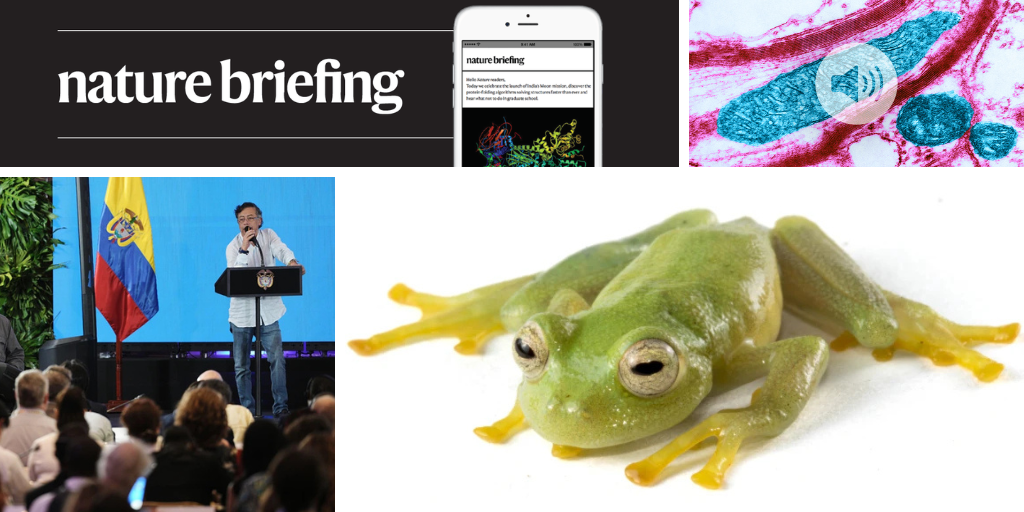
This newly identified species of glass frog (provisional name Nymphargus dajomesae) was found in the Cordillera del Cóndor mountain range in the Andes.Credit: Photo archive PUCE-BIOWEB
Species recovery, cancer-preventing vaccines and progress in developing renewable-energy sources are just some of the positive developments that have happened this year so far. Among them is artemether-lumefantrine, the first first-ever malaria treatment for babies and infants.
Nature | 6 min read
At the annual United Nations climate conference (COP30) last year, Colombia stepped up to host a new conference, alongside the Netherlands, to create a roadmap for countries to transition away from fossil fuels that doesn’t require consensus between all of the world’s countries, as the COP process does. At the conference, which just finished in Santa Marta, one of the first orders of business was to launch a panel of scientists that will advise willing countries to shift to clean energy. A separate group of researchers released a report listing 12 high-level actions that nations can take to support a fossil-fuel phaseout. “We’re not trying to replicate the [UN Intergovernmental Panel on Climate Change] here. We’re trying to give some practical policy insights” based on science, says climate-change economist Frank Jotzo, who was part of the editorial team.
Nature | 7 min read
Reference: Santa Marta Action Repertoire (SMART) Summary
Researchers have developed organoids that can regenerate like the endometrium, the lining of the uterus that sheds and re-forms during the menstrual cycle. The team used the miniature 3D structures to simulate rarely seen repair processes, which could inform future therapeutic strategies for tissue renewal and wound healing.
Nature | 6 min read
Reference: Cell Stem Cell paper
Features & opinion
Physicists know that their elegant theoretical description of forces and particles — the Standard Model — must be incomplete, because there are a host of phenomena it cannot explain. But observations continue to confirm the model’s accuracy with ever greater precision. Thank goodness an analysis from an experiment at the Large Hadron Collider at CERN, Europe’s particle-physics laboratory, suggests at least one way out: the decay of particles called B meson. A new analysis found that the angle at which the final products emerge from the decay disagree with those predicted by the Standard Model. Evidence for this anomaly has been growing since 2015.
Nature | 8 min read
Futures: science fiction from Nature
Cyberspace proves insufficient in In the flesh, and an AI explores the necessary freedom of making the wrong choice in The imperfect legacy — the latest short stories for Nature’s Futures series.
Eating seems to prime immune cells for action, helping infection-fighting T cells proliferate more quickly in response to threats, finds research in mice and people. The study didn’t fine-tune what people ate to study their immune response, but that might be a good thing, suggests one of the authors, immunologist Greg Delgoffe. “Even across all 30 or so donors that we had tested, we always saw the postprandial effect,” he tells the Nature Podcast. “There may be some things that are better or not as good, but you’re going to get this effect regardless.”
Nature Podcast | 20 min listen
Subscribe to the Nature Podcast on Apple Podcasts, Spotify or YouTube Music, or use the RSS feed.
In this week’s penguin search, Leif Penguinson is hiding somewhere in Gobi Gurvansaikhan National Park in Mongolia. Can you find the penguin?
Monday is a holiday here in the United Kingdom, so the answer will be in Tuesday’s e-mail, all thanks to Briefing photo editor and penguin wrangler Tom Houghton.
This newsletter is always evolving — tell us what you think! Please send your feedback to briefing@nature.com.
Thanks for reading,
Flora Graham, senior editor, Nature Briefing
• Nature Briefing: Careers — insights, advice and award-winning journalism to help you optimize your working life
• Nature Briefing: Microbiology — the most abundant living entities on our planet — microorganisms — and the role they play in health, the environment and food systems
• Nature Briefing: Anthropocene — climate change, biodiversity, sustainability and geoengineering
• Nature Briefing: AI & Robotics — 100% written by humans, of course
• Nature Briefing: Cancer — a weekly newsletter written with cancer researchers in mind
• Nature Briefing: Translational Research — covers biotechnology, drug discovery and pharma