







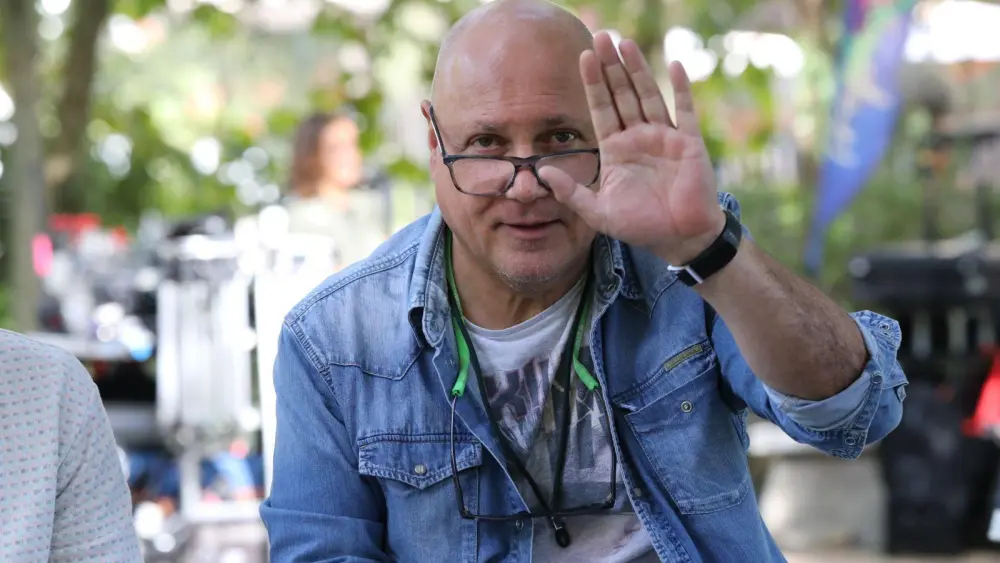
Portuguese director-producer Leonel Vieira, the filmmaker behind Portuguese box office hit “The Courtyard of the Ballads” (“O Pátio das Cantigas”), is moving ahead with “The Night” (“A Noite”), a José Saramago adaptation set on the night the Carnation Revolution reached a Lisbon newsroom.
The film stars Nuno Lopes, known internationally for Netflix’s “White Lines,” Adriano Luz, seen in Bille August’s “Night Train to Lisbon,” and Spain’s Enrique Arce, widely recognized for Netflix global hit “Money Heist.” Vieira previously worked with Arce on his 2008 feature “The Art of Stealing.”
A Portugal-Spain co-production, “The Night” turns on April 25, 1974, as the uprising against Portugal’s dictatorship reaches a newspaper aligned with António de Oliveira Salazar’s regime. The newsroom is split between those determined to suppress the truth and those who insist on publishing it.
The project is being presented at Cannes ahead of a Lisbon shoot scheduled to begin May 25 and continue through June.
Vieira will direct and produce through Volf Entertainment, with the participation of Portuguese public broadcaster RTP, distributor NOS Audiovisuais and ICA, the Portuguese Film and Audiovisual Institute. Spanish producer Antonio Pérez, producer of Benito Zambrano’s “Solas,” is attached to the project on the Spanish side.
“The Night” is adapted from Saramago’s 1979 play “A Noite.” The screenplay is written by Vieira and journalist-actor José Martins, also part of the cast, who won best actor at the Shanghai International Film Festival for “The Scent of Things Remembered.”
Vieira told Variety Cannes will be used to explore conversations with international distributors.
The director-producer described “The Night” as “a political drama about the Carnation Revolution.” The film is also being positioned around Saramago’s international recognition, following previous screen adaptations of his work such as Fernando Meirelles’ “Blindness.”
Saramago’s international profile is key to the project’s positioning, according to Vieira. “We believe it can bring significant visibility due to the worldwide recognition and international reach of Saramago’s work, as well as the artistic quality of his writing,” he said.
The film’s Portugal-Spain configuration also gives the project a cross-border industrial dimension, pairing Portuguese institutional and distribution partners with well-known Spanish producer Pérez, often associated to socially grounded auteur cinema.
Vieira also pointed to the cast’s international visibility, led by Lopes, Luz and Arce, as part of the film’s appeal beyond Portugal. “They are three actors of exceptional artistic calibre, and I believe their performances will strongly resonate with international audiences,” Vieira said. “In addition, the international audience that already knows them from previous projects will certainly be very interested in seeing them again.”