






Publisher Correction: Reproducibility and robustness of economics and political science research

University of Ottawa, Ottawa, Ontario, Canada Abel Brodeur, Derek Mikola, Jonathan Crechet, Guidon Fenig, Jonathan Holmes, Jenny John, Myra Mohnen, Louis-Philippe Morin, Nicholas Rivers, Vincent Thivierge, Wenjie Tian, Hung Truong, Myra Yazbeck & Aline Zayat Wilfrid Laurier University, Waterloo, Ontario, Canada Nikolai Cook Institute for Replication, University of Ottawa, Ottawa, Ontario, Canada Lenka Fiala Institute for Replication, Tilburg University, Tilburg, The Netherlands Lenka Fiala University of Oxford, Oxford, UK…
Read More

Field re-entrant superconductivity in Eu-doped infinite-layer nickelates

Intertwined superconducting and magnetic orders may give rise to exotic quantum phases1–7, including field-induced and re-entrant superconductivity8–10. However, such magnetism-enhanced superconductivity has remained elusive in superconductors with higher transition temperatures1–3. While infinite-layer nickelates represent a new class of unconventional superconductors11–20, the impact of rare-earth magnetism on superconducting properties remains largely unexplored. Here, we show that…

Read More

Wikipedia-based AI model reveals the 100 technologies to watch

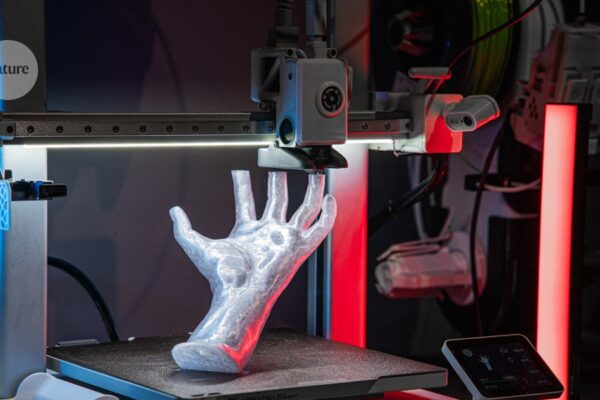
3D printing is predicted to be one of the fastest-growing technologies this year. Credit: Stenko Vladislav Vitalievich/iStock via Getty Machine learning, blockchain databases and 3D printing will be some of the fastest-growing technologies this year. That’s the prediction of the artificial-intelligence-powered 2026 Momentum 100 list of rapidly emerging technology, released by Australian researchers in December…

Read More

We need to talk about failure in science

You have full access to this article via your institution. A failed experiment shouldn’t mean the end of a project, or affect a researcher’s future grant opportunities.Credit: Getty Last week, Imperial College London, in collaboration with Nature, hosted a conference on a subject that’s rarely talked about in science: failure. The success of a conference…

Read More

What 6,000 researchers think about the future of science

Perspectives on questions such as the availability of research funding and what leads to impactful science varied widely in the Nature Index survey.Credit: Evgeniy Shkolenko/iStock via Getty A leading research career is influenced by many factors: a researcher’s interests, yes, but also funding conditions, institutional expectations and the often-shifting priorities, policies and attitudes of wider…

Read More

Big G is more mysterious than ever

You have full access to this article via your institution. Hello Nature readers, would you like to get this Briefing in your inbox free every day? Sign up here. Stephan Schlamminger (left) and colleague Vincent Lee with the equipment used to measure big G.Credit: R. Eskalis/NIST The results of a decade-long experiment have brought scientists…

Read More

Evaluating large language models for accuracy incentivizes hallucinations

Large language models sometimes produce confident, plausible falsehoods (“hallucinations”), limiting their reliability1,2. Prior work has offered numerous explanations and effective mitigations such as retrieval and tool use3, consistency-based self-verification4, and reinforcement learning from human feedback5. Nonetheless, the problem persists even in state-of-the-art language models6,7. Here we show how next-word prediction and accuracy-based evaluations inadvertently reward…

Read More

Genomic roots of Indigenous Americans uncovered

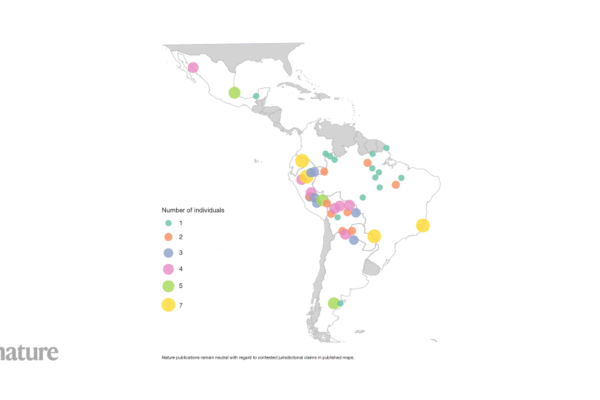
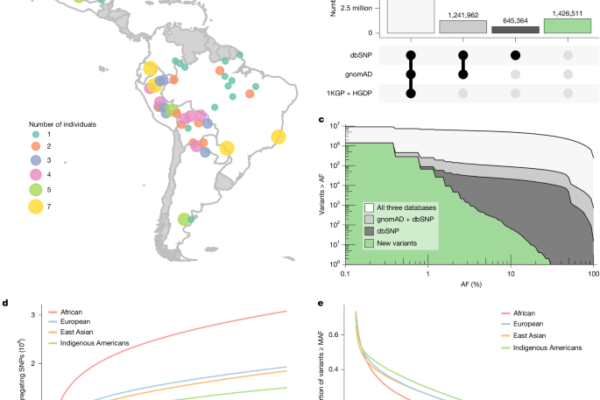
RESEARCH BRIEFINGS 22 April 2026 A large and diverse collection of Indigenous American genomes uncovers extensive genetic diversity and a complex history of dispersals, continuity and adaptation across the Americas. The findings reveal the evolutionary processes that shaped Indigenous American populations and address the under-representation of these populations in global genomic research. Source link

Read More

The evolutionary history and unique genetic diversity of Indigenous Americans

Sample description and DNA sequencing In this study, we generated new whole-genome sequencing (WGS) data from 128 Indigenous American individuals representing 45 populations and 28 language families across 8 Latin American countries (Extended Data Fig. 1 and Supplementary Note 1). Whole genomes were sequenced at the Beijing Genomics Institute (China) and Dasa Genômica (Brazil) using BGISEQ-500…

Read More